Highlights
- Upper and lower town
See how the fortified peninsula relates to the later harbor city.
- A divided medieval settlement
An internal wall reveals the organization of power within the enclosure.
- Adaptation to artillery
Venetian works reshaped the vulnerable landward approaches.
- Modern layers
Military use, imprisonment and tourism explain changes in the interior.
Strategic role
The fortified upper town and citadel of Nafplio, overlooking the harbor, Argolic Gulf and approaches from the plain.
The fortified height above Nafplio
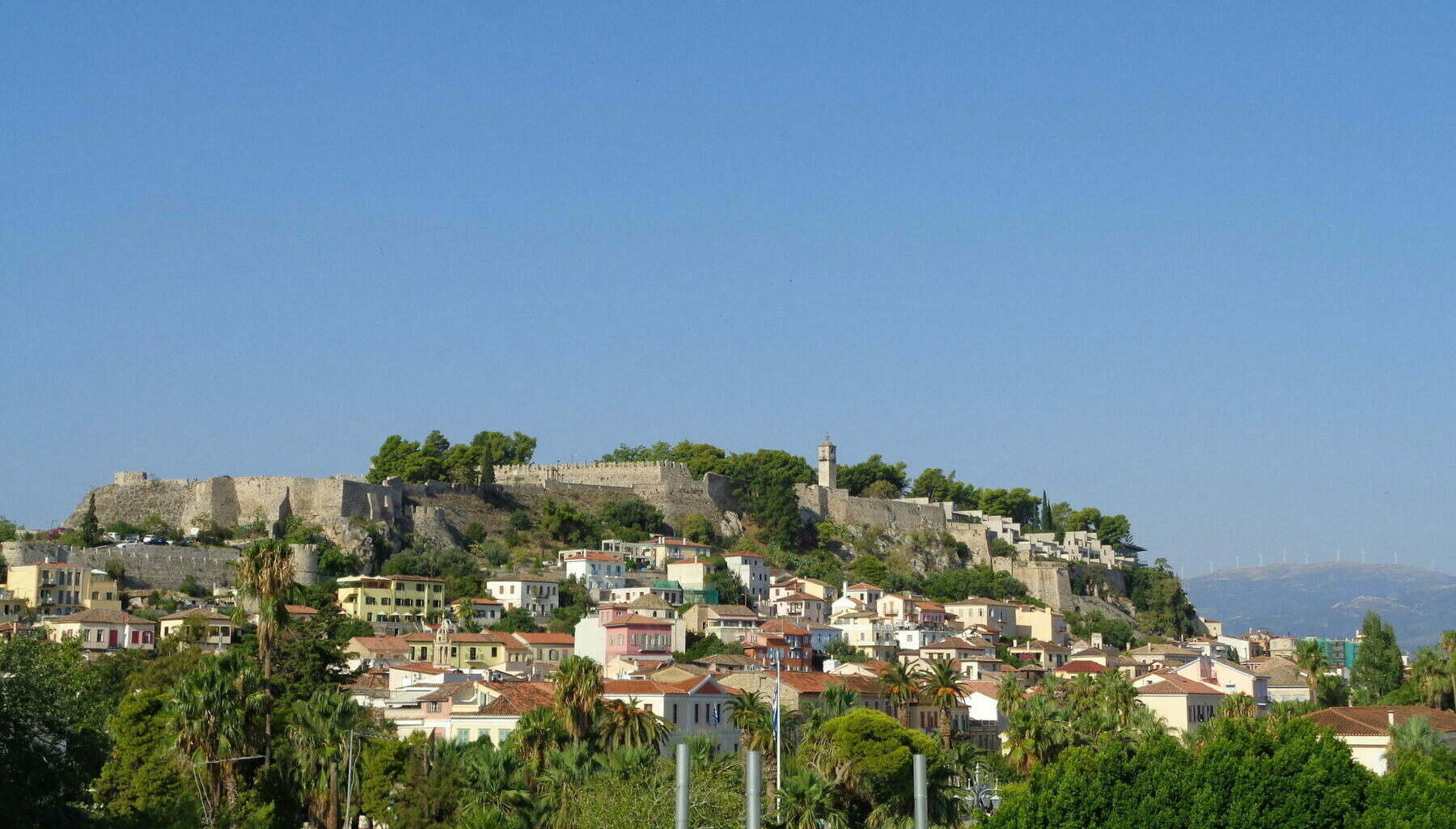
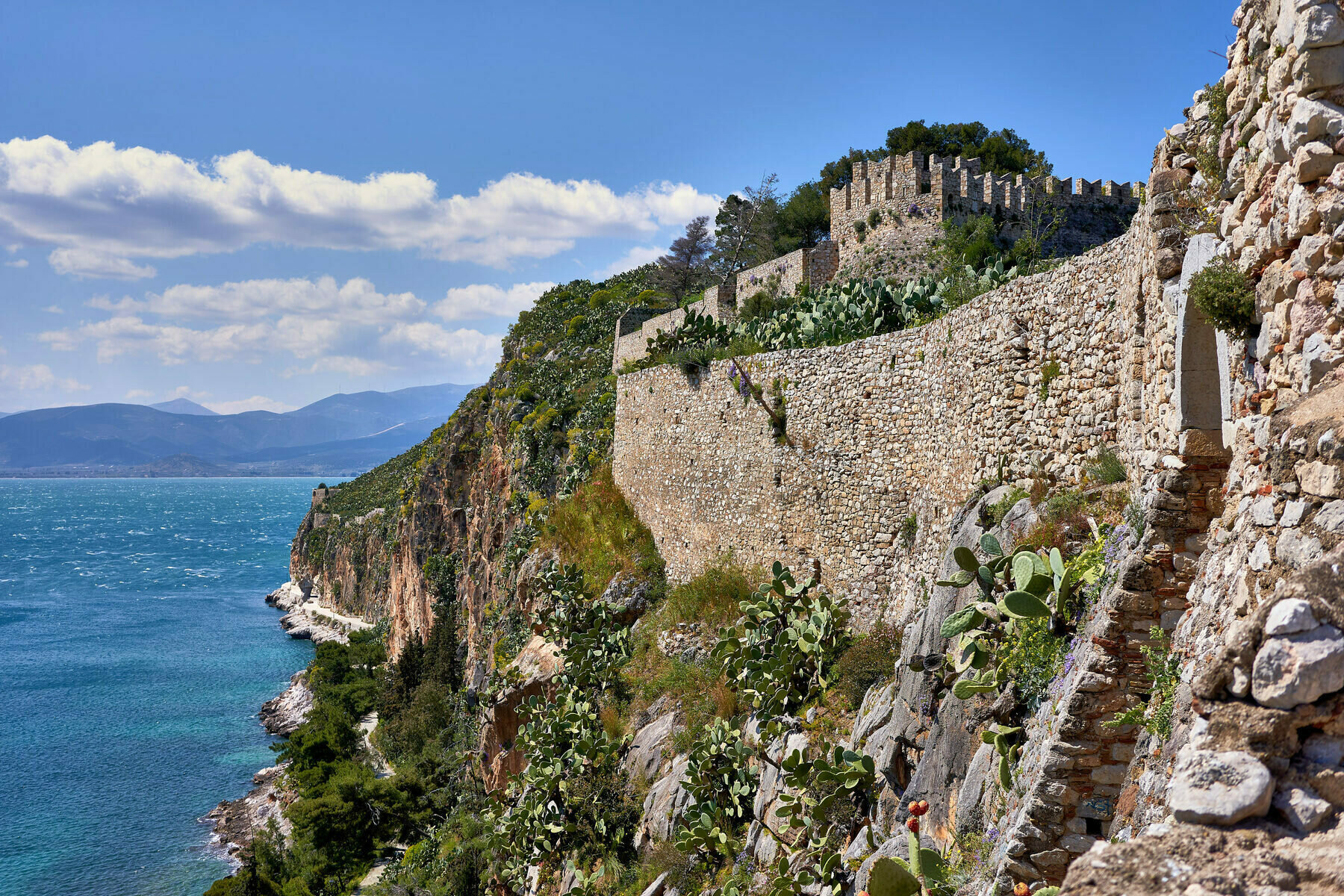
Akronafplia is easiest to understand from the old town below. Its steep seaward cliffs create a natural barrier, while the eastern connection towards Palamidi required more substantial built protection. The original settlement occupied the heights; the lower town developed later beside the harbor.
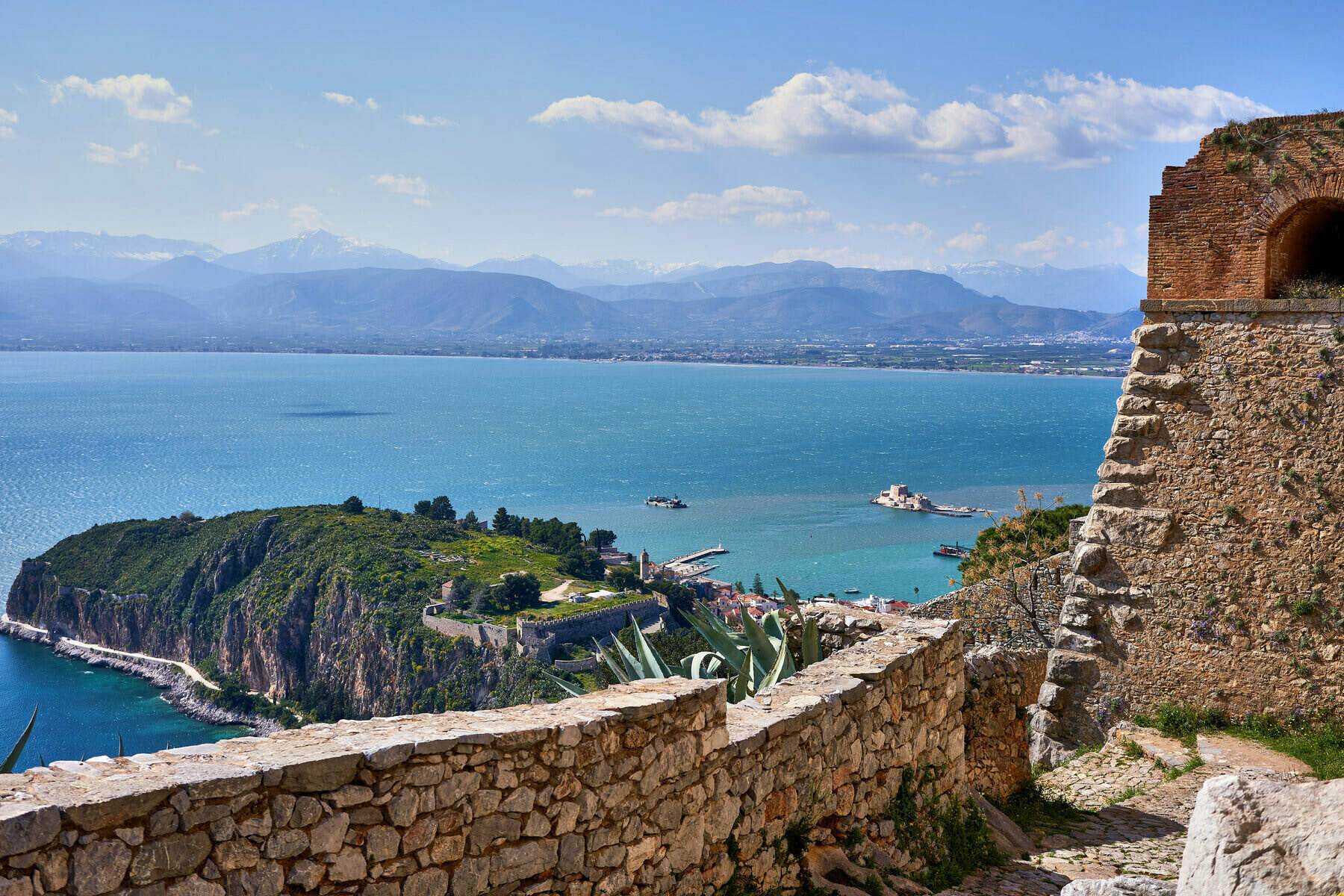
From permitted viewpoints, compare these three parts of the city: the old fortified peninsula, the lower streets and waterfront, and the higher fortress of Palamidi. Bourtzi belongs to the harbor defenses farther out in the water. They form a related landscape, but each has its own history and visiting arrangements.
An ancient acropolis and a divided medieval town
Akronafplia was fortified by at least the late fourth century BCE. Large polygonal blocks survive beneath later work, giving glimpses of the ancient defenses within a much altered circuit. Byzantine occupation continued the use of the height as a fortified settlement.
After the Frankish conquest in the early thirteenth century, a transverse wall divided the upper town. The western enclosure became known as the Castle of the Greeks, while the eastern section served the Frankish rulers and their administration. Look for the surviving internal division as well as the outward-facing walls: fortification could organize authority within a town as well as defend it from outside.
Venetian works and the changing city
Venetian rule brought extensive adaptation to artillery. The lower eastern ground was enclosed by the Tori works, and the Traversa Gambello introduced another defensive line inside the earlier Frankish section. Gates and passages changed as the needs of defense and circulation evolved.
During the later Venetian occupation, military use displaced the remaining residential role of the upper town. The construction of Palamidi shifted the balance of the city’s defenses again. Akronafplia remained important, but it increasingly formed one part of a larger fortified system rather than the whole protected city.
Barracks, prison and hotels
After Greek forces took Nafplio in 1822, military facilities were repaired and a hospital was established on the height. Later imprisonment added a darker chapter to its history. The peninsula’s subsequent transformation for tourism removed buildings and changed large parts of the interior.
These modern interventions help explain why Akronafplia can feel fragmented. Hotels, roads and open ground interrupt the earlier enclosures; what survives is not a complete medieval town. Read the gaps alongside the walls, and remember that preservation here involves recovering legibility within a place that continued to be used.
What to notice
The strongest visit follows the relationship between defensive lines, gateways and the changing levels of the rock. Compare the heavy ancient blocks at the base of later walls with medieval divisions and the more expansive artillery defenses. Notice the surviving approaches linking the height to the lower town.
The former military-hospital area, church remains and powder-storage building add evidence of life behind the walls. Archaeological presentation has recovered portions of these monuments and introduced interpretation and an outdoor theater. For the wider urban story, continue into Nafplio’s old town and its museums rather than expecting the peninsula alone to explain every period.
Exploring Akronafplia today
The upper area is approached by road and by stepped routes from the old town. Expect changes of level, exposed edges and uneven surfaces. Use public routes, observe barriers and respect the boundaries of hotel property and closed buildings. The views are accessible from several permitted areas without entering ruins.
In the November 2026 review, the Ministry’s castle guide describes the existing approaches and archaeological presentation; it does not guarantee access to every gate, wall top or interior. Confirm local restrictions and do not assume that the coastal path below is continuously open merely because it appears in older photographs.
Architecture
- Polygonal ancient masonry beneath later defenses
- Transverse wall dividing medieval upper-town enclosures
- Tori fortification and Traversa Gambello artillery adaptations
- Gateways connecting upper and lower town
- Hospital, religious and powder-storage remains amid modern alterations
Timeline
- Late fourth century BCE Fortifications enclose the ancient settlement.
- Early thirteenth century Frankish conquest is followed by division of the fortified upper town.
- Late fifteenth century Venetian artillery defenses reshape and extend the enclosure.
- 1686–1715 Renewed Venetian rule brings military reorganization and the development of Palamidi.
- 1822 onward Greek control brings renewed military and hospital use.
- Twentieth century Prison use and later tourism development substantially alter the interior.
- 2011–2016 Archaeological enhancement recovers and presents parts of the monument.
Visiting today
Walk up from Nafplio’s old town using permitted roads or stepped routes. Follow current signs around archaeological remains and private property, keep clear of wall edges and verify any restrictions before planning a continuous coastal or fortified circuit.
Historical contexts
- Late Byzantium
- Frankish Greece
- Venetian Maritime Empire
- Ottoman Period
- Rise of Modern Greece
- Harbor Defense and Sea-Lane Control
Expedition guides
Images
References
Related places
Related Stops
Topics
- Ancient Fortifications
- Byzantine
- Frankish
- Venetian
- Urban History
- Prison History