Overview
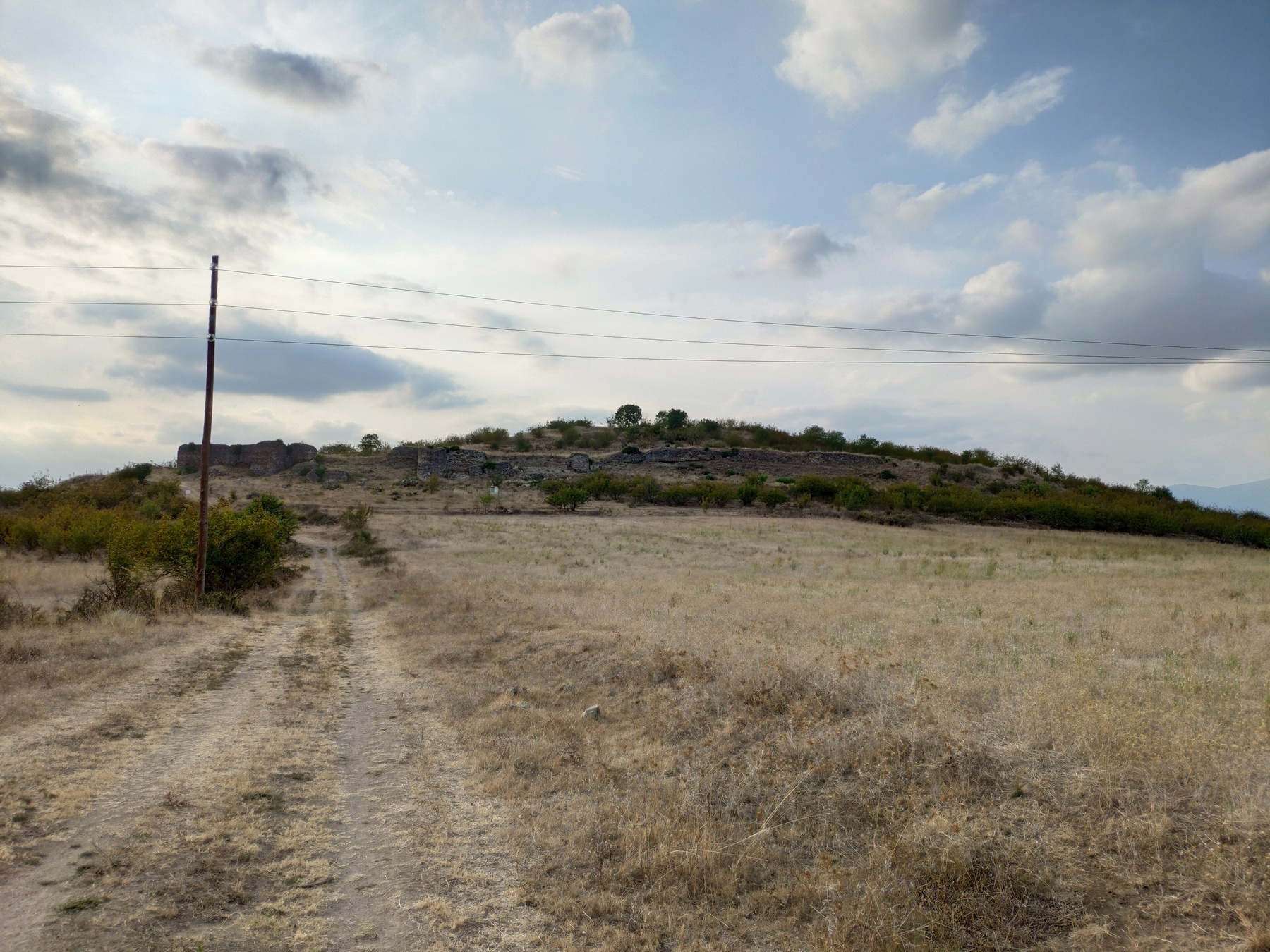
Moglena is important because military, administrative and religious functions are preserved in one compact archaeological landscape. The fortified enclosure covers about four hectares on a low hill commanding the western Almopia plain. The Almopaios River curves around the site on the south and west, providing both water and a natural defensive barrier. Written sources place Moglena repeatedly at the center of struggles for Macedonia: Basil II captured and destroyed the Bulgarian-held fortress in 1015; Bohemond rebuilt and garrisoned it during the Norman invasion of 1082; and Gregory Pakourianos recovered and again dismantled its defenses in 1083. In the later eleventh century Moglena became the seat of a Byzantine theme, while its bishopric and large three-aisled basilica reveal its ecclesiastical importance. The fortifications visible today contain several construction phases, including a distinctive thirteenth-century rebuilding associated on architectural grounds with the recovery of the region by John III Vatatzes in 1246. The site declined after the Ottoman conquest and was gradually abandoned, but its archaeological importance has been recognized through excavation, conservation and a major restoration program completed in 2026.
Highlights
- Basil II's Siege
Moglena was one of the fortresses personally attacked by Basil II in 1015 during the final phase of the Byzantine conquest of the First Bulgarian Empire.
- Castle-City, Not Isolated Fortress
The roughly four-hectare enclosure contained an administrative and ecclesiastical center serving the fertile plain of Almopia.
- Episcopal Basilica
A large three-aisled church with synthronon, mosaics, marble paving, opus sectile and frescoes is identified as the cathedral of medieval Moglena.
- Thirteenth-Century Brickwork
Decorative recessed-brick masonry, crosses and radiating patterns distinguish a major rebuilding phase associated with the Nicaean recovery of 1246.
- Norman and Byzantine Contest
Bohemond rebuilt and garrisoned Moglena in 1082; Gregory Pakourianos recaptured and dismantled it for Alexios I in 1083.
- Funerary Church and Cemetery
A Middle Byzantine cross-plan church outside the walls was surrounded by dozens of burials and yielded an early medieval cross-shaped reliquary.
- A Managed Frontier
Sources connect the region with the settlement of Pechenegs, Cumans and Vlachs, illustrating Byzantine demographic as well as military frontier policy.
- Restored for Public Access
A €1.85 million conservation and presentation program stabilized walls and churches and created paths, viewpoints, interpretation and lighting before the 2026 reopening.
Strategic role
A fortified regional center controlling the Almopia plain and the secondary routes north of the Via Egnatia, while also serving as a Byzantine administrative center and episcopal seat.
A Castle-City in the Plain of Almopia
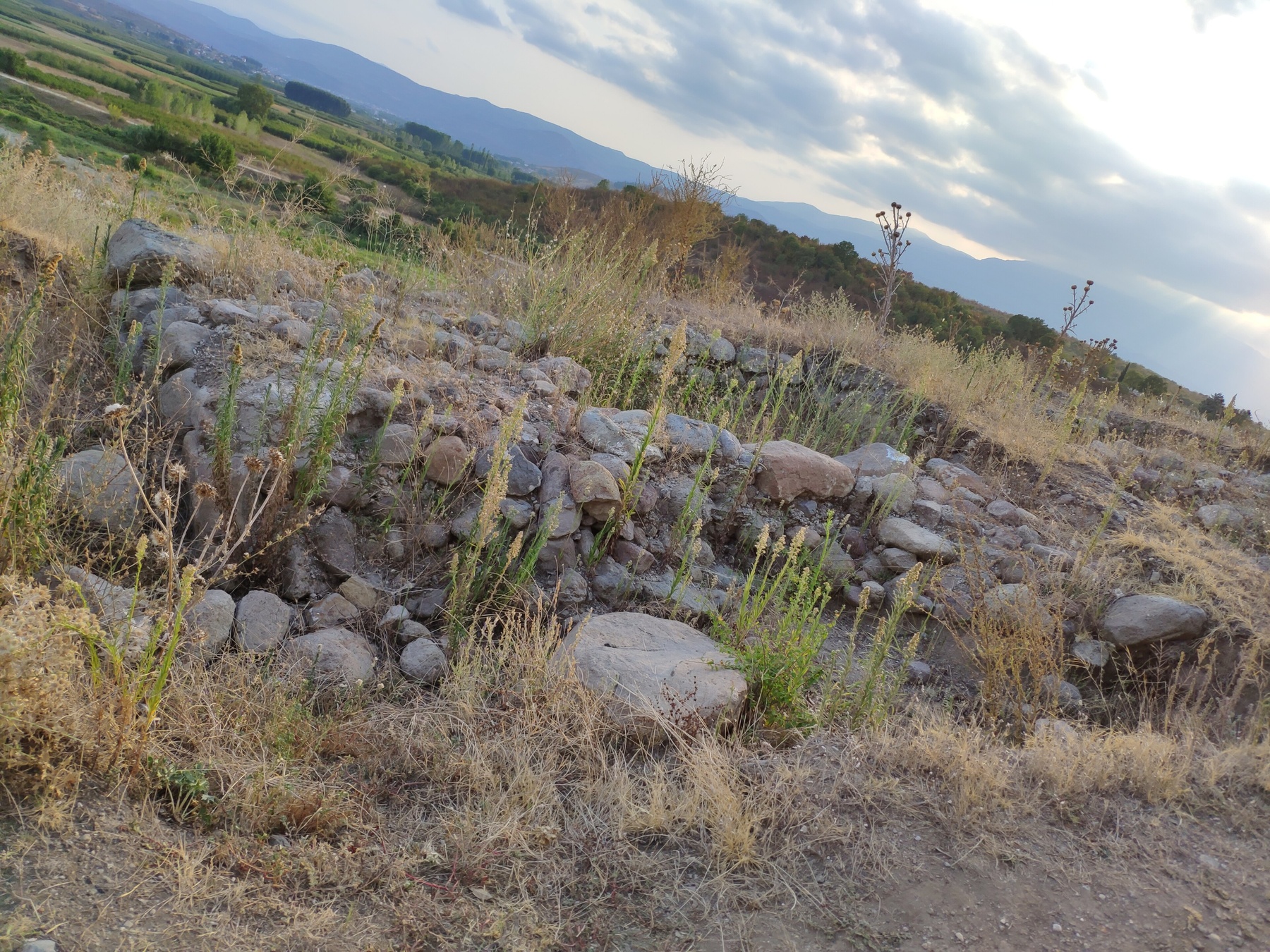
Moglena stands on a low, gently rounded hill about one kilometer northwest of Chrysi in the Municipality of Almopia. Its setting explains much of its history. The enclosed plain of Almopia is bounded by the Voras range to the west and north, Mount Paiko to the east and the hills of Edessa to the south. The Almopaios River, also known as the Moglenitsa or Moglenitikos, curves around the castle hill on the south and west. It formed a defensive obstacle, supplied the settlement with water and irrigated the surrounding agricultural land. From the hill the inhabitants could watch much of the western plain. Moglena was therefore not a mountain refuge but a fortified administrative town embedded in a productive rural landscape.
Origins and the Problem of the Early Castle
The beginnings of Moglena remain uncertain. Archaeology shows human activity in the wider Chrysi area from the Iron Age, while Late Classical-Hellenistic black-glaze pottery has been recovered from the fill of the castle gate. Evidence for an Early Christian occupation of the hill itself is still inconclusive. Traces of an Early Christian structure were reported outside the walls, and two pieces of Early Christian sculpture were later reused in the funerary church, but these finds do not securely establish a fortified early Christian town. The Ministry of Culture notes that construction of the castle has been proposed for the early ninth century, in the context of Byzantine efforts to strengthen Macedonia against Bulgarian pressure, but the evidence is not decisive. What is clear is that Moglena flourished most strongly between the tenth and thirteenth centuries.
Basil II and the Siege of 1015
Moglena enters the written historical record dramatically during Basil II's long war against the Bulgarian state of Tsar Samuel and his successors. Bulgarian forces had gained control over much of inland Macedonia west of Thessaloniki in the late tenth century. In 1015 Basil II personally campaigned against Moglena. Byzantine tradition records that the emperor used the river and the ground itself as weapons: the Almopaios was diverted, the foundations of the fortifications were undermined, and combustible material was placed beneath the walls and burned. After the defenses failed, the fortress was taken and destroyed so that it could not immediately serve again as a Bulgarian stronghold. The episode demonstrates the strategic importance of Moglena and also explains why later fortification phases cannot simply be treated as the original castle.
From Frontier Fortress to Administrative Center
The destruction of 1015 did not end Moglena's importance. After Basil II completed the conquest of the First Bulgarian Empire in 1018, the Byzantine state reorganized Macedonia and re-established communications along the regional road system north of the Via Egnatia. Moglena developed as one of the provincial castle-cities serving those secondary routes. By the later eleventh century the region had sufficient administrative weight for a Theme of Moglena to be established. The castle thus functioned not merely as a wall circuit but as the center of a territorial district. Its position in a fertile plain was crucial: fiscal administration, agriculture, military control and communications were all concentrated around the fortified settlement.
The Bishopric and the Religious Landscape
Moglena was also an ecclesiastical center. A document attributed to Basil II and dated to 1019 lists Moglena as a bishopric dependent on the Archbishopric of Ohrid. The documentary tradition is complicated because the original imperial sigillia do not survive and their texts are known through a later thirteenth-century transmission; scholars have questioned aspects of their authenticity, especially claims about earlier transfers of the Bulgarian archiepiscopal seat. The existence of the bishopric itself, however, is well supported by later history and by the archaeology of the site. Around 1134 Hilarion became bishop of Moglena and became famous for his opposition to Bogomil communities in the region. He died in 1164 and was venerated as a saint. When the Bulgarian ruler Kalojan captured Moglena in 1206, Hilarion's relics were transferred to Tarnovo, where the Bulgarian capital was being furnished with prestigious sacred relics.
Bohemond, the Normans and the Destruction of 1083
Moglena again became a strategic objective during the Norman invasion of the Balkans. According to Anna Komnene, Bohemond, son of Robert Guiscard, captured the site in 1082 while campaigning against Emperor Alexios I Komnenos. Before moving east toward the Axios, Bohemond rebuilt the kastellion of Moglena and installed a strong garrison under a commander called Sarakinos. The Byzantine response came quickly. In 1083 the general Gregory Pakourianos recaptured the fortress and, following the logic already used by Basil II, razed its defenses to prevent renewed enemy occupation. Moglena therefore experienced repeated cycles of conquest, rebuilding and deliberate demolition, a pattern that helps explain the complexity of its surviving masonry.
Pechenegs, Cumans, Vlachs and a Managed Frontier
The history of Moglena also reveals how Byzantine frontier administration relied on population policy as well as fortifications. Medieval sources state that Pechenegs were settled in the region in the early twelfth century. Documents of the Great Lavra monastery on Mount Athos, which held property in the wider area, also refer to groups such as Cumans and Vlachs. These records are important because they show Moglena as a lived and cultivated territory, not an isolated garrison. The surrounding landscape contained fields, vineyards, pastures, livestock enclosures, houses, outbuildings and a mill. The castle-city sat at the center of an economically organized countryside in which military security, landholding, taxation and settlement were closely connected.
Fortifications and the Thirteenth-Century Rebuilding
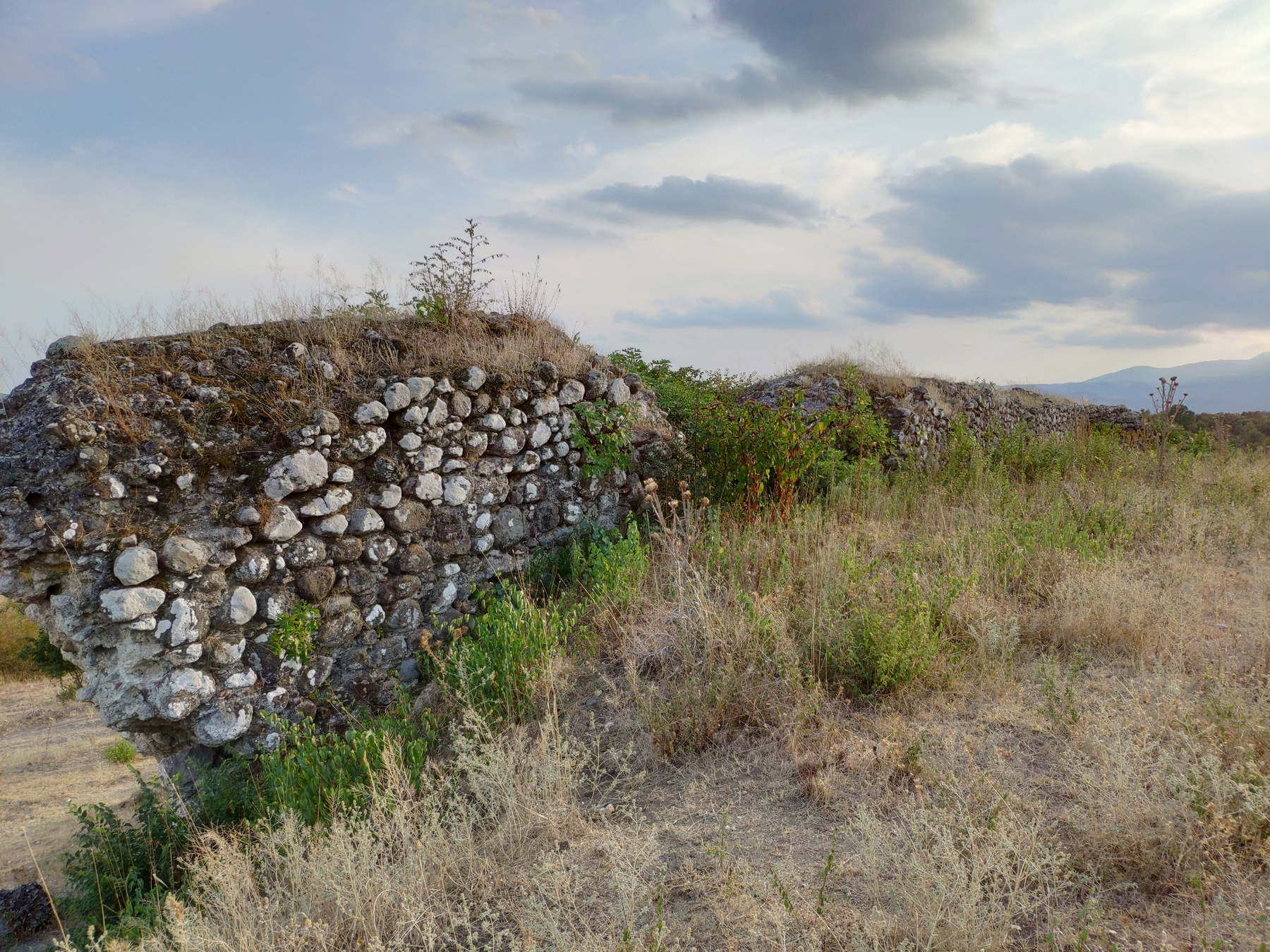
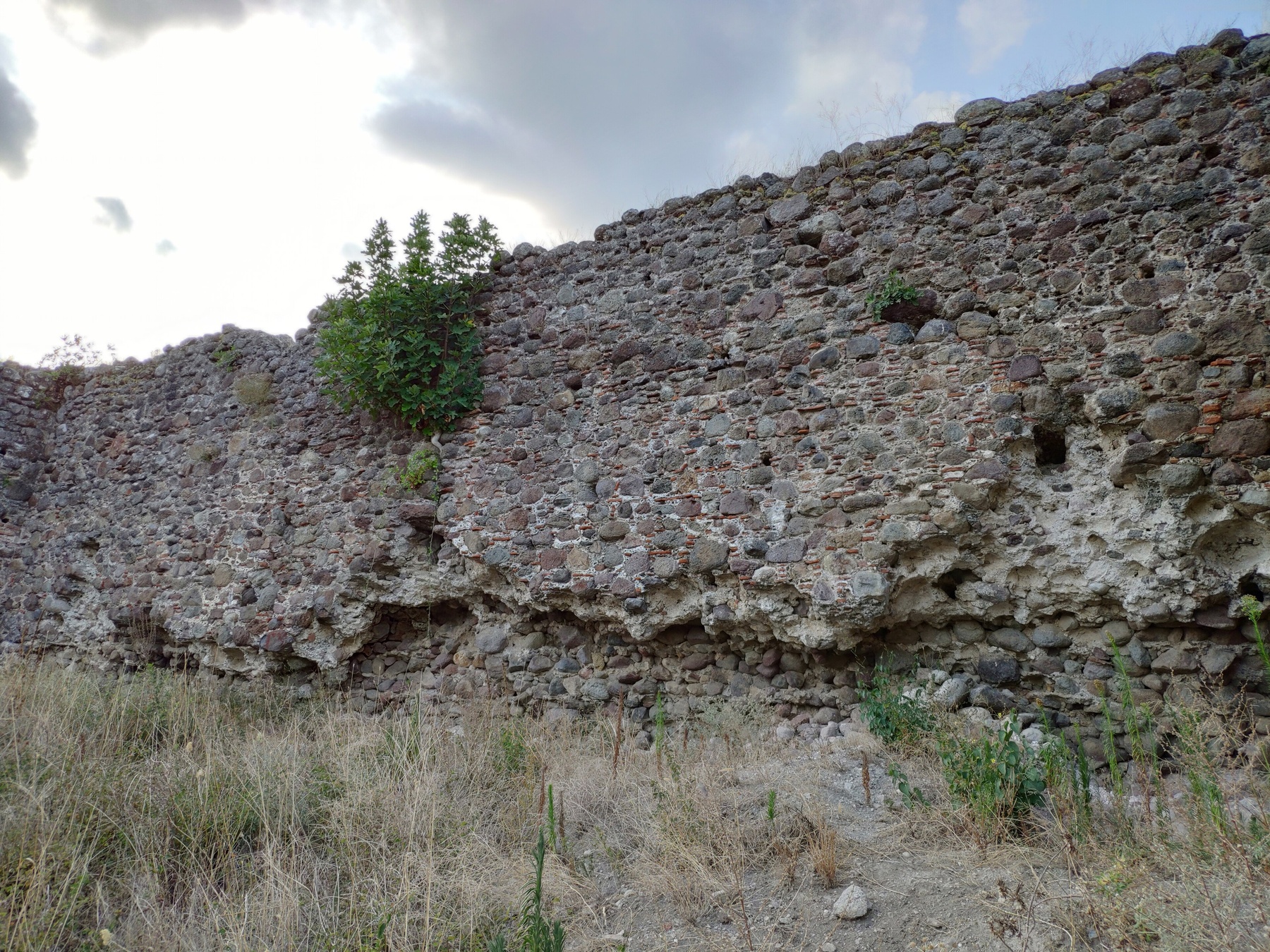
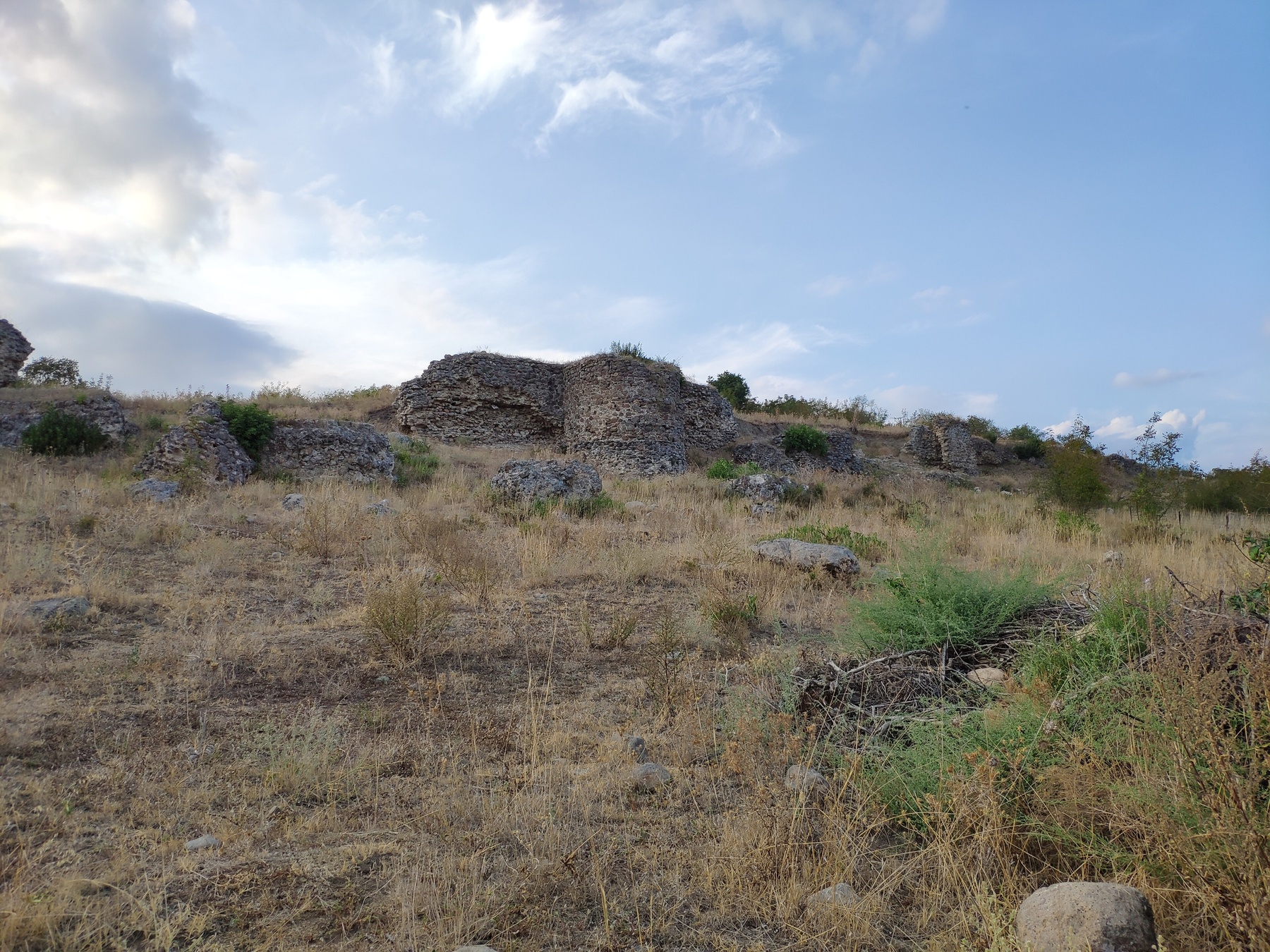
Only parts of the enclosure are fully visible today, but the surviving eastern and southern defenses preserve substantial architecture. The eastern wall extends for about 180 meters and reaches roughly six to seven meters in height at its best-preserved points. The southern wall can be followed for about 200 meters and is approximately 2.30 meters thick. A gate on the south was protected by a powerful circular tower, while square and oval towers strengthened the circuit at intervals. At least ten towers have been uncovered. Two principal masonry techniques are visible. Some sections consist mainly of roughly dressed stone with scattered brick; elsewhere regular brick courses articulate the stonework. The gate tower has more elaborate brick bands executed with recessed-brick technique and a brick cross, while another tower preserves radiating brick ornament. On stylistic and constructional grounds, the Ministry of Culture dates this more decorative phase to the mid-thirteenth century and connects it with the recovery of Moglena by John III Vatatzes in 1246.
The Episcopal Basilica
Inside the castle archaeologists uncovered a large three-aisled basilica with a narthex, measuring approximately 21 by 13.5 meters and dated between the tenth and twelfth centuries. The aisles were separated by substantial pier walls rather than light colonnades. In the sanctuary apse, traces of a synthronon—the stepped seating associated with a bishop and clergy—provide one of the strongest indications of the church's status. The interior was richly finished. Mosaic pavement survives in the prothesis apse; additional tesserae were found elsewhere; marble and gray-stone slabs remained in the nave; fragments of opus sectile came from the area before the sanctuary; and traces of wall painting were recovered from the apses and throughout the church. Although only small pieces of architectural sculpture survive, they confirm an ambitious decorative program of the eleventh and twelfth centuries. Its scale, furnishings and synthronon identify the building convincingly as the episcopal church of Moglena.
The Funerary Church and Cemetery
Outside the fortifications on the southern side of the hill lies a second important monument: a free cross-plan church about 9.5 by 8.4 meters, dated to the ninth or tenth century. Traces of fresco painting survive in the north arm. Two Early Christian sculptural fragments—a small colonette and a panel—were reused in its pavement, valuable evidence for older material circulating at the site even though the precise origin of those pieces is uncertain. Excavation uncovered fifty-three burials both within and around the church, establishing its funerary function. Among the most notable finds was a cross-shaped reliquary dated to the eighth or ninth century. Together, the cemetery church and the episcopal basilica show that the sacred topography of Moglena extended beyond the defensive wall and served different social and liturgical functions.
Thirteenth-Century Contest and the Return of Byzantium
After the fragmentation of Byzantine power following the Fourth Crusade, Moglena again lay in a contested zone. The Bulgarian ruler Kalojan captured it in 1206. In 1246 John III Vatatzes, emperor of Nicaea, took control of Moglena during his expansion into Macedonia and the struggle for Thessaloniki. The more elaborate surviving brickwork of the fortifications is generally associated with this phase of recovery and reconstruction. When Constantinople was retaken in 1261, Moglena formed part of the restored Byzantine Empire. These thirteenth-century works are architecturally important because they show that the castle was not simply repaired for emergency defense: masonry was laid with deliberate decorative effects, placing Moglena within broader Middle and Late Byzantine traditions of brick-articulated fortification.
Ottoman Conquest, Decline and Dispersal
Moglena was conquered in the later fourteenth century as Ottoman power spread across Macedonia. The fortified town gradually declined and was eventually abandoned, while population shifted to settlements dispersed across the surrounding plain and mountains. The episcopal seat was later transferred away from the old castle-city. In the Ottoman period the religious demography of Almopia also changed substantially, including conversions among communities in the lowlands. Chrysi itself was formerly known as Slatena and was renamed in 1926 in honor of Saint Chrysi, an eighteenth-century Christian martyr from the village. The old castle increasingly became a source of building material: after refugees settled in Chrysi following the population movements of the early twentieth century, stone from the ruins was reused in local houses.
Archaeology, Conservation and the 2026 Reopening
Modern study transformed Moglena from a largely overgrown ruin into a documented archaeological site. Nineteenth-century travelers associated the remains with Byzantine Moglena, and systematic excavation in the 1980s exposed the episcopal basilica and other structures. Further investigations and technical studies in the 2010s prepared the way for a major conservation program. The project was incorporated into Greece's Recovery and Resilience Plan in 2022 with an approved budget of €1.85 million. Work included stabilization of eastern and southern wall sections, strengthening of foundations, repair and selective rebuilding of collapsed masonry, conservation of the churches, landscape treatment, new paths, stairs, viewing areas, interpretation panels and lighting. The restored site was formally returned to public use in 2026, giving Moglena renewed significance as one of the most legible provincial Byzantine castle-cities of inland Macedonia.
Why Moglena Matters
Moglena deserves to be understood as more than a ruined castle. Its walls record repeated frontier wars; its basilica preserves the institutional presence of a bishop; its administrative history reflects Byzantine attempts to govern and repopulate a sensitive border region; and its rural setting shows why fortified towns mattered to the economy of medieval Macedonia. Few sites bring together Basil II's wars against Bulgaria, the Norman campaigns of Bohemond, Komnenian frontier policy, the Church of Ohrid, the Nicaean reconquest and the everyday agricultural life of a provincial plain within such a compact landscape. The recent restoration makes that layered history easier to read on the ground.
Architecture
- Fortified enclosure of roughly four hectares on a low hill beside the Almopaios River
- Best-preserved eastern wall extending about 180 m and rising in places to 6–7 m
- Southern wall approximately 200 m long and about 2.30 m thick
- Gate on the south side protected by a strong circular tower
- Square and oval flanking towers placed at intervals along the eastern and southern defenses
- At least ten documented towers, most open to the interior at the rear
- Masonry phases combining roughly dressed stone with brick bands and decorative brickwork
- Recessed-brick decoration and brick crosses associated with the thirteenth-century rebuilding phase
- Large three-aisled basilica with narthex, synthronon, mosaic paving, marble and opus sectile decoration
- Middle Byzantine cross-plan funerary church outside the walls with an associated cemetery
Timeline
- Late Classical–Hellenistic period Black-glaze pottery later recovered from the gate fill provides limited evidence for activity on or near the castle hill before the Byzantine fortification.
- Early 9th century The foundation of the castle has been proposed for this period, in the context of Byzantine efforts to strengthen Macedonia against Bulgarian pressure, but the date remains uncertain.
- Late 10th century Moglena came under Bulgarian control during the prolonged struggle between Byzantium and the state of Tsar Samuel.
- 1015 Emperor Basil II captured Moglena after a siege traditionally associated with diversion of the Almopaios River and undermining of the walls; the fortress was then destroyed.
- 1019 Moglena appears as an episcopal see dependent on the Archbishopric of Ohrid in the documentary tradition associated with Basil II's ecclesiastical settlements.
- 1082 Bohemond captured Moglena during the Norman invasion, rebuilt the fortress and installed a garrison.
- 1083 The Byzantine commander Gregory Pakourianos recovered Moglena and again dismantled its defenses.
- c. 1086 The region increased in administrative importance and the Theme of Moglena was established.
- 1122 Pechenegs were reportedly settled in the region as part of Byzantine frontier population policy.
- c. 1134 Hilarion became bishop of Moglena and later became known for his opposition to Bogomil communities.
- 1164 Bishop Hilarion died and became the focus of a local saintly cult.
- 1206 The Bulgarian ruler Kalojan captured Moglena and transferred the relics of St Hilarion to Tarnovo.
- 1246 John III Vatatzes of Nicaea conquered Moglena; a major decorative rebuilding phase of the fortifications is associated archaeologically with the mid-thirteenth century.
- 1261 Moglena formed part of the restored Byzantine Empire after the recovery of Constantinople.
- Late 14th century Ottoman conquest initiated the long decline and eventual abandonment of the fortified town.
- 1985–1987 Systematic archaeological excavations exposed major remains including the three-aisled basilica identified as the episcopal church.
- 2016–2018 New archaeological investigations and technical studies refined plans for conservation and presentation of the site.
- 2022 The conservation, restoration and enhancement project for Moglena entered Greece's Recovery and Resilience Plan with an approved budget of €1.85 million.
- 2026 Following completion of major conservation and visitor-access works, the restored Castle of Moglena was reopened to the public.
Visiting today
The restored archaeological site reopened to the public in 2026 after a major conservation and presentation program led by the Ephorate of Antiquities of Pella. The project stabilized vulnerable wall sections and foundations, conserved the episcopal basilica and funerary church, improved circulation, and added visitor paths, stairs, viewing points, interpretation panels and lighting. Because operating hours and access arrangements can change, current Ministry of Culture or Ephorate information should be checked before a visit. The site is best understood as a complete fortified settlement: the walls, river, churches and views over the Almopia plain explain why Moglena mattered.
Images
References
- Hellenic Ministry of Culture, Cultural Egnatia — Moglena (Castle of Chryssi)
- Hellenic Ministry of Culture, Odysseus — Castle of Moglena (Chrysi)
- Hellenic Ministry of Culture — Restoration and presentation of monuments in Pella, including the Castle of Moglena
- Hellenic Ministry of Culture — Restored Castle of Moglena returned to the public
- Greece 2.0 — Conservation, restoration and enhancement of the Byzantine Castle of Moglena (Chrysi)
- Greek Reporter — Greece Reopens Restored Byzantine Moglena Castle in Pella
- Wikimedia Commons — Castle of Moglena media category
Topics
- Byzantine
- Fortified City
- Macedonia
- Pella