Overview
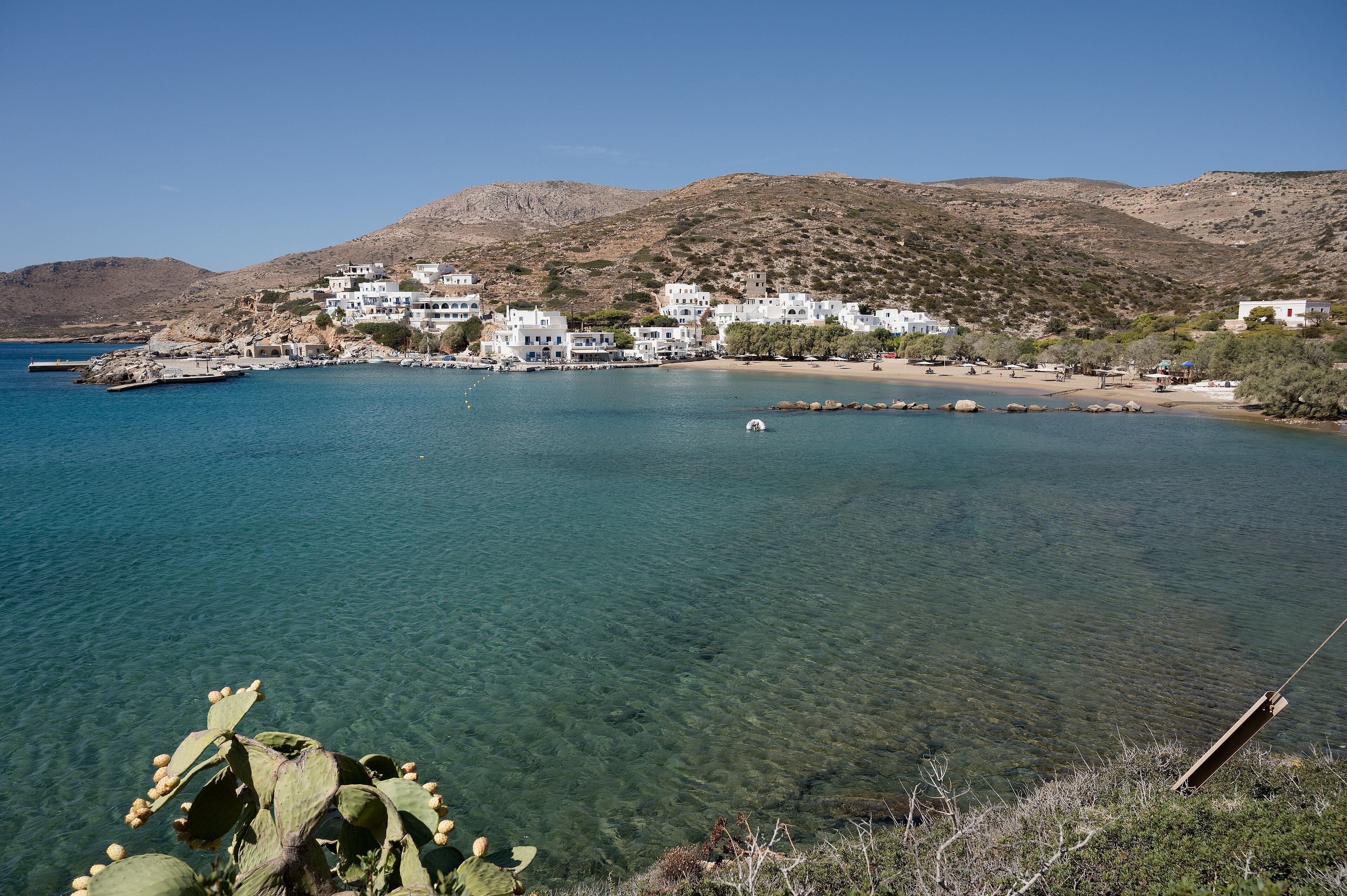
Sikinos lies between Ios and Folegandros in the southern Cyclades. Its rugged terrain, limited water, steep coasts and narrow cultivable zones encouraged compact settlement, terracing and a close dependence on pastoralism, dry farming and the sea. Ancient tradition knew the island as Oinoe, 'wine-bearing', a name that reflects the long importance of viticulture. The ancient polis occupied the high ground around Agia Marina, where fortification and public or sacred remains survive. On the edge of its necropolis stands Episkopi, the island's most extraordinary monument: a third-century AD Roman mausoleum built in temple form, later converted into a Christian church and repeatedly altered through Byzantine and post-Byzantine centuries. Its restoration by the Ephorate of Antiquities of the Cyclades revealed the undisturbed tomb of an elite woman named Neiko and won a 2022 European Heritage Award / Europa Nostra Award. In the medieval and early modern periods population concentrated in Chora, formed by adjacent Kastro and Chorio. Kastro developed as the defensible nucleus on the cliff edge, while Chorio expanded beside it. Above them, the monastery of Zoodochos Pigi, traditionally dated to 1690, was built with a strongly fortified character and served as a refuge during the era of piracy. The island's extensive terraces, dry-stone walls and chapels preserve the working landscape that supported grain, vines, livestock and local wine. Modern Sikinos remains lightly developed by Cycladic standards; its appeal lies precisely in the survival of these relationships among settlement, agriculture, religion, landscape and sea.
Highlights
- Episkopi
A third-century AD Roman mausoleum converted into a Byzantine church and preserved through almost two millennia of continuous adaptation; restored by the Ephorate and awarded a 2022 Europa Nostra prize.
- Kastro
The compact cliff-edge defensive nucleus of Chora, where houses, narrow lanes, churches and topography together formed a fortified settlement.
- Zoodochos Pigi
A strongly fortified post-Byzantine monastery above Chora, traditionally dated to 1690 and remembered as a refuge during the era of piracy.
- Ancient Sikinos
The ancient polis occupied the Agia Marina heights, with fortification and public or sacred remains overlooking the island's central landscape.
Strategic role
A small southern Cycladic island whose ancient city, Roman mausoleum-turned-church, fortified Chora, refuge monastery, terraced agriculture and wine tradition preserve an unusually legible continuity between antiquity and early modern island life.
Ancient Sikinos
The ancient city occupied the high ground around Agia Marina, above the interior route between Chora and Episkopi. Surface remains indicate a fortified urban center with walls, a summit strongpoint and platforms that probably supported public or sacred buildings. The city's precise internal organization remains less fully excavated than major Cycladic sites such as Delos or Thera, so reconstruction should remain cautious. Ancient literary tradition knew the island as Oinoe or Oenoe, a name connected with wine production, and later sources preserve the name Sikinos. The island belonged to the political world of the classical Cyclades and later passed through Hellenistic and Roman spheres. Its greatest surviving ancient monument, Episkopi, stood outside the city in the funerary landscape rather than in its civic core.
Episkopi
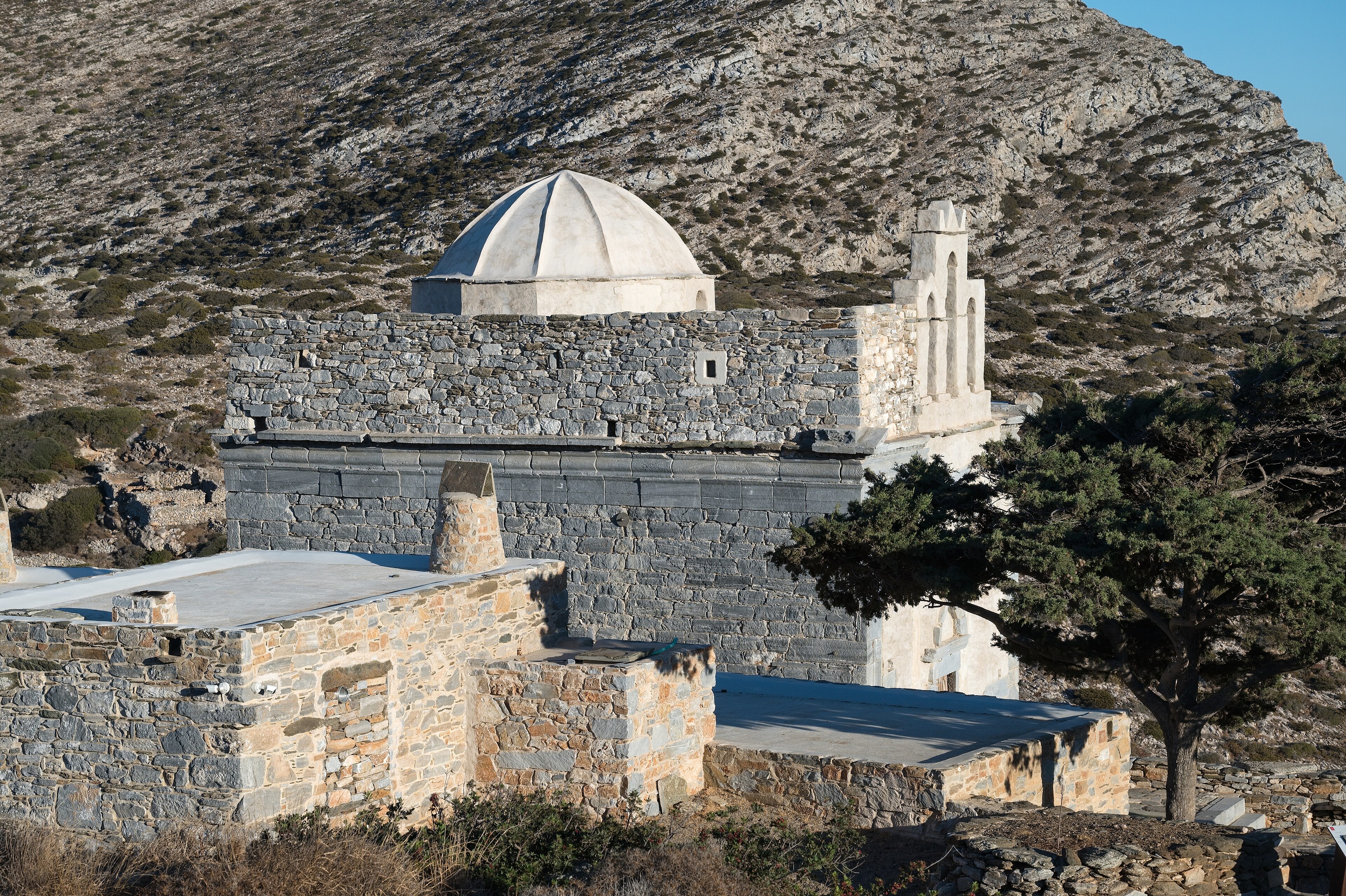
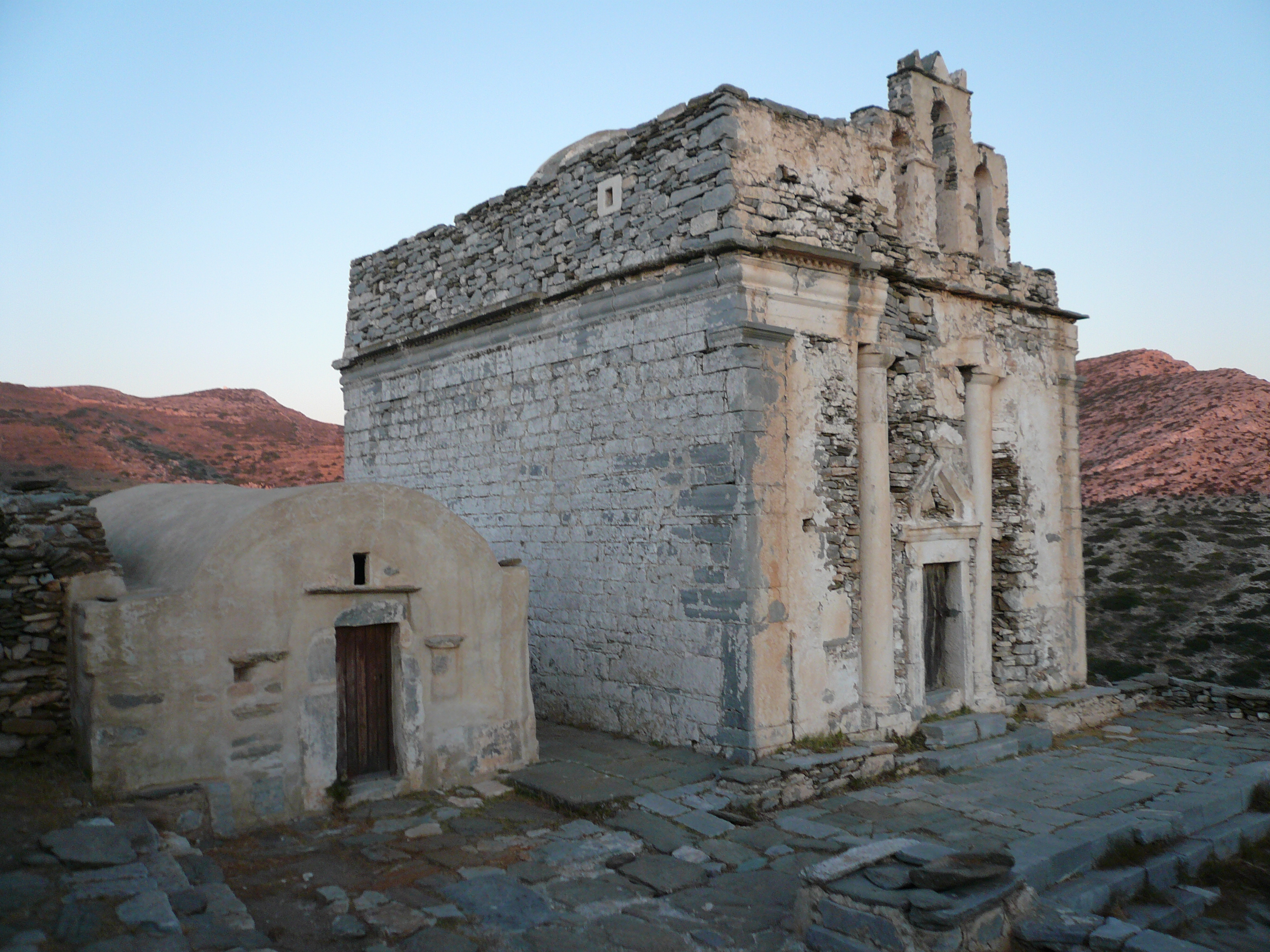
Episkopi is one of the most remarkable architectural palimpsests in the Cyclades. The Ephorate of Antiquities identifies the core as a third-century AD Roman mausoleum constructed in the form of a temple and set on the necropolis of the ancient city. The building rises on a high podium containing two barrel-vaulted crypts; its ancient exterior combined a porch, pediments and a limestone entablature, while the architectural vocabulary mixes Ionic and Doric features. During the Byzantine period the mausoleum was converted into a Christian church. Crucially, the conversion adapted itself to the ancient monument rather than demolishing it, allowing the Roman structure to survive to an exceptional degree. Later medieval and post-Byzantine changes added further layers. The building therefore records nearly two millennia of continuous reuse within one compact monument.
Kastro and Chorio
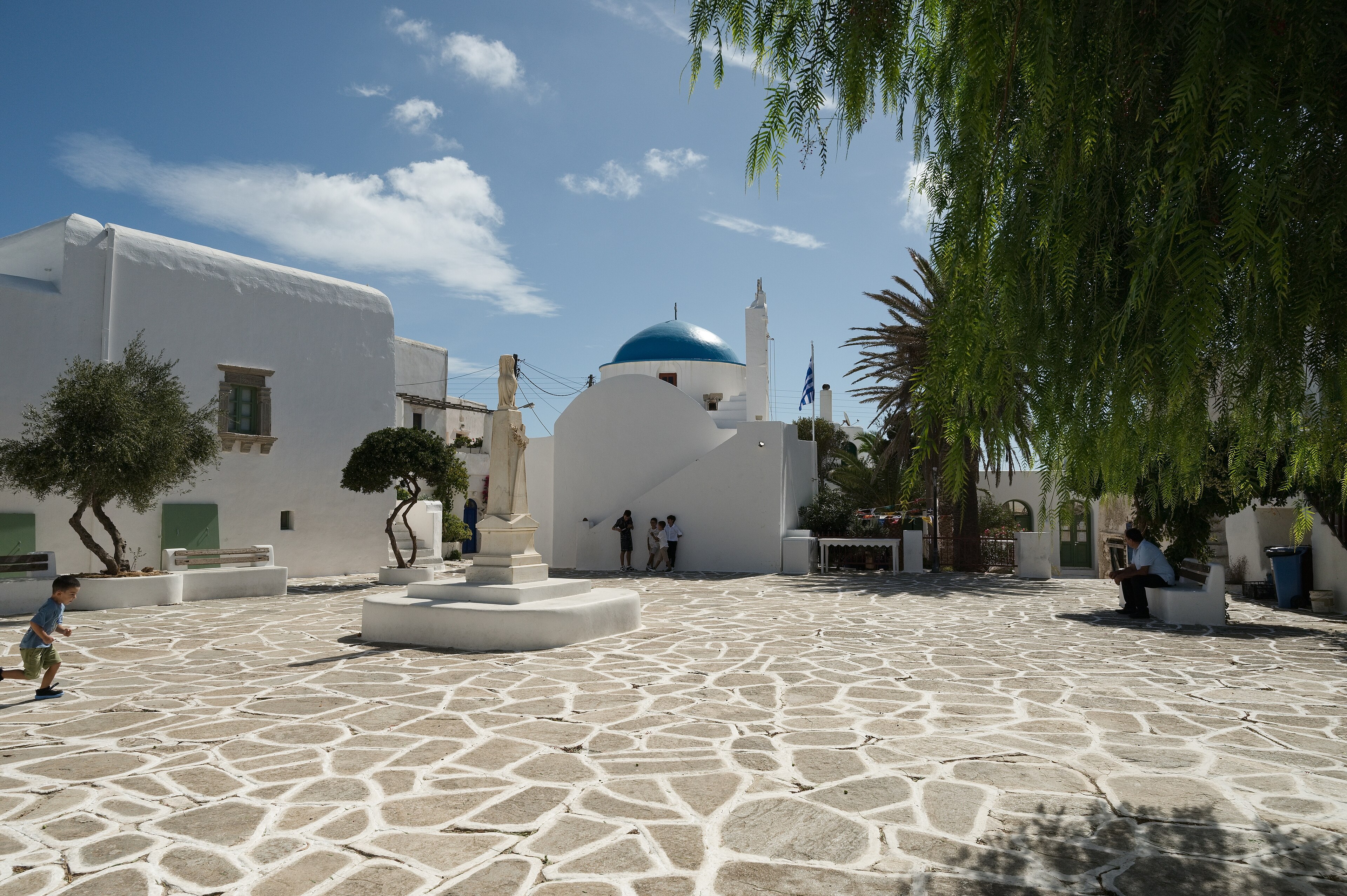
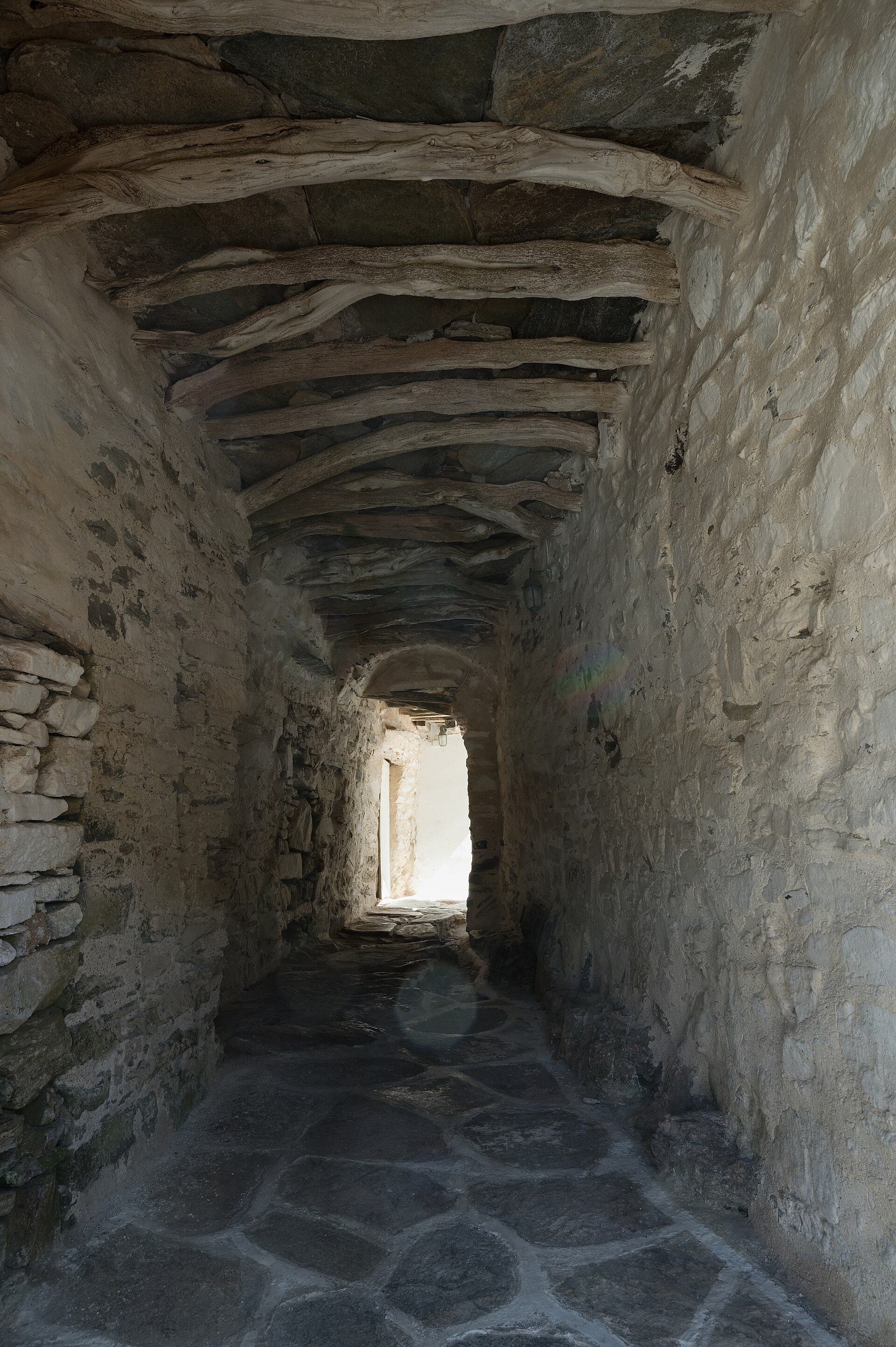
The inhabited core of Chora developed as two adjoining settlements: Kastro on the western cliff edge and Chorio immediately to the east. Kastro was the defensive nucleus, with houses compactly arranged around narrow lanes and a limited number of approaches. Its cliff-edge position reduced the sides from which attackers could approach, while dense construction allowed the domestic fabric itself to participate in defense. Chorio represents later outward growth and is less overtly fortified, though it preserves the same Cycladic vocabulary of whitewashed masonry, tight alleys, small courts and irregular plots. Together they form a particularly clear example of the transition from fortified nucleus to expanded village.
Zoodochos Pigi
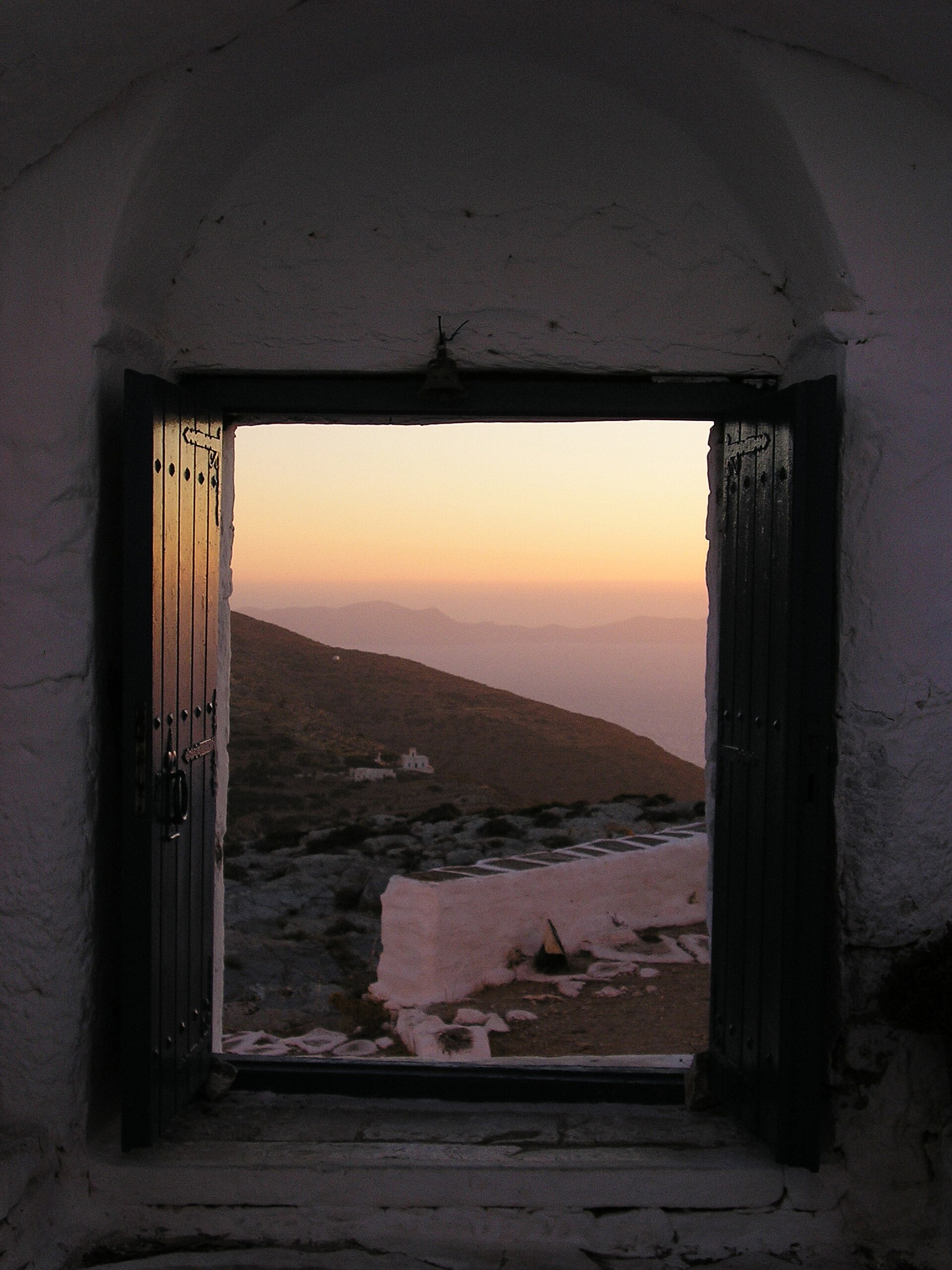
The monastery of Zoodochos Pigi, also called Chrysopigi, crowns the height above Kastro and preserves the island's strongest post-Byzantine defensive architecture. It is traditionally dated to 1690, during the late era of intensive piracy in the Aegean. High enclosure walls, controlled access and its commanding position gave it the character of a refuge as well as a religious institution. Local and modern accounts consistently emphasize its role as a place to which inhabitants could retreat during pirate attacks. The monastery functioned as a convent and was closed in the nineteenth century under the monastic reforms of the early Greek state. Its church remains active and its location provides a commanding reading of the relationship between Kastro, Chorio, the terraced interior and the sea.
Terraces and Chapels
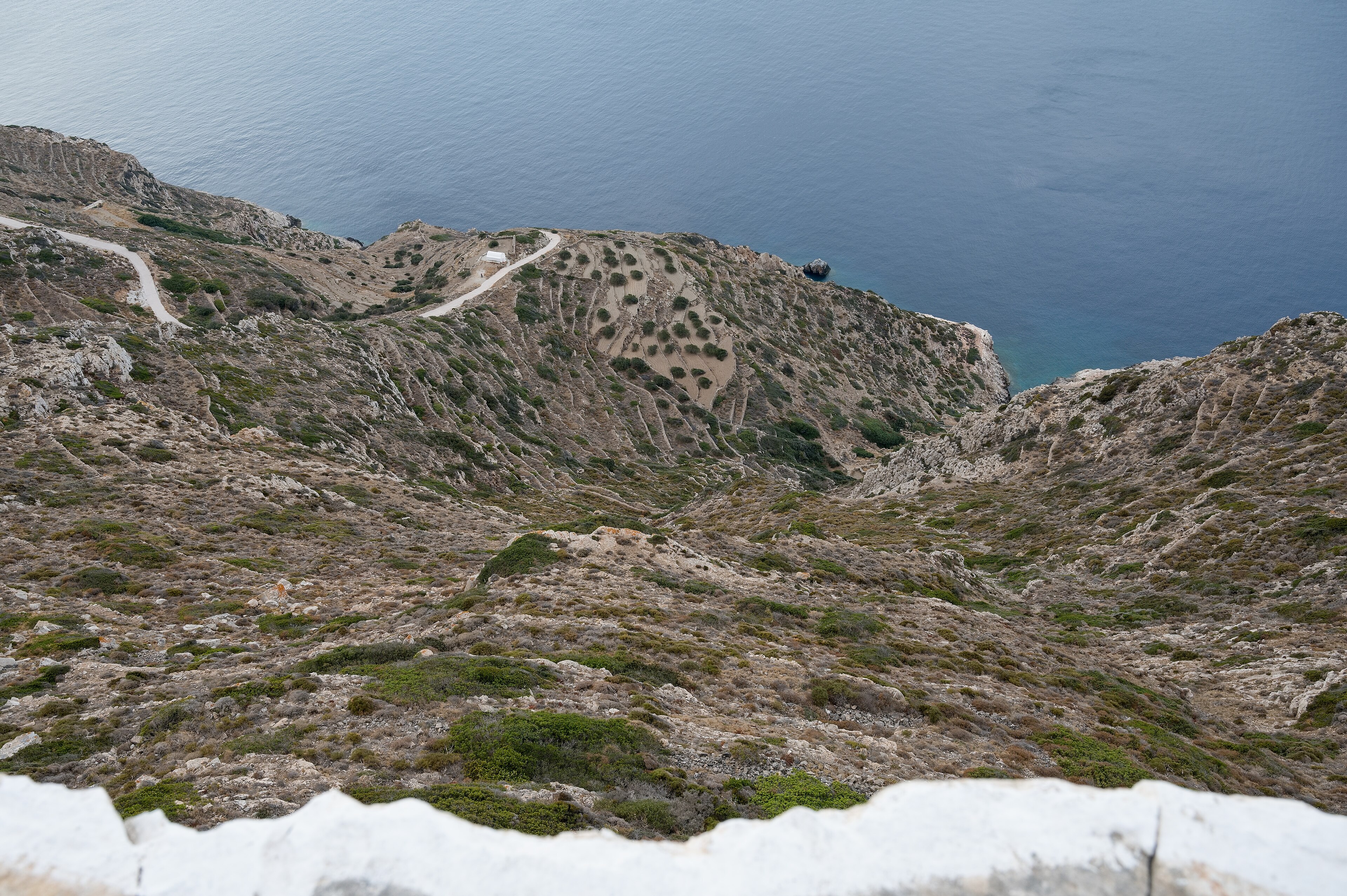
Sikinos is one of the Cyclades' clearest examples of an agricultural landscape engineered through dry-stone construction. Large areas of steep ground are covered by terraces built to retain scarce soil, reduce erosion and create narrow cultivable plots. Historically these supported cereals, pulses, vines and fodder while goats and sheep used rougher ground. Dry-stone field walls, cisterns, threshing areas, rural shelters and chapels formed part of the same productive system. The numerous chapels are not isolated picturesque objects: they mark routes, agricultural zones, family devotion and seasonal movement. Even where cultivation has declined, the terraced landscape remains a monumental record of centuries of labor.
The Ancient Necropolis and the Setting of Episkopi
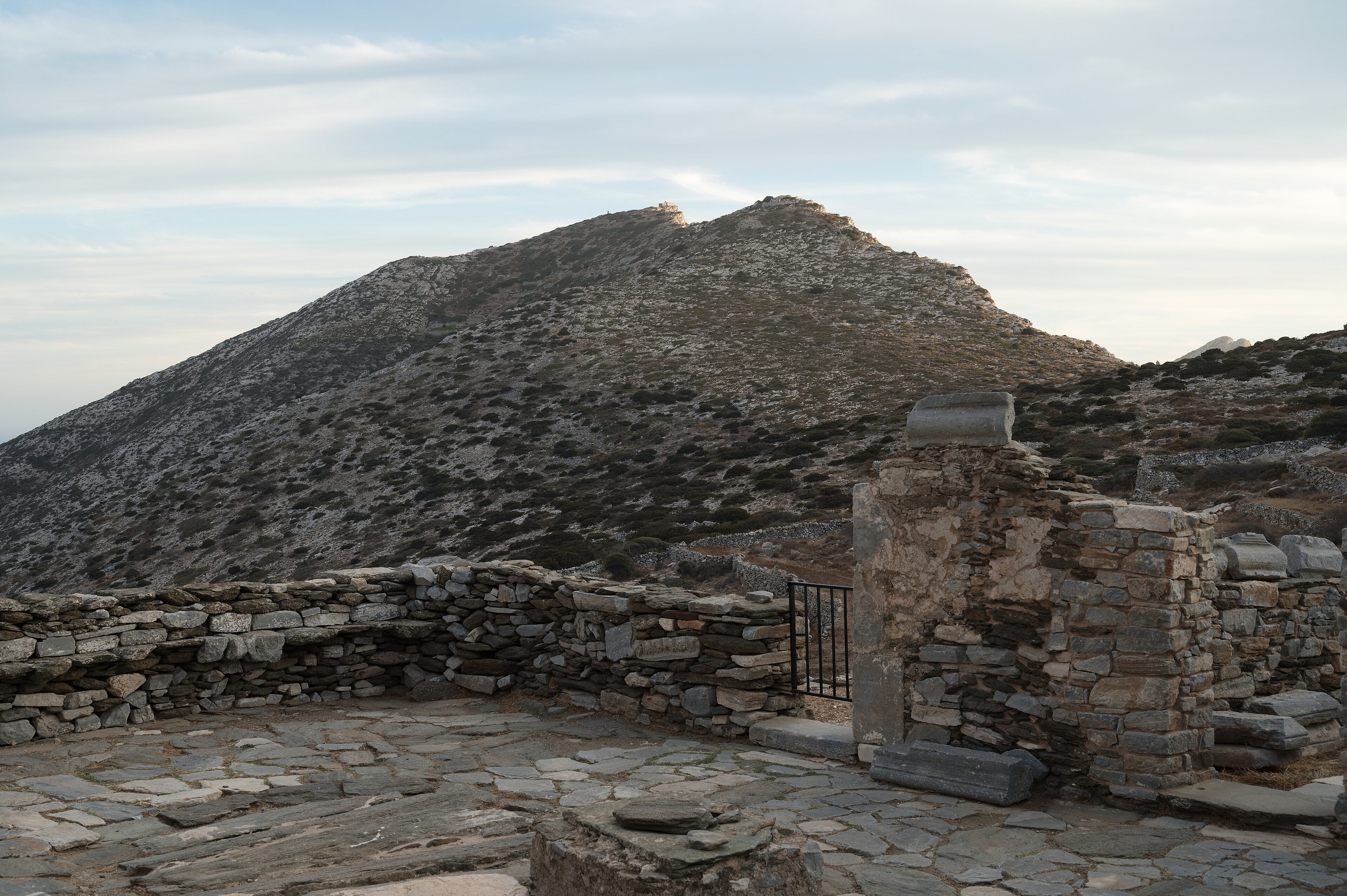
Episkopi stood on the outskirts of the ancient city in its funerary zone, which is essential to understanding its original function. Rather than a temple later converted to Christianity, current archaeological interpretation identifies the monument as a high-status Roman funerary structure deliberately built with the appearance and dignity of sacred architecture. That distinction is important because older travelers and antiquarians often interpreted the building as a classical temple. Its location between Agia Marina and the later settlements preserved the monument in relative isolation and ultimately helped make it one of the island's defining landmarks.
Neiko: An Elite Woman Rediscovered
Restoration work at Episkopi produced one of the most important recent archaeological discoveries in the Cyclades: an undisturbed, hermetically sealed tomb belonging to an upper-class woman named Neiko, whose name survives in an inscription. Jewellery and other finds confirmed high social status. Because the burial had escaped ancient and modern looting, it offered rare evidence for the people associated with the mausoleum rather than only its architecture. The discovery shifted Episkopi from an enigmatic building into a monument connected with an identifiable individual and materially enriched the study of Roman funerary culture in the eastern Mediterranean.
Restoration of Episkopi
By the twentieth century earthquakes, structural failure and centuries of intervention had left Episkopi seriously damaged and eventually closed. In 2016 the Ephorate of Antiquities of the Cyclades began a comprehensive program of investigation, stabilization and restoration. The work reused authentic architectural material wherever possible, incorporated compatible local stone, conserved Roman and Byzantine wall paintings and inscriptions, and installed environmental monitoring for vulnerable finds. The project reopened the monument to the public and received the 2022 European Heritage Award / Europa Nostra Award in the Conservation category. Its importance lies as much in the methodology as in the visual result: ancient, Byzantine and later phases were conserved together rather than forcing the building back to one selected historical moment.
From Roman Mausoleum to Christian Church
The Christian transformation of Episkopi illustrates a widespread Mediterranean process in an unusually intact form. Instead of quarrying the Roman mausoleum for stone, Christian builders converted the existing shell, inserting liturgical functions and adapting openings, roofs and interior surfaces. Successive Byzantine and later interventions accumulated without entirely masking the Roman structure. Fragments of Byzantine sculpture and frescoes recovered during restoration demonstrate that the site remained a meaningful sacred place over many centuries. Episkopi therefore offers a rare opportunity to study continuity not as an abstract idea but as architecture physically transformed through use.
Wine, Oinoe and the Agricultural Identity of Sikinos
The ancient name Oinoe, 'wine-bearing', preserved in official Greek tourism material, reflects the island's long association with viticulture. The dry, windy environment is challenging but suitable for low-yield vines when carefully terraced and protected. Wine was part of a wider mixed agricultural economy rather than a monoculture. Modern viticulture has revived this historical association, giving Sikinos a contemporary wine identity that is more than branding: vineyards occupy the same engineered landscape of terraces and dry-stone walls that structured earlier farming.
Kastro as Defensive Urbanism
Kastro is best understood as a fortified settlement rather than a freestanding castle. Its defensive strength derived from topography, compact housing, controlled access and the cliff itself. This is characteristic of smaller Cycladic communities that lacked the resources for massive masonry castles but could organize domestic architecture into a defensible perimeter. The distinction also explains why visitors should not expect monumental ramparts comparable to Rhodes or Naxos. The surviving value lies in urban morphology: how houses, passages, churches, walls and cliff edge together created security.
Pantanassa and the Sacred Core of Chora
The church of Pantanassa stands prominently in Kastro's square and belongs to the dense sacred geography of Chora. Its post-Byzantine furnishings and later modifications reflect the religious continuity of the settlement after the age of piracy. Sikinos preserves numerous churches and chapels, including examples with Byzantine and post-Byzantine phases. These buildings structure village space, agricultural routes and communal memory. In a small island community, churches were also important repositories of icons and family patronage, making sacred architecture one of the most durable forms of local cultural expression.
Alopronia and the Maritime Gateway
Alopronia is the island's small port and modern point of arrival. Unlike Chora, which occupies high defensible ground, Alopronia represents the maritime face of Sikinos: ferry connection, fishing, beach and seasonal movement. Its modest scale helps clarify why the historic settlement remained inland. The port is practical rather than monumental, but it is essential to the island's evolution from defensive isolation toward modern accessibility.
Paths and Movement Across the Island
Historic footpaths linked Kastro and Chorio with Episkopi, Agia Marina, fields, chapels, beaches and the port. In a landscape where roads are recent, paths were the infrastructure of everyday life. They moved people, animals, crops and religious processions through the terraced hills. Walking today is therefore not simply recreation; it reconstructs the spatial relationships that organized the island before motor transport. Routes to Episkopi and Agia Marina are especially valuable because they connect ancient, Roman, Byzantine and agricultural landscapes in one continuous sequence.
Nature and the Unbuilt Landscape
Sikinos remains comparatively lightly developed, and official tourism material emphasizes its protected flora and fauna, rocky coasts, caves and Natura 2000 landscape. The island's sparse vegetation and dry terrain can appear austere, but the ecological and cultural landscapes are closely intertwined. Terraces alter water flow and soil retention, abandoned fields become habitat, and isolated chapels and paths punctuate areas that now seem wild. The limited scale of tourism is itself relevant to heritage preservation because the historic relationship between settlement and open land remains unusually legible.
Religious Festivals and Community Tradition
Panigyria and church feast days remain central to Sikiniot social life. The annual celebration associated with Episkopi, traditionally linked with the Dormition on 15 August, has particular symbolic importance because restoration allowed the community to reconnect with a monument that had been closed for decades. A distinctive local custom places responsibility for an icon with community members for a period before its ceremonial return. Such practices demonstrate that the island's religious monuments are not archaeological shells but active parts of social identity.
Modern Sikinos and the Value of Restraint
Sikinos has not experienced the scale of resort development seen on neighboring Ios, Santorini or Mykonos. That relative restraint has preserved the visual coherence of Chora and the continuity of the terraced landscape. Tourism today is centered on walking, small beaches, heritage sites, local food and wine, and the experience of a small resident community rather than large-scale nightlife or resort infrastructure. This slower development pattern is increasingly one of the island's cultural assets.
What to Visit Today
Episkopi should be the first priority for anyone interested in architecture or archaeology. Its restoration allows visitors to read Roman funerary design, Byzantine adaptation and modern conservation in one monument. In Chora, walk through both Kastro and Chorio, then continue to Zoodochos Pigi for the strongest view of the island's defensive urban system. Pantanassa and the small churches enrich the village circuit. A longer walk to Agia Marina adds the ancient city and puts Episkopi back into its archaeological setting. Alopronia provides the maritime counterpoint, while vineyard visits and walks through the terraces reveal the working landscape. Current opening hours for Episkopi should always be confirmed with the Ephorate.
Why Sikinos Matters
Sikinos is important not because it preserves a large number of monumental sites, but because a small number of exceptionally legible places explain almost the entire history of the island. The ancient city defines the classical landscape; Episkopi compresses Roman, Byzantine and modern conservation history into one building; Kastro and Zoodochos Pigi embody life under piracy; terraces and chapels preserve the productive countryside; and Alopronia shows the later opening of the island to regular maritime connection. Together they form a rare, coherent record of how a small Cycladic society adapted to limited resources, insecurity and changing religious worlds.
Architecture
- Ancient city on the Agia Marina heights with fortification remains and platforms for public or sacred buildings
- Episkopi: third-century AD Roman mausoleum in temple form, later converted into a Byzantine church
- Episkopi podium with two barrel-vaulted crypts and an originally temple-like façade
- Eclectic Roman architectural vocabulary at Episkopi combining Ionic and Doric elements
- Byzantine and later additions at Episkopi adapted to the ancient fabric rather than erasing it
- Kastro: compact fortified residential nucleus of Chora on the cliff edge
- Chorio: adjoining settlement of narrow alleys, whitewashed houses and small squares
- Zoodochos Pigi: fortified post-Byzantine monastery with high enclosure walls and refuge function
- Pantanassa and other churches embedded in the urban fabric of Kastro and Chorio
- Dry-stone retaining walls and agricultural terraces covering large parts of the island
- Traditional vineyard plots, farm structures, cisterns, threshing floors and chapels
- Alopronia: modest harbor settlement serving as the island's maritime gateway
Timeline
- Archaic period The ancient polis of Sikinos develops on the heights around Agia Marina.
- Classical period Sikinos participates in the political networks of the Cycladic poleis and Aegean maritime world.
- Hellenistic period The ancient city and its fortified highland landscape remain active.
- 3rd century AD The monumental Roman mausoleum now known as Episkopi is built on the necropolis outside the ancient city.
- Byzantine period Episkopi is converted into a Christian church, preserving much of the Roman structure through adaptive reuse.
- Middle Ages Successive repairs and church modifications accumulate at Episkopi while settlement patterns shift toward defensible inland locations.
- late medieval / early post-Byzantine period Kastro consolidates as the fortified residential nucleus of Chora.
- 1690, traditional date Zoodochos Pigi monastery is founded or substantially established above Kastro as a fortified religious refuge.
- 18th century Church building and village life continue within Kastro and Chorio while piracy remains an important memory in local defensive architecture.
- 1834 Zoodochos Pigi ceases functioning as a convent during the monastic reforms of the early Greek state.
- 19th century European travelers and antiquarians visit Episkopi and debate whether it was originally a classical temple.
- 20th century Structural damage and abandonment eventually force Episkopi out of regular use.
- 2016 The Ephorate of Antiquities of the Cyclades begins a major restoration and archaeological investigation of Episkopi.
- 2018 Restoration research reveals the sealed tomb of the elite woman Neiko.
- 2022 The restored Episkopi receives a European Heritage Award / Europa Nostra Award in the Conservation category and reopens to the public.
- 2020s Sikinos continues to emphasize low-intensity cultural tourism, walking, wine, landscape conservation and heritage restoration.
Visiting today
Episkopi is the essential archaeological visit and is now open to the public on a seasonal schedule managed by the Ephorate of Antiquities of the Cyclades; check the current 2026 hours before setting out. Chora is best explored slowly on foot, moving between Kastro and Chorio and continuing uphill to Zoodochos Pigi for the defensive relationship between settlement and refuge monastery. The ancient city at Agia Marina is a walking destination rather than a fully monumentalized archaeological park and requires good footwear and respect for unfenced remains. Alopronia is the port and practical arrival point. Sikinos is particularly rewarding for walkers because terraces, chapels and historic tracks remain visible across the island. Summer heat, strong wind, steep paths and limited shade make water and sun protection important.
Images
References
- Ephorate of Antiquities of the Cyclades — Episkopi, Sikinos
- Hellenic Ministry of Culture — Stabilization and Restoration of Episkopi, Sikinos
- D. Athanasoulis — Episkopi of Sikinos: The Resurrection of an Iconic Monument, AIA Proceedings (2024)
- Greek National Tourism Organisation — Sikinos
- Ephorate of Antiquities of the Cyclades — Opening Hours and Admission
- ToposText — Ancient Sikinos
Topics
- Cyclades
- Historic Island
- Ancient Greek
- Roman
- Roman Mausoleum
- Episkopi
- Byzantine
- Adaptive Reuse
- Kastro
- Fortified Settlement
- Zoodochos Pigi
- Piracy
- Terraces
- Dry Stone
- Viticulture
- Religious Heritage
- Historic Paths
- Low Impact Tourism