Highlights
- Panagia Evangelistria
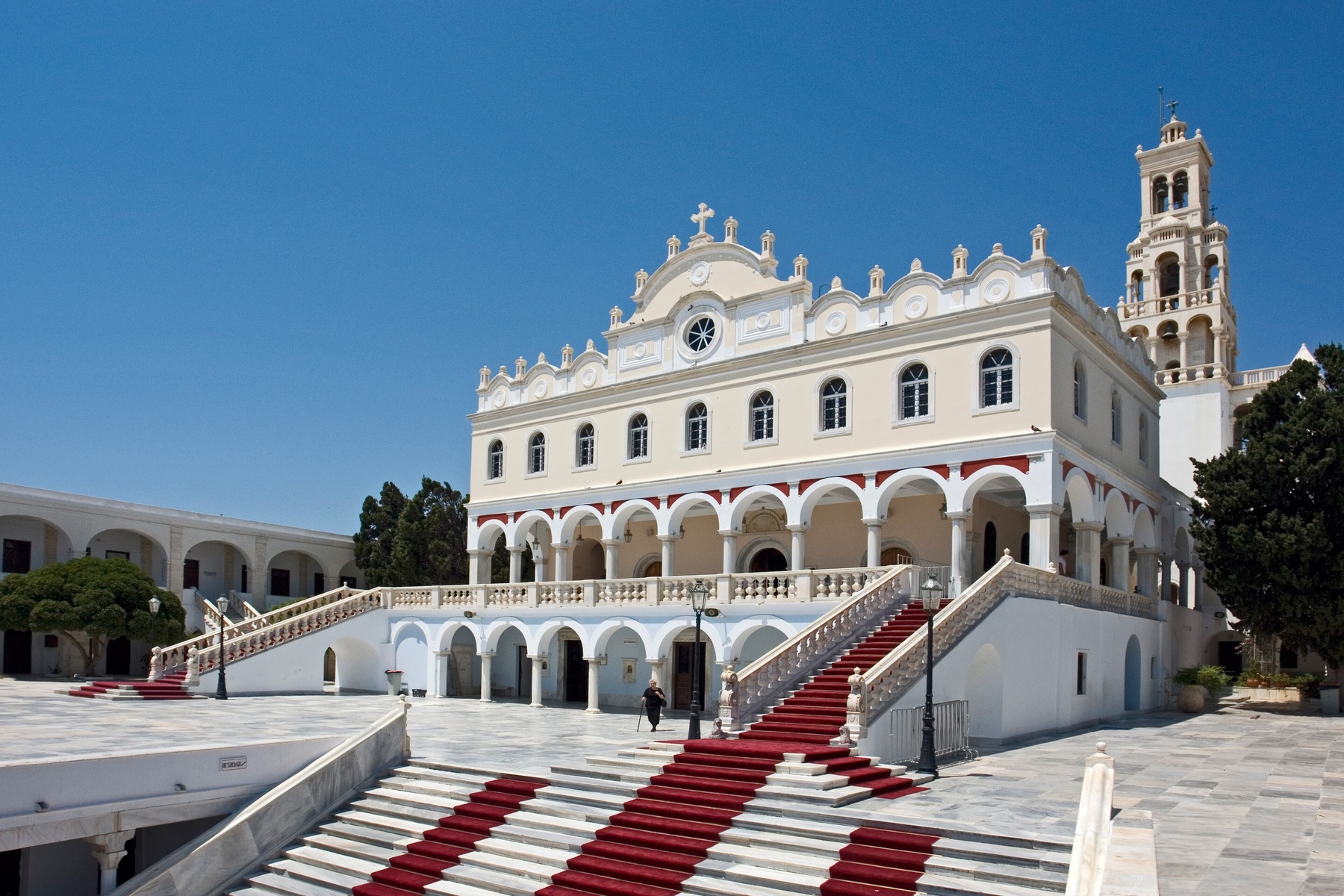
The great sanctuary above Chora made Tinos one of the principal Orthodox pilgrimage destinations of the Greek world after the discovery of the icon in 1823.
- Kionia
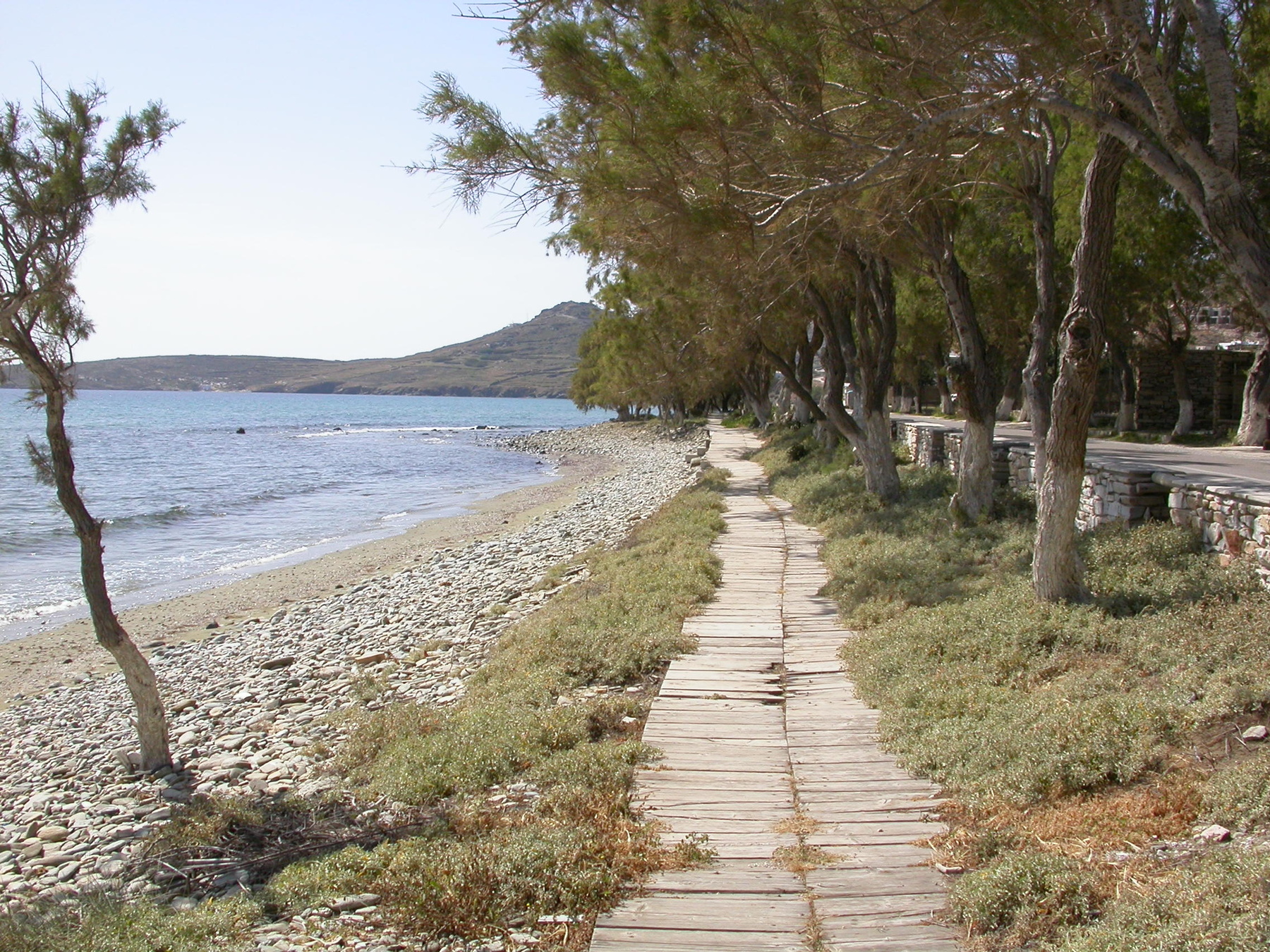
The Hellenistic sanctuary of Poseidon and Amphitrite was unique in the Cyclades and attracted pilgrims from across the Mediterranean.
- Pyrgos and Marble Craft
The principal center of a living marble-working tradition recognized by UNESCO as Intangible Cultural Heritage.
- Exombourgo
The island's ancient inland center and great Byzantine, Latin and Venetian fortress; its archaeology and fortifications are treated in a separate rich page.
- Dovecotes and Terraces
Ornamental pigeon houses, dry-stone terraces and rural paths turn much of the island into a historic working landscape.
- Orthodox and Catholic Tinos
Centuries of Latin rule produced a durable Catholic presence alongside Orthodox communities, especially visible in the central village network.
- Tinian Artists
Yannoulis Chalepas, Nikephoros Lytras and Nikolaos Gyzis exemplify the island's outsized contribution to modern Greek art.
- Archaeological Museum
Collections spanning Mycenaean to Roman Tinos connect the island's ancient city, Kionia, Exombourgo and other archaeological sites.
Overview
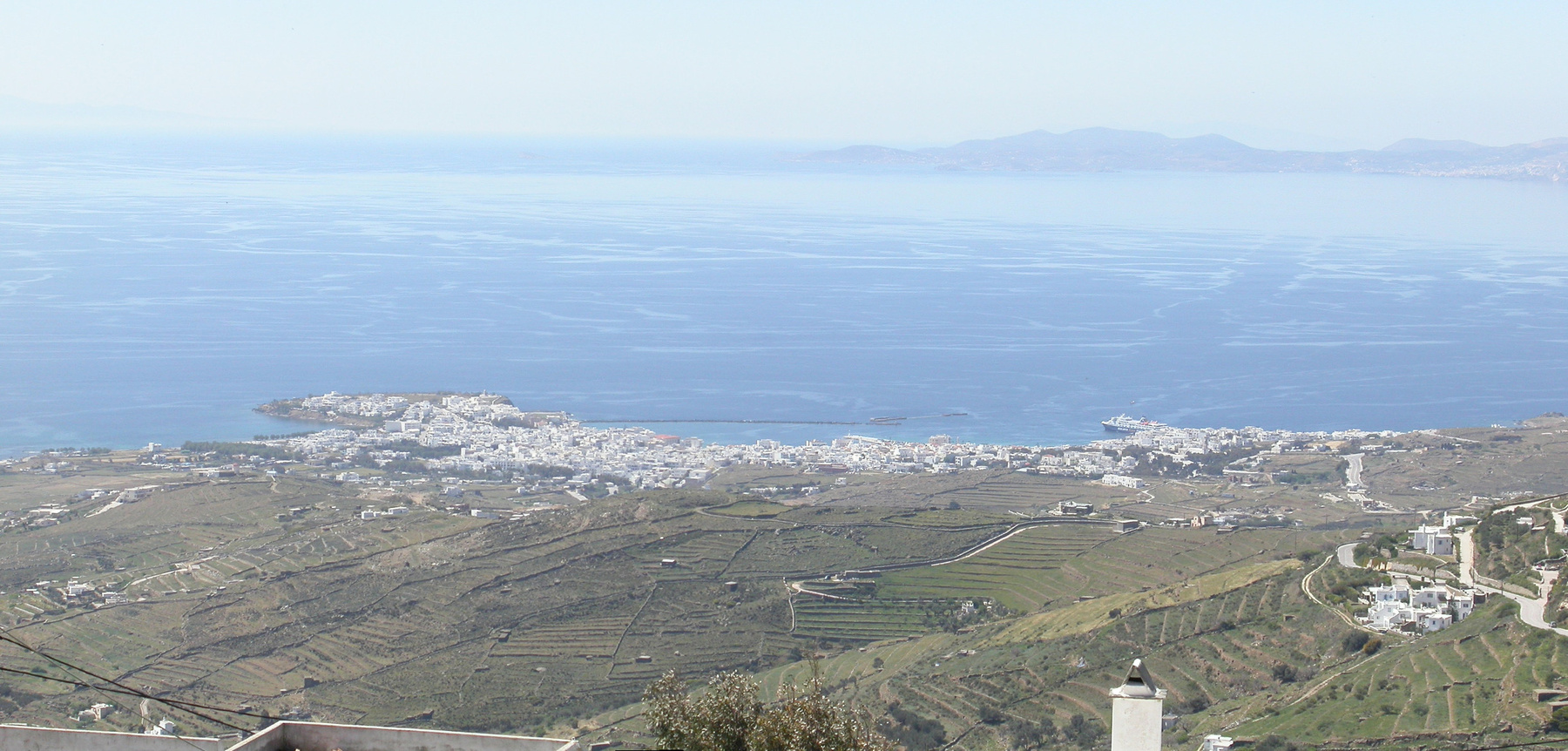
Tinos combines ancient sanctuaries, a long history of defensive settlement, Orthodox pilgrimage, Catholic and Orthodox village traditions, marble craftsmanship and a distinctive rural architecture of terraces, dovecotes and stone-built settlements. Its historical geography repeatedly shifted between exposed coastal centers and defensible inland sites. The ancient city developed near the southern coast and maintained the great sanctuary of Poseidon and Amphitrite at Kionia; in later antiquity and the Middle Ages political gravity moved inland toward the formidable rock of Exombourgo. After its capture by the Ottomans in 1715, Chora expanded around the southern harbor. The discovery in 1823 of the icon venerated as Panagia Evangelistria transformed the town into one of the principal pilgrimage destinations of the Greek world. This island-level page treats Exombourgo only as an essential part of Tinos's wider history; its archaeology and fortifications warrant a separate detailed place page.
Ancient Tinos
Archaeology carries the island's history well beyond the Classical period. Finds in the Archaeological Museum span from the Mycenaean era to Roman times, and the renewed exhibition includes material from the undisturbed tholos tomb at Agia Thekla, dated to the thirteenth–twelfth centuries BC and one of only three Mycenaean tholos tombs currently known in the Cyclades. During the Geometric period the principal residential and political center lay inland at Exombourgo, where occupation continued until about the middle of the fourth century BC. Thereafter the ancient city developed on the southern coast in the area of modern Chora. Three kilometers west, at Kionia, a sanctuary of Poseidon and Amphitrite was founded at the end of the fourth century BC. The Ephorate of Antiquities identifies it as the only known Cycladic sanctuary jointly dedicated to these sea deities. It achieved pan-Hellenic fame in the third century BC and continued to prosper in the second and first centuries BC. Poseidon was worshipped there as a healing god and Amphitrite was associated with fertility; the Posideia included dramatic competitions. Monumental additions included a temple with marble Doric columns, an elaborate fountain, altar, votive exedrae and a double-faced Great Stoa about 170 meters long. In the early second century BC the sanctuary became the seat of the reorganized Koinon of the Islanders. Its importance diminished under the Roman Empire and the sanctuary was abandoned around the middle of the third century AD. Late Classical and Hellenistic towers elsewhere in the countryside also reveal a landscape organized for surveillance, refuge and agricultural management.
Medieval and Venetian Tinos
The island's medieval history is inseparable from Exombourgo, but the fortified rock is only one part of a wider Tinian story. Archaeological work places an early fortification on its summit in the period of Arab raiding, probably in the second half of the seventh century, with another substantial horizon in the late twelfth or early thirteenth century. After the Fourth Crusade, Andreas and Jeremiah Ghisi took Tinos in 1207 and established the Castle of Saint Helen. Their rule lasted until 1390, when Tinos passed directly to Venice. The island remained Venetian until 1715—exceptionally late among the Cyclades—and the long Latin period left a durable Catholic population and architectural legacy in the central villages. Exombourgo survived attacks including Barbarossa's brief occupation in 1538 and was subsequently strengthened. By the Venetian period its urban complex comprised an unwalled borgo, a larger inhabited town and the upper fortified castle. The details of those defenses, the ancient settlement beneath them and the 1715 siege belong properly to the separate Exombourgo page. For Tinos as a whole, the greater legacy is the network of villages, parishes, roads, cultivated terraces and Catholic as well as Orthodox institutions that developed around this long-lived inland center.
Pilgrimage and Religious Culture
Modern Tinos is inseparable from Panagia Evangelistria. According to the ecclesiastical tradition, the nun Pelagia of the monastery at Kechrovouni experienced visions that led to excavations and, in January 1823, to the discovery of an icon identified with the Annunciation. The sanctuary erected above the discovery site quickly became a major center of Orthodox pilgrimage at the same moment that the Greek War of Independence was reshaping the political world of the Aegean. Its significance therefore became simultaneously devotional and national. The monumental complex above Chora contains the principal church, the lower Church of the Finding, museums and collections, and a broad processional axis descending toward the harbor. The great pilgrimages associated especially with the Annunciation, the July feast of Saint Pelagia and the Dormition on 15 August continue to structure the island's annual religious life. Yet Tinian religion is broader than this national sanctuary. Numerous Orthodox and Catholic churches and chapels are embedded in villages and the agricultural landscape, reflecting the island's unusual continuity of the two Christian traditions after centuries of Latin and Ottoman rule.
Chora: From Harbor Settlement to Pilgrimage Town
Present-day Tinos town, or Chora, developed decisively after the Ottoman capture of Exombourgo in 1715, when the decline of piracy and the new political order made permanent settlement around the southern harbor increasingly practical. Local historical material places the formation of its recognizable urban form principally between 1715 and 1745. The discovery of the Evangelistria icon a century later radically reoriented the town. A ceremonial and commercial spine linked harbor and sanctuary, while accommodation, workshops, shops and charitable institutions grew around the pilgrimage economy. Chora nevertheless preserves an older archaeological substratum: finds from the ancient city and the area of Evangelistria form part of the Archaeological Museum's collections. The modern town is therefore best understood as both the successor to the island's ancient southern center and a settlement transformed by eighteenth-century maritime security and nineteenth-century pilgrimage.
Marble, Villages and Vernacular Architecture
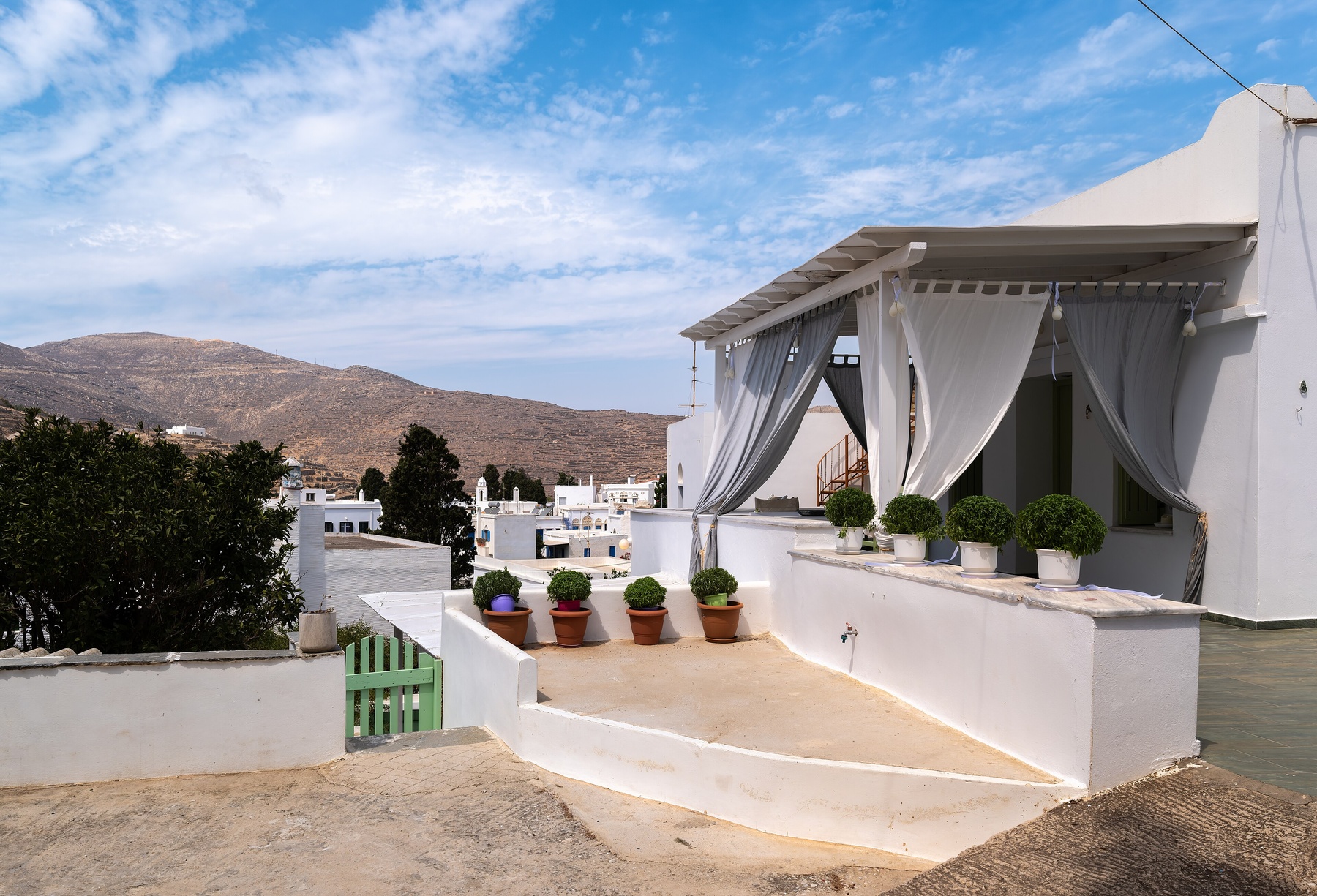
The cultural landscape of Tinos is distinguished by an unusually sophisticated use of stone and marble. In Exo Meria, especially Pyrgos and the Panormos district, quarrying and marble working developed into a specialized craft economy. Marble appears not only in sculpture but in lintels, fountains, fanlights, coats of arms, church fittings, tombs and ordinary household objects. UNESCO inscribed Tinian marble craftsmanship on the Representative List of the Intangible Cultural Heritage of Humanity in 2015, emphasizing the empirical knowledge of stone, apprenticeship within workshops and the symbolic repertoire of cypresses, flowers, birds and ships. Pyrgos remains the craft's principal living center. The Museum of Marble Crafts documents quarrying, cutting, workshop organization, tools and the social economy of the trade. The island's villages extend this craftsmanship into a broader vernacular ensemble: marble-paved passages, whitewashed houses, vaulted ways, fountains, churches, dry-stone walls and terraces respond to terrain, wind and scarce water while giving individual settlements markedly different characters.
Pyrgos, Panormos and the Artists of Tinos
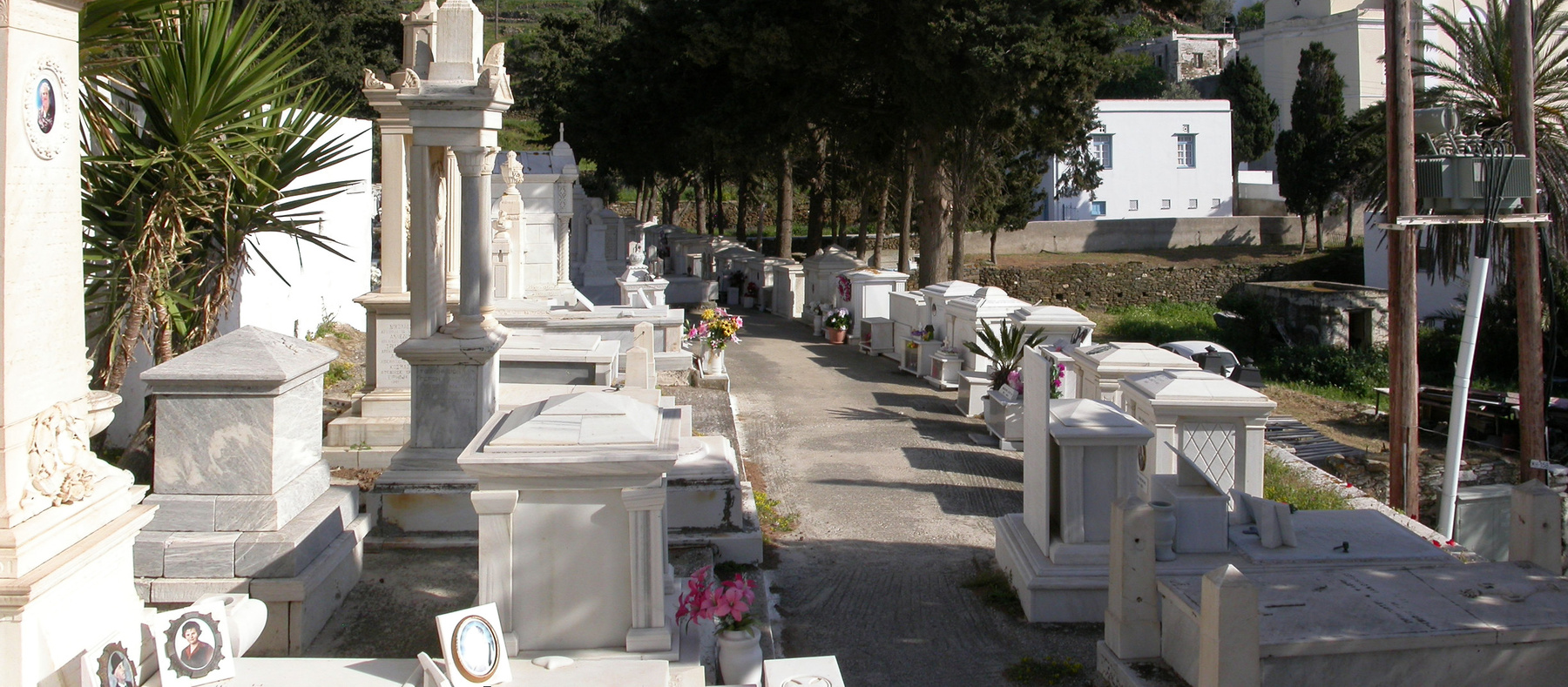
Pyrgos is more than a picturesque marble village: it represents the institutional and artistic culmination of the Tinian stone-working tradition. Generations of quarrymen, carvers and sculptors trained there and carried their skills to major building projects elsewhere in Greece. Tinos produced figures central to nineteenth- and early twentieth-century Greek art, including the sculptor Yannoulis Chalepas and painters Nikephoros Lytras and Nikolaos Gyzis. The Museum of Marble Crafts interprets the technological and social history of the trade, while museums and collections associated with Tinian artists preserve the transition from workshop craft to academic and national art. Nearby Panormos provided a maritime outlet for the marble-producing district. Together the quarry landscape, workshops, village architecture, cemetery sculpture and artists' museums make Exo Meria one of the strongest examples in Greece of a local material tradition shaping both everyday architecture and national artistic culture.
Dovecotes, Terraces and the Productive Landscape
Tinos's rural monuments are as characteristic as its churches. Elaborately decorated dovecotes stand throughout the countryside, their geometric façades combining practical nesting openings with conspicuous architectural display. Although closely associated with the centuries of Venetian and Latin rule, the surviving buildings represent a long and evolving agricultural tradition rather than a single construction campaign. Pigeons supplied meat and fertilizer, while the scale and ornament of a dovecote could advertise ownership and status. Around them, generations of farmers built dry-stone retaining walls and terraces to create cultivable ground on steep, wind-exposed slopes. Paths, threshing floors, windmills, chapels and farm buildings connect the villages to this productive infrastructure. These structures are crucial to understanding Tinos as a cultural landscape: monumental marble carving and humble dry-stone construction belong to the same deep knowledge of local materials.
Religious Coexistence and the Village Network
One of the island's most distinctive historical features is the persistence of both Catholic and Orthodox communities. The long Latin and Venetian centuries entrenched Catholic institutions particularly in the central interior, while Orthodox communities remained part of the island's social fabric and became increasingly prominent after Venetian rule. Villages such as Xinara, Loutra and others around the Exombourgo basin preserve Catholic churches, monasteries and institutional memories, while Orthodox sanctuaries are distributed across the same landscape. The result is not two separate islands but an interwoven geography of villages, kinship, agriculture and worship. This coexistence gives Tinos a religious history substantially more complex than the island's modern identification with a single Orthodox pilgrimage shrine might suggest.
Museums and Cultural Memory
Tinos supports an unusually dense network of institutions interpreting its past. The Archaeological Museum in Chora holds material from the Mycenaean era through Roman times, including finds from Kionia, Exombourgo, Kardiani and the ancient city; its permanent exhibition was renewed in 2026 and now includes the Agia Thekla tholos-tomb assemblage. At Pyrgos, the Museum of Marble Crafts explains the technology and social organization of quarrying and carving. Collections associated with the Evangelistria foundation and Tinian artists connect pilgrimage patronage with modern Greek art, while the island's smaller museums and village collections preserve domestic and craft traditions. Taken together, they allow Tinos to be read not simply as a pilgrimage destination but as an archaeological, artistic and ethnographic landscape.
Why Tinos Matters
Tinos is significant because several histories normally treated separately remain visible in one island landscape. Its Mycenaean tombs and ancient sanctuary document participation in successive Aegean worlds; Exombourgo records the movement of population and power toward defensible inland terrain and an unusually long Venetian era; Chora embodies the return to the harbor and the rise of a national pilgrimage center; and Pyrgos demonstrates how a local quarrying and carving tradition could influence modern Greek architecture and sculpture. Dovecotes, terraces, villages and the coexistence of Catholic and Orthodox communities connect these monumental histories to everyday life. Exombourgo deserves its own page precisely because the general Tinos page can then show how that fortress participated in a much larger island system.
Timeline
- 13th–12th centuries BC The Mycenaean tholos tomb at Agia Thekla was constructed; its undisturbed finds are now displayed in the Archaeological Museum of Tinos.
- 10th–8th centuries BC Exombourgo was the principal residential and political center of Geometric Tinos.
- c. mid-4th century BC The ancient settlement at Exombourgo declined as the island's principal urban focus shifted toward the southern coast.
- late 4th century BC The Sanctuary of Poseidon and Amphitrite was founded at Kionia.
- 3rd century BC The Kionia sanctuary achieved pan-Hellenic fame and attracted pilgrims from across the Mediterranean.
- early 2nd century BC Kionia became the seat of the reorganized Koinon of the Islanders; major monumental building continued during the Hellenistic period.
- mid-3rd century AD The Sanctuary of Poseidon and Amphitrite was abandoned after a long decline under Roman rule.
- second half of 7th century Archaeological interpretation places an early Byzantine fortification on the summit of Exombourgo during the era of Arab raiding.
- 1207 Andreas and Jeremiah Ghisi took Tinos and established Latin rule centered on the Castle of Saint Helen at Exombourgo.
- 1390 Tinos passed to direct Venetian rule.
- 1538 Hayreddin Barbarossa briefly occupied Exombourgo; Venetian control was subsequently restored and the defenses strengthened.
- 1715 Ottoman forces captured Exombourgo, ending more than three centuries of direct Venetian rule and accelerating the growth of the harbor settlement at Chora.
- 1715–1745 Modern Tinos town developed its recognizable harbor-centered urban form.
- January 1823 The icon venerated as Panagia Evangelistria was discovered following the visions attributed to the nun Pelagia, initiating the modern pilgrimage tradition.
- 19th century Tinian marble workers and artists became influential in the architecture and sculpture of the modern Greek state.
- 1960s The Archaeological Museum of Tinos was constructed in Chora to house finds spanning the Mycenaean through Roman periods.
- 2015 UNESCO inscribed Tinian marble craftsmanship on the Representative List of the Intangible Cultural Heritage of Humanity.
- 2026 The Archaeological Museum renewed part of its permanent exhibition, including the first permanent display of finds from the Agia Thekla Mycenaean tholos tomb.
Images
References
- Ephorate of Antiquities of the Cyclades — Sanctuary of Poseidon and Amphitrite in Kionia, Tenos
- Ephorate of Antiquities of the Cyclades — Archaeological Site of Xombourgo of Tenos
- Ephorate of Antiquities of the Cyclades — Archaeological Museum of Tenos
- Ephorate of Antiquities of the Cyclades — Renewed Permanent Exhibition of the Archaeological Museum of Tenos (2026)
- Directorate of Archaeological Museums — Archaeological Museum of Tinos
- UNESCO Intangible Cultural Heritage — Tinian Marble Craftsmanship
- Piraeus Bank Group Cultural Foundation — Museum of Marble Crafts
- Tinian Cultural Foundation — Tinos
Related places
Topics
- Cyclades
- Historic Island
- Ancient Greek
- Hellenistic
- Byzantine
- Venetian
- Ottoman
- Religious Heritage
- Pilgrimage
- Catholic Heritage
- Marble Craft
- Intangible Heritage
- Vernacular Architecture
- Dovecotes
- Cultural Landscape
- Archaeology
- Tinian Art