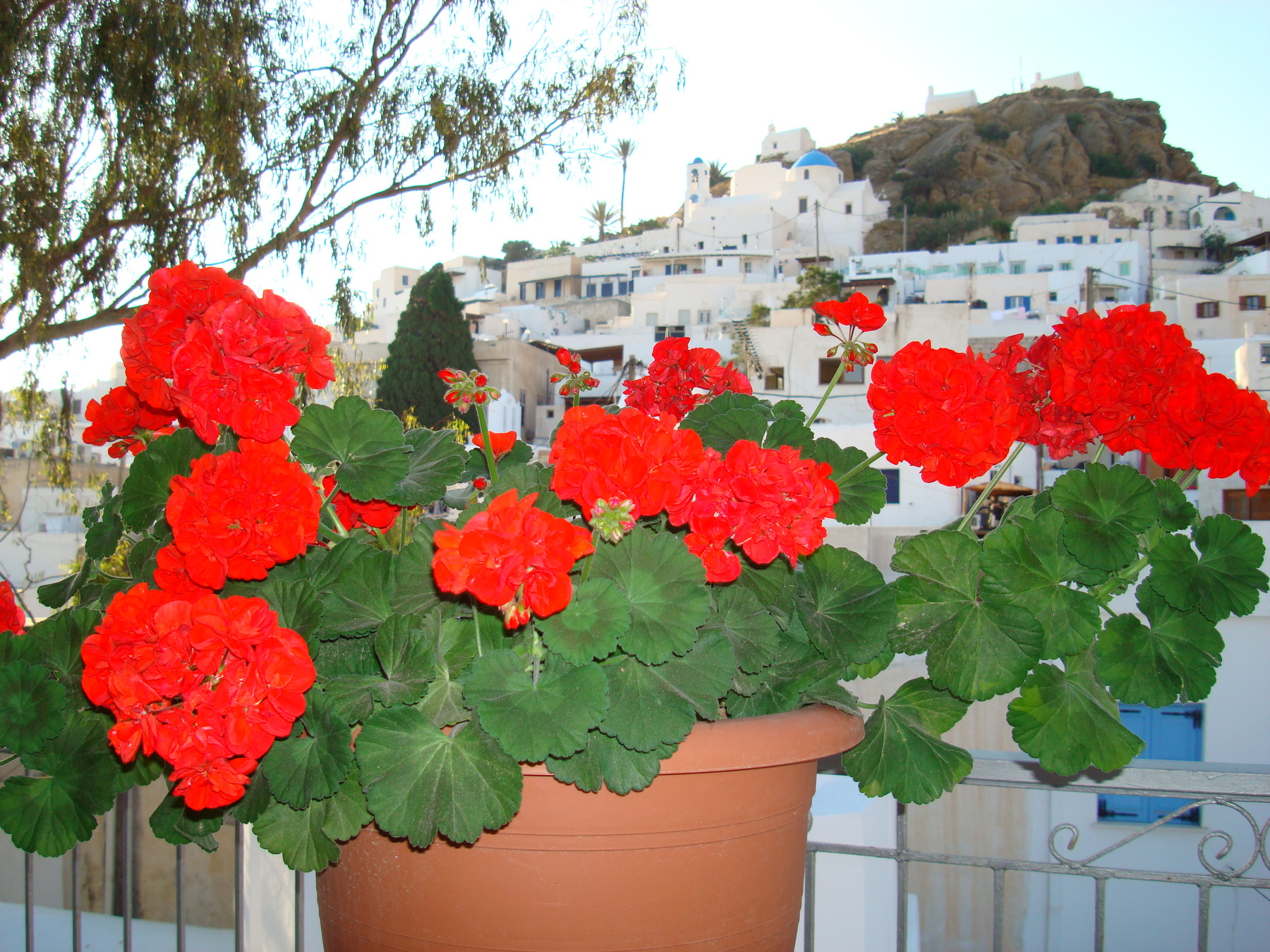
Overview
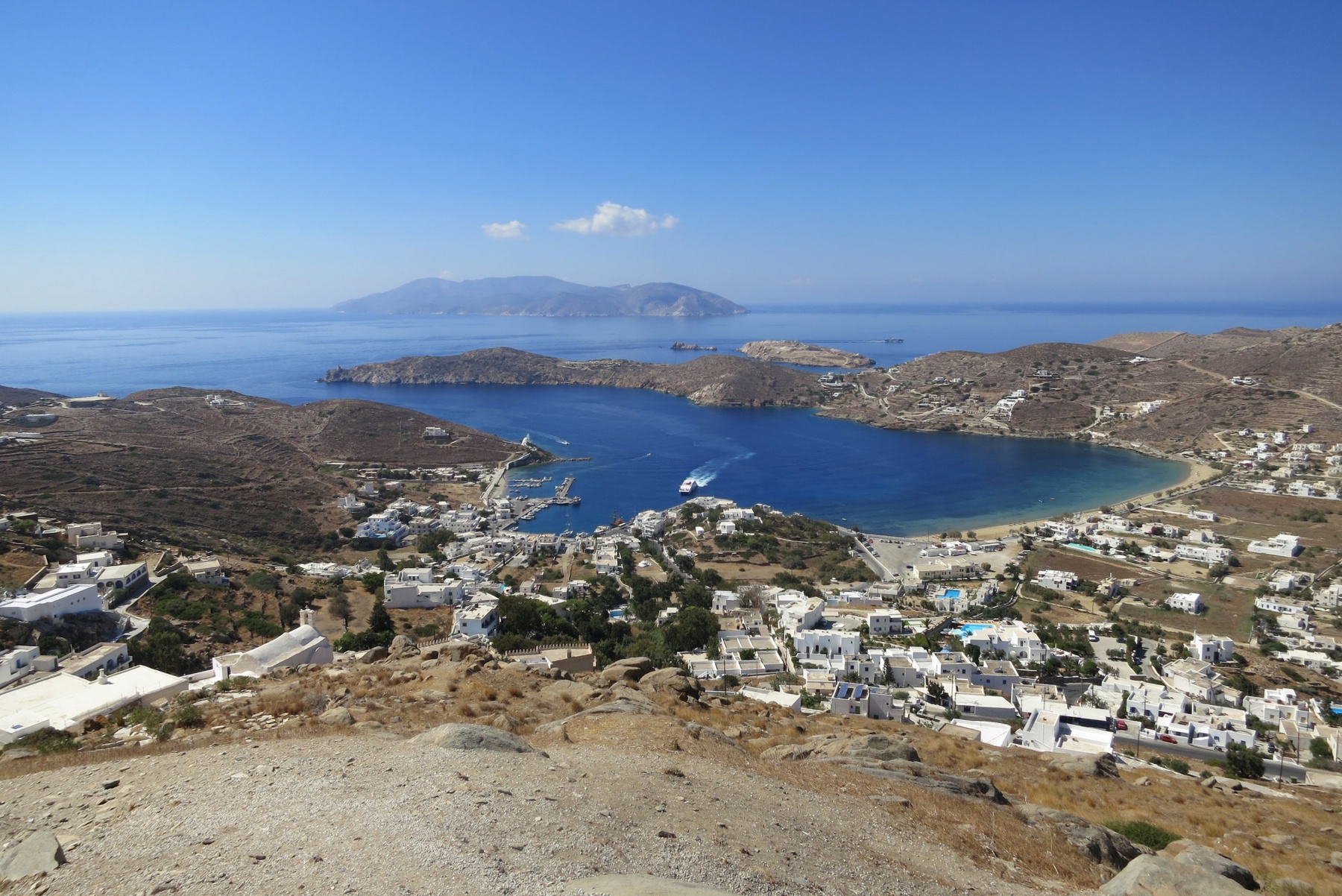
Ios lies between Naxos, Sikinos and Thera and combines a mountainous interior with fertile valleys and an unusually safe harbor at Gialos. Skarkos flourished beside the western harbor and Kato Kampos during the Early Cycladic II period, when maritime exchange linked Ios with other Cycladic islands and the wider Aegean. In historical antiquity the principal city occupied the Kastro hill of modern Chora, commanding the same harbor; its fortification began in the Archaic period and was repeatedly strengthened in Classical and Hellenistic times. Rural sanctuaries, towers and farm buildings extended civic life across the island, while Roman roads, drains, aqueducts and coastal remains show continuing occupation into Late Antiquity. The transition into the medieval period is less securely documented, but Chora remained the island's principal settlement and developed the compact, stepped form characteristic of defensive Cycladic hill towns. Ios's cultural identity is equally marked by Homer. Ancient writers connected the poet with the island, local coins bore his image, and a sacrificial calendar used the month-name Homereon. The traditional 'Tomb of Homer' at Plakotos should therefore be understood as part of a genuine ancient civic tradition, even though the surviving monument cannot be authenticated as the poet's actual grave.
Highlights
- Skarkos
One of the best-preserved Early Cycladic settlements in the Aegean, with multi-storey houses, streets, drainage, workshops and evidence of wide maritime exchange.
- Chora
A living settlement built directly over the ancient city, where Archaic walls, Classical-Hellenistic architecture and Roman infrastructure remain visible among later houses and churches.
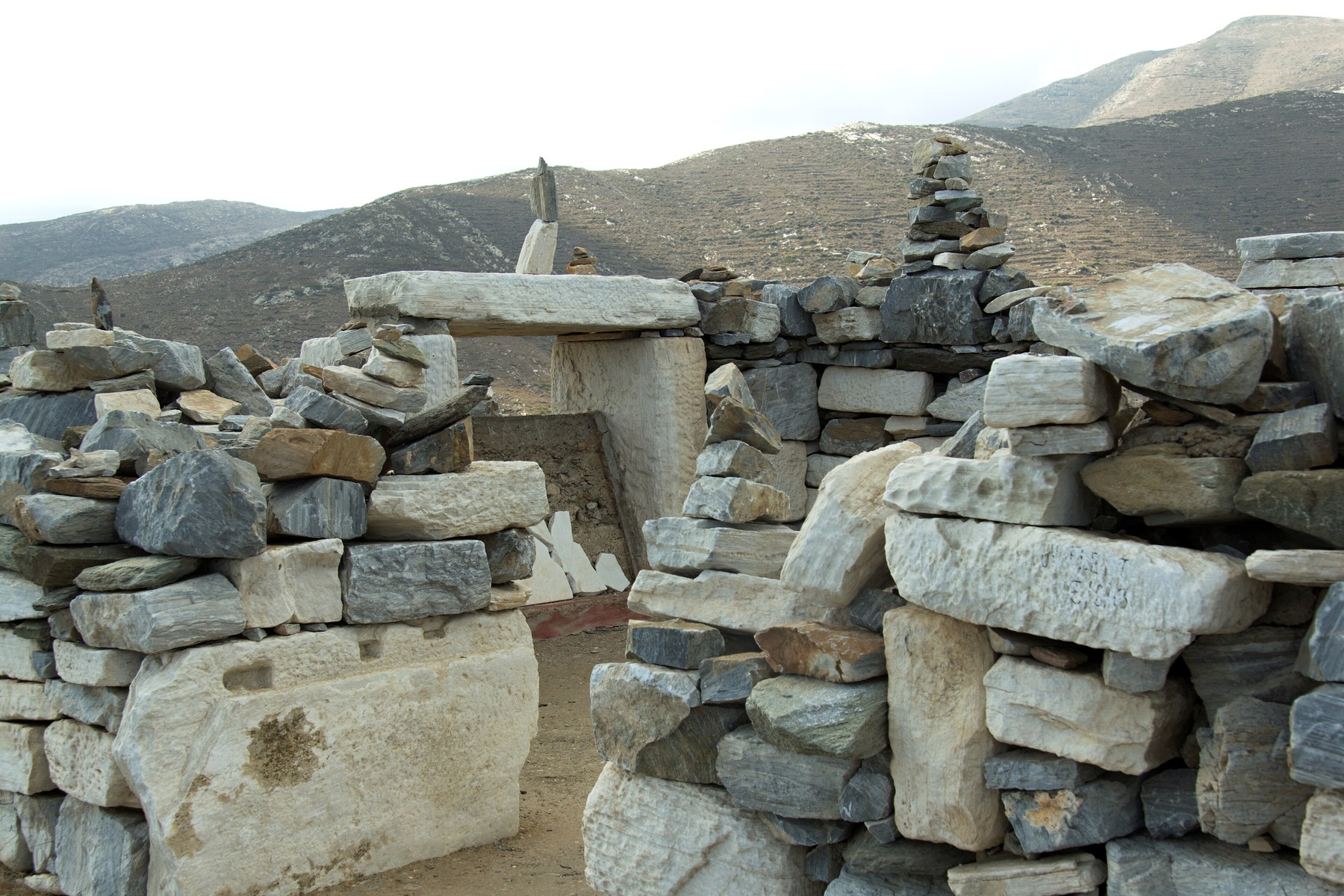
- Traditional Tomb of Homer
A culturally important northern site rooted in a genuine ancient Ietan Homer tradition, but not an archaeologically authenticated grave of the poet.
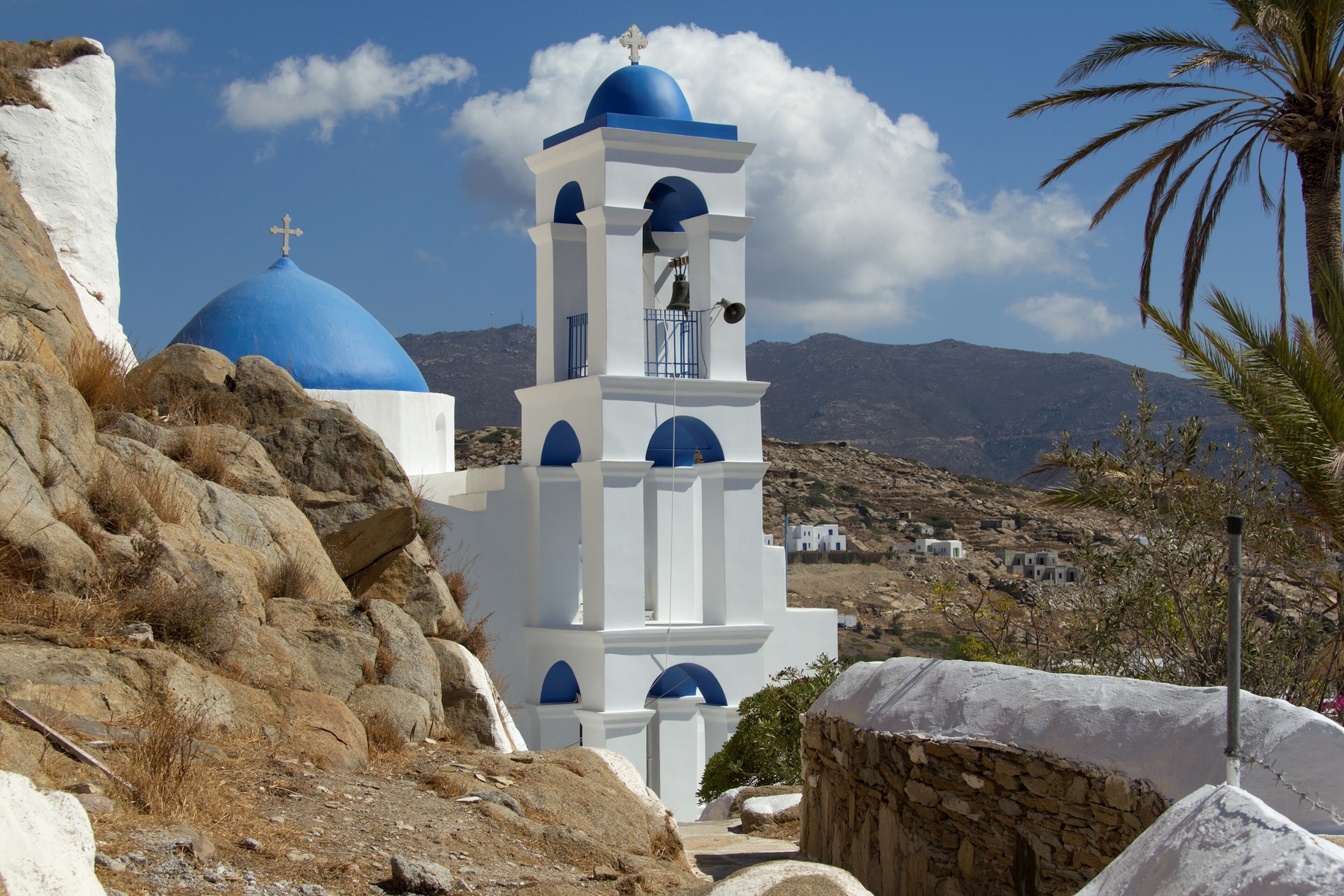
- Panagia Gremiotissa
The 1797 church on the upper Kastro hill forms the most recognizable sacred landmark of Chora.
- Ancient City Wall
The surviving slate fortification preserves an Archaic first phase with later Classical and Hellenistic strengthening.
- Archaeological Museum
The essential companion to Skarkos and Chora, presenting Early Cycladic finds, inscriptions, sculpture and material evidence for ancient civic life.
- Plakotos–Psaropyrgos
A northern archaeological landscape combining Late Classical tower architecture with the later monumentalization of Homeric memory.
- Terraced Landscape
Dry-stone terraces, cultivated valleys, chapels and rural architecture preserve the working landscape that supported island communities for centuries.
Strategic role
An island community organized around one of the safest natural harbors of the Cyclades, with a major Early Cycladic settlement, a long-lived fortified ancient city beneath modern Chora, dispersed rural towers and sanctuaries, and a distinctive literary identity centered on Homer.
Skarkos and Early Cycladic Ios
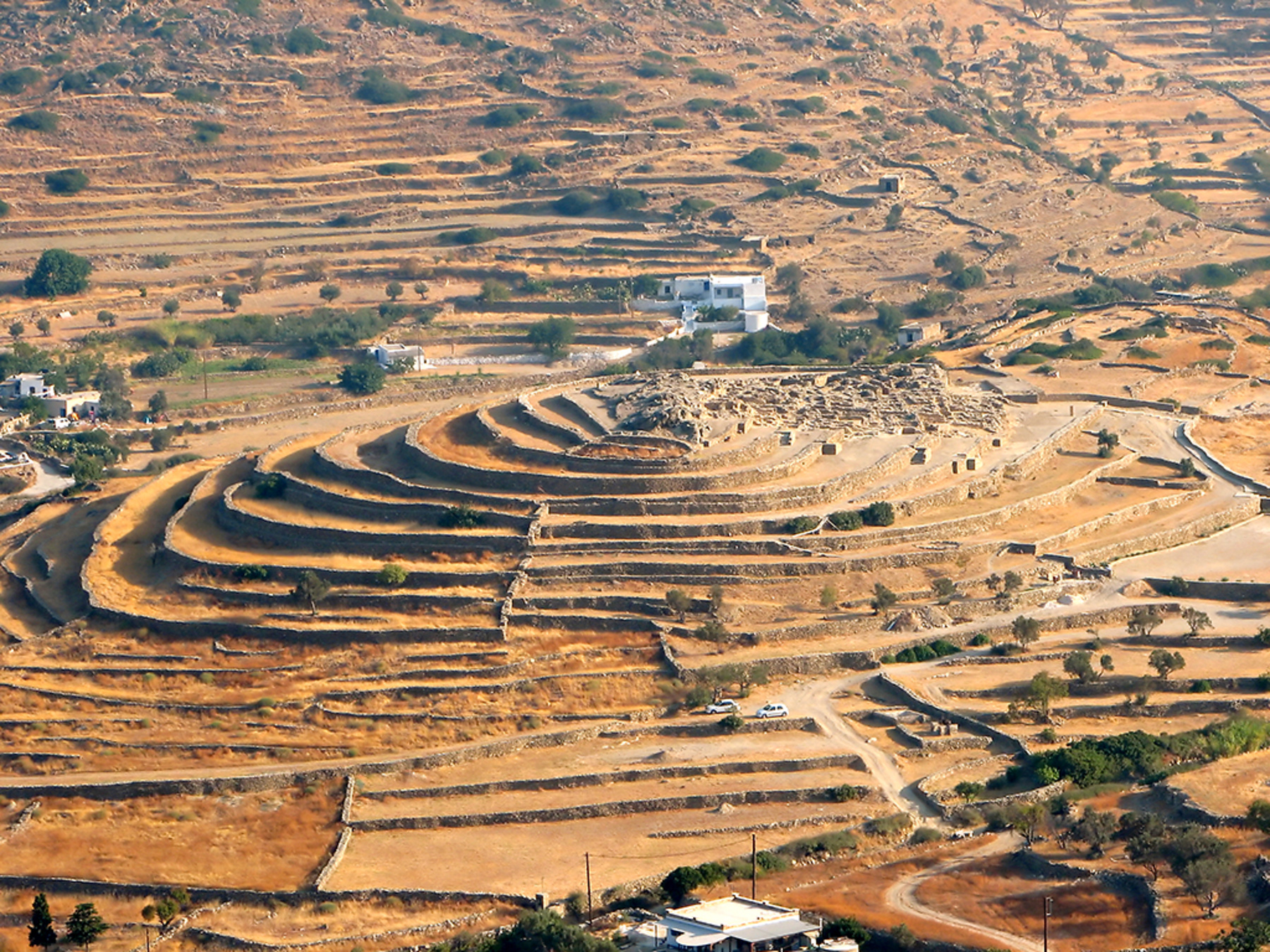
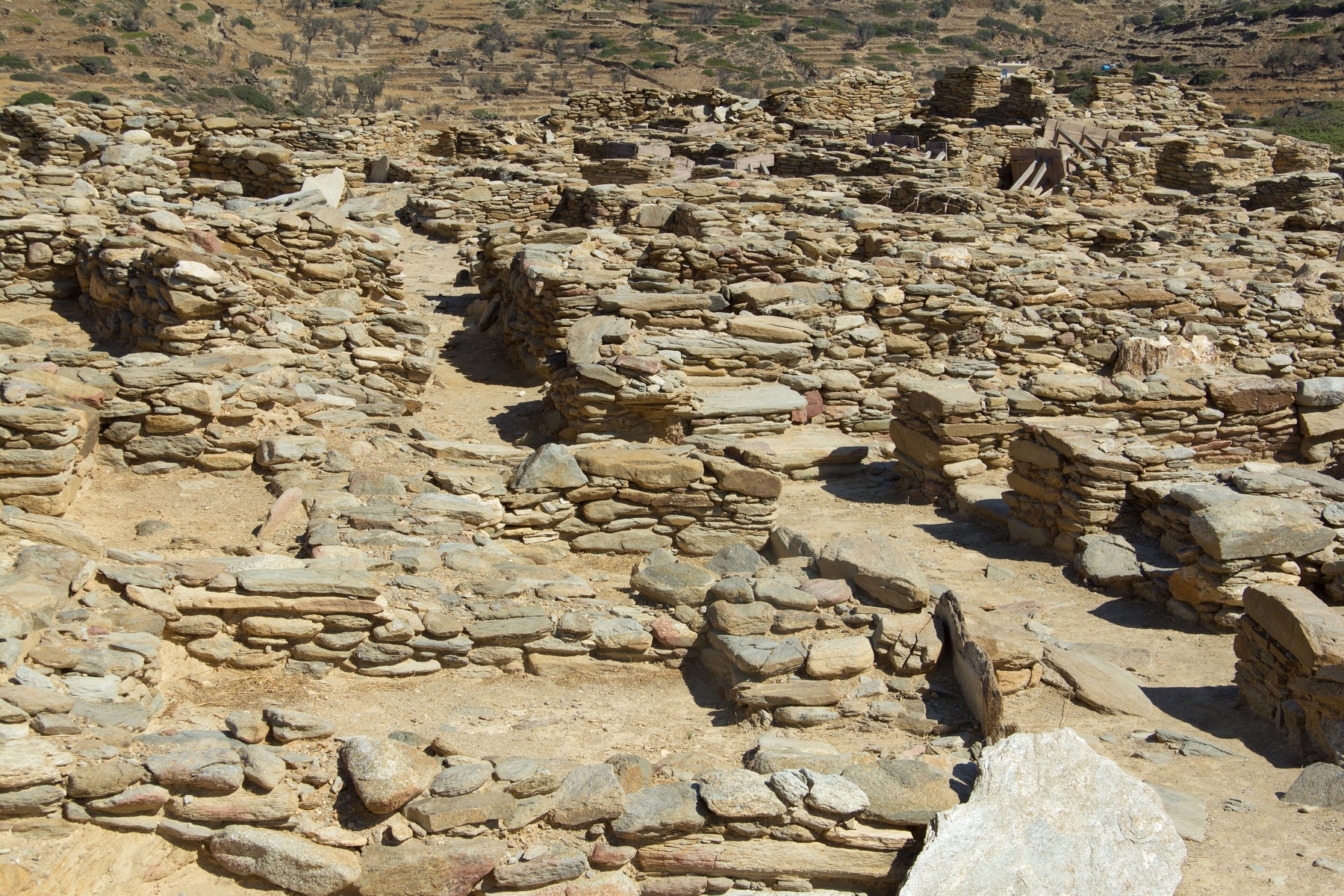
Skarkos is the archaeological cornerstone of Ios. The hill stands above Kato Kampos beside one of the safest natural harbors in the Cyclades, combining access to sea routes with one of the island's largest cultivable areas. Human presence begins at least in the transition from Early Cycladic I to II, but the settlement visible today belongs principally to Early Cycladic II, the Keros–Syros cultural phase of roughly 2700–2400/2300 BC. Its preservation is exceptional. Excavators have uncovered fifty-five buildings, many two storeys high, organized into blocks along two major streets and a network of smaller lanes. Houses preserve stone staircases, upper-floor pavements, built-in cupboards and slate storage chests. A drainage system carried rainwater away from the settlement. The Building of the Idols functioned as a workshop for marble figurines and vessels. Pottery, obsidian, metal objects, seals and sealings, stone tools, animal bones and plant remains show a community with specialized crafts, agriculture, storage systems and active maritime trade. A later cemetery of the Middle-to-Late Bronze Age partially overlies the settlement. The site's conservation program received the European Union/Europa Nostra Grand Prize in 2008.
Ancient Ios
The historical city of Ios occupied the Kastro hill of modern Chora and was positioned to dominate the natural harbor at Gialos. The Ephorate has demonstrated continuous occupation from the Archaic period through Late Antiquity. Its city wall was built of massive elongated slate blocks; pottery from the foundations dates the first phase to the Archaic period, while substantial repairs and reinforcements belong to the Classical and especially Hellenistic eras. The principal gate stood on the west, where a rock-cut stepped road descended toward the harbor. Late Classical public, private and sacred buildings have been identified on Kastro and the opposite hill of Pentanassa. In Roman times the city remained organized around the same hill, with streets, drainage works and other architecture surviving below the modern settlement. The polis participated in the Ionian amphictyony of Delos and later in the first and second Athenian alliances; in the Hellenistic period it joined the Koinon of the Islanders. Known cults included Athena Polias, Zeus Polieus and Apollo Pythios.
The Island Beyond the Polis
Ancient Ios was not confined to Chora. Archaeological research has identified settlement, sanctuaries, towers, farm buildings and water infrastructure across the island. At Psathi and Agia Theodoti, later Christian churches were built over ancient structures interpreted as small temples or sanctuaries. Late Classical rectangular buildings survive at Ellinika in Epano Kampos and at Gefyraki; tower remains are visible at Mersinia and Plakotos-Psaropyrgos. Roman aqueduct remains and a coastal settlement at Magazia show that the island continued to exploit both inland and coastal zones. The Ministry of Culture has formally protected seven major archaeological areas, creating an island-wide archaeological map rather than a single-site narrative.
Chora and Medieval Defense
Modern Chora occupies essentially the same strategic hill as the ancient city, making it one of the island's clearest examples of settlement continuity. The medieval history of its defensive fabric is less securely documented than the ancient walls beneath it, so precise claims about individual Venetian building campaigns should be treated cautiously. The steep terrain, restricted approaches and compact residential pattern were nevertheless well suited to an era of maritime insecurity. Narrow stepped lanes, closely packed houses and the summit sacred zone created a defensible settlement above the harbor rather than an exposed coastal town. Ancient architectural blocks were repeatedly reused in later houses and churches, making Chora a physical palimpsest of Archaic, Classical, Roman, medieval and modern material.
Panagia Gremiotissa and the Sacred Skyline
Panagia Gremiotissa, dated to 1797, occupies the upper Kastro area and is one of the defining landmarks of Chora. Its position above the clustered white houses makes it dominant from much of the settlement and from approaches across the valley. Together with smaller summit chapels, the church turns the old defensive height into a sacred skyline. Ios is notable more broadly for churches and chapels distributed through villages, agricultural valleys and coastal landscapes. Several later churches incorporate ancient architectural material or stand directly over ancient sacred structures, making Christian topography one of the principal ways in which earlier landscapes were reused.
Homer and Island Memory
Ios's association with Homer is ancient, substantial and still impossible to verify biographically. Pausanias records that the inhabitants of Ios showed visitors a tomb of Homer and another of his supposed mother Clymene, and preserves a Delphic oracle predicting that Ios, his mother's homeland, would receive the poet in death. More important archaeologically is evidence that the association became part of civic identity: Classical and Hellenistic coins of Ios depicted Homer's head and named him, while an inscription from Agia Theodoti records a sacrificial day in a local month called Homereon. There may also have been a sanctuary or heroon dedicated to him. The modern monument at Plakotos is therefore not evidence that the historical Homer has been securely located; rather, it occupies a landscape in which the ancient Ietans themselves cultivated and monumentalized a Homeric connection.
Plakotos, Psaropyrgos and the Northern Landscape
The northern archaeological zone around Plakotos and Psaropyrgos is important independently of the Homer tradition. A square building about ten meters on each side, probably a tower, dates to the Late Classical period and remained in use into Roman times. A fragmentary inscribed marble slab found in the area by Pasch van Krienen in 1774 was later associated with the supposed Homeric burial place and entered modern cartographic and antiquarian traditions. The landscape thus combines real Classical architecture, eighteenth- and nineteenth-century antiquarian interpretation, and modern memorialization.
Roman Ios and Late Antiquity
Roman Ios never achieved the political prominence of major Aegean ports, but the archaeological record shows continued urban and rural occupation. The city at Chora retained roads and drains, aqueducts served parts of the island, and a coastal settlement developed at Magazia. Like several smaller Cyclades, Ios also appears in Roman history as a place of exile. From at least the second century AD the Cyclades belonged administratively to the province of Asia, and by the middle of the third century Ios was included in the Provincia Insularum. The island's later ancient remains are important precisely because they demonstrate continuity rather than collapse after the Hellenistic period.
Terraces, Agriculture and the Working Landscape
Ios is predominantly mountainous, but valleys at Epano and Kato Kampos, Manganari, Psathi and Agia Theodoti provided cultivable land. The historic economy depended heavily on cereals, olives, wine and livestock. Dry-stone agricultural terraces made steep slopes productive and are documented on the island from antiquity. These terraces, together with rural buildings, towers, paths and chapels, form an architectural landscape as historically important as Chora itself. They explain how a small island community sustained dense prehistoric settlement, an ancient polis and later village life despite limited level ground.
The Archaeological Museum of Ios
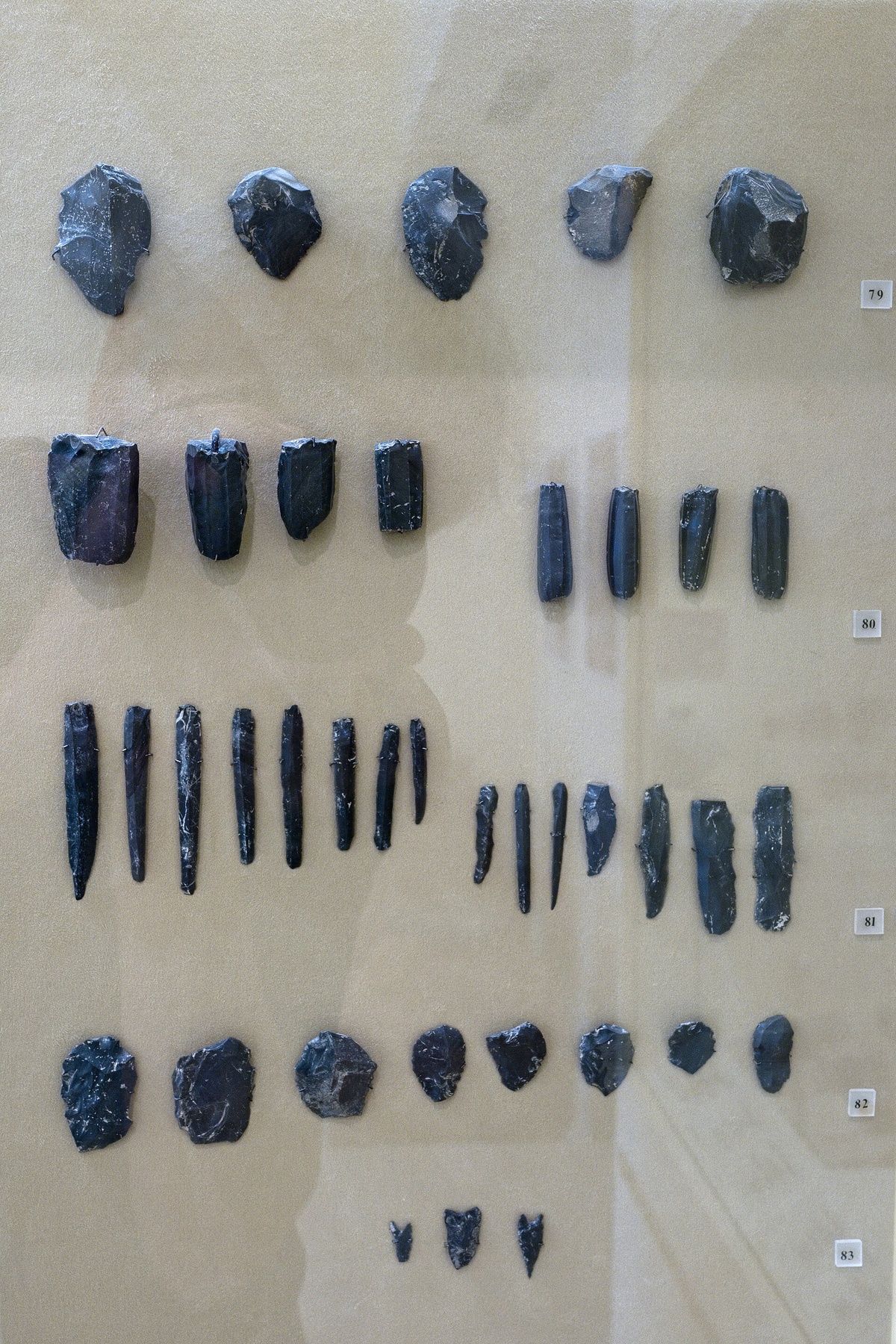
The Archaeological Museum in Chora is essential for understanding the island because so much of its ancient architecture is incorporated into later settlement or dispersed across rural sites. Its collections bring together finds from Skarkos, the ancient city and island-wide surveys and excavations. Early Cycladic pottery, figurines, obsidian tools, sealings and other objects explain the social complexity of Skarkos, while inscriptions, sculpture and architectural pieces document the historic polis. The museum also preserves evidence through which the Homer tradition can be evaluated critically, distinguishing ancient civic commemoration from later claims about a physical tomb.
What to Visit
The essential historical sequence is Skarkos, the Archaeological Museum and Chora. At Skarkos, the street plan and multi-storey houses provide the clearest encounter with Early Cycladic urban life. In Chora, the surviving ancient fortification, Kastro hill, reused ancient blocks, Panagia Gremiotissa and views toward Gialos explain why the same location remained dominant for centuries. A longer circuit can include Plakotos and the traditional Tomb of Homer, Agia Theodoti, Psathi and the rural archaeological zones. Visitors should respect protected areas and treat the Homer monument as cultural memory rather than authenticated biography.
Why Ios Matters
Ios compresses several major Aegean histories into one relatively small island: an exceptionally preserved Early Cycladic town, a fortified ancient polis continuously occupied into Roman times, an island-wide network of rural sites and terraces, a living hill settlement built over ancient fabric, and a Homeric identity that can be documented as ancient civic culture even when the poet's biography cannot. The combination makes Ios far more historically substantial than its modern tourism image suggests.
Architecture
- Early Cycladic settlement at Skarkos organized around two principal streets and a dense network of smaller lanes
- At least fifty-five excavated buildings at Skarkos, many originally two storeys high with stone staircases and paved upper floors
- Rainwater drainage network integrated into the Early Cycladic settlement
- Specialized workshop building at Skarkos used for producing marble figurines and vessels
- Ancient city wall at Chora built from large elongated slate blocks, with an Archaic first phase and Classical-Hellenistic strengthening
- Rock-cut stepped approach linking the ancient harbor zone with the principal western gate of the city
- Late Classical public, private and sacred buildings on Kastro and Pentanassa hills
- Late Roman road and drainage infrastructure surviving beneath the modern settlement
- Late Classical rural towers at Mersinia and Plakotos-Psaropyrgos
- Ancient structures reused as foundations for later churches at Psathi and Agia Theodoti
- Compact whitewashed fabric of Chora adapted to steep terrain and long-term defensive occupation
- Panagia Gremiotissa and summit chapels forming the dominant sacred skyline above Chora
- Dry-stone agricultural terraces shaping cultivable slopes from antiquity into modern times
Timeline
- c. 2800–2700 BC Earliest identified activity at Skarkos belongs to the transition from Early Cycladic I to Early Cycladic II.
- c. 2700–2400/2300 BC Skarkos flourished as a large Early Cycladic II settlement with dense housing, streets, drainage, specialized crafts and maritime exchange.
- c. 2300–2000 BC Activity continued on Ios through later Early Cycladic phases at Skarkos, Manganari and other sites.
- mid-2nd millennium BC A Middle-to-Late Bronze Age cemetery developed on part of the earlier Skarkos settlement.
- Archaic period The first major phase of the fortification wall of the ancient city at Chora was constructed.
- 5th–4th centuries BC Ios participated in the Ionian amphictyony and Athenian alliances; the city walls and public architecture were strengthened.
- Hellenistic period Ios joined the Koinon of the Islanders; its fortifications received major repairs and the polis maintained established civic cults.
- Classical–Hellenistic periods Local coinage and calendrical evidence demonstrate the civic cultivation of Homer as a cultural figure associated with Ios.
- c. 220–mid-2nd century BC Ios maintained particularly close political ties with Rhodes after an earlier period of Macedonian influence.
- 1st century BC Ios and the Cyclades were drawn into the wars of Mithridates and the Roman civil conflicts.
- Roman imperial period The city remained occupied; roads, drains, aqueducts and coastal settlements attest continuing life across the island.
- mid-3rd century AD Ios was included with the Cyclades in the Roman Provincia Insularum.
- 12th century The vernacular form Nios is attested in the geographical work of al-Idrisi.
- 15th century Cristoforo Buondelmonti depicted Ios in his Liber Insularum Archipelagi.
- 1774 Pasch van Krienen recorded an inscribed marble fragment at Plakotos later connected with the local Homer tradition.
- 1797 Panagia Gremiotissa was built in the upper Kastro area of Chora.
- 1980s–present Systematic archaeological research and rescue excavation by the Ephorate of Antiquities of the Cyclades greatly expanded knowledge of ancient Ios.
- 2008 The conservation and presentation of Skarkos received the European Union / Europa Nostra Grand Prize for cultural heritage conservation.
Visiting today
A historically focused visit should begin at Skarkos and the Archaeological Museum of Ios in Chora, which together provide the clearest introduction to the island's prehistoric and ancient sequence. In Chora, look for surviving stretches of ancient wall, reused architectural blocks, the Kastro hill, the route toward Panagia Gremiotissa and the relationship between the hill town and Gialos harbor. The Plakotos area in the north preserves the traditional site associated with Homer's tomb and nearby ancient tower remains; it should be approached as an archaeological and cultural-memory landscape rather than as a verified grave. Agia Theodoti, Psathi and other protected areas preserve ancient structures incorporated into later sacred sites. Opening hours at Skarkos and the Archaeological Museum change seasonally and should be checked with the Ephorate of Antiquities of the Cyclades before visiting.
Expedition guides
Images
References
- Ephorate of Antiquities of the Cyclades — Ios: Island History
- Ephorate of Antiquities of the Cyclades — The Hill of Skarkos on Ios
- Ephorate of Antiquities of the Cyclades — The Archaeological Sites and Monuments of Ios
- Ephorate of Antiquities of the Cyclades — Archaeological Museum of Ios
- Ephorate of Antiquities of the Cyclades — Opening Hours and Admission
- Ephorate of Antiquities of the Cyclades — Cycladic Nexus: Skarkos
Related Stops
Topics
- Cyclades
- Historic Island
- Early Cycladic
- Skarkos
- Ancient Greek
- Fortified City
- Archaeology
- Homer
- Literary Heritage
- Roman
- Chora
- Religious Heritage
- Vernacular Architecture
- Terraces
- Maritime History