Overview
The Aliki peninsula concentrates several aspects of Thasian history that are only summarized on the island-level Thasos page. Here, the visitor can read the physical process by which marble was extracted, shaped, moved and shipped; see how quarry workers, merchants and sailors used a sanctuary beside the loading places; and trace the later Christianization of the same landscape through the double basilica. The French School at Athens identifies Aliki as one of the major extra-urban sites of Thasos and records quarrying from the Archaic through the proto-Byzantine period. Scientific analysis has confirmed Aliki marble at major eastern Mediterranean and Italian sites, while inscriptions from the sanctuary preserve prayers for safe navigation and evidence for ships involved in the marble trade. Aliki therefore complements the general Thasos page by focusing closely on the intersection of geology, labor, religion, transport and long-distance commerce.
Highlights
- Ancient Marble Quarries
Extensive quarry faces preserve more than a millennium of stone extraction in a form that remains easy to read on the ground.
- Direct Sea Loading
Quarrying reached the shoreline, allowing blocks to move from working faces toward ships with minimal overland transport.
- Coastal Sanctuary
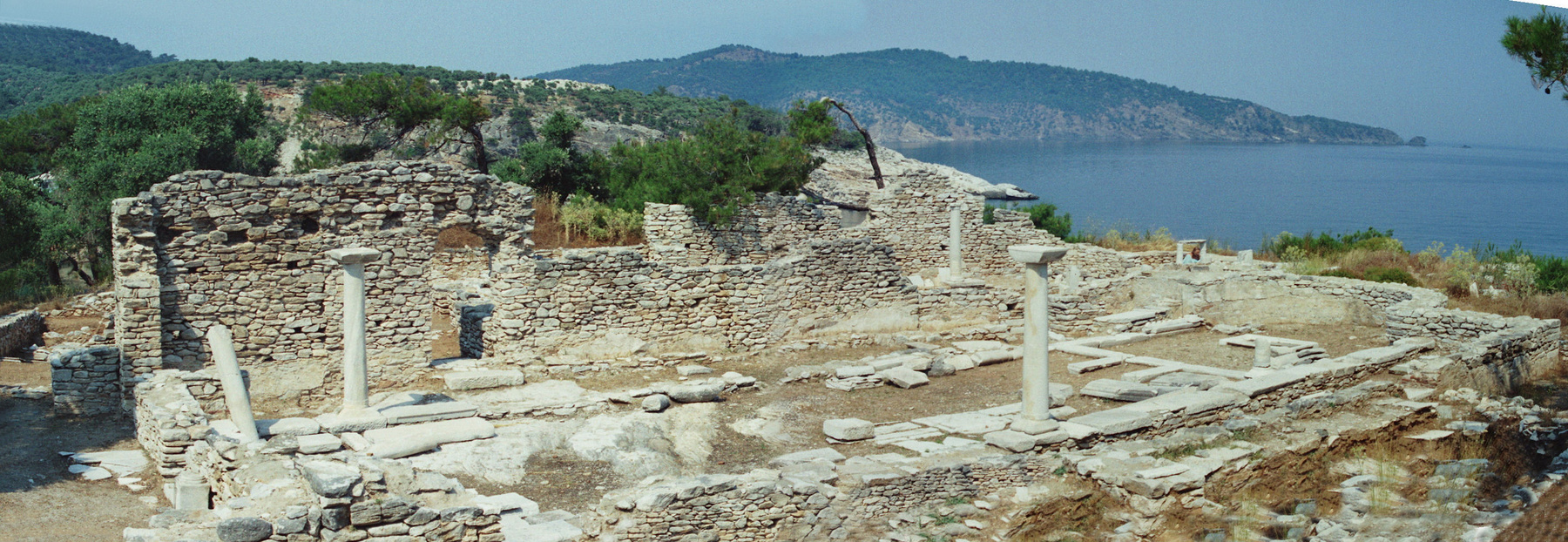
Twin sanctuary buildings served a community whose religious life was closely tied to quarrying and maritime traffic.
- Prayers for Safe Sailing
Inscriptions invoke protection for ships and sailors, linking religion directly to the risks of the marble trade.
- Cult Caves
Rock-cut sacred spaces extend the religious landscape beyond the formal sanctuary buildings.
- Double Early Christian Basilica
Two adjoining basilicas reveal the Christian transformation of Aliki during Late Antiquity.
- Marble across the Mediterranean
Scientific analysis has identified Aliki marble at major sites in Asia Minor and Italy.
- Industrial Archaeology in Antiquity
Tool marks, extraction trenches, working floors and abandoned blocks preserve the practical organization of ancient production.
- More than a Quarry
Settlement, worship, transport and labor were integrated into one functioning coastal community.
- Research Landmark
French School excavations and publications made Aliki a reference site for ancient quarry technology and Early Christian archaeology.
Strategic role
A major quarrying and maritime-export center of ancient Thasos where industrial production, religious practice and coastal logistics were integrated on one peninsula.
Overview: A Quarry Landscape by the Sea
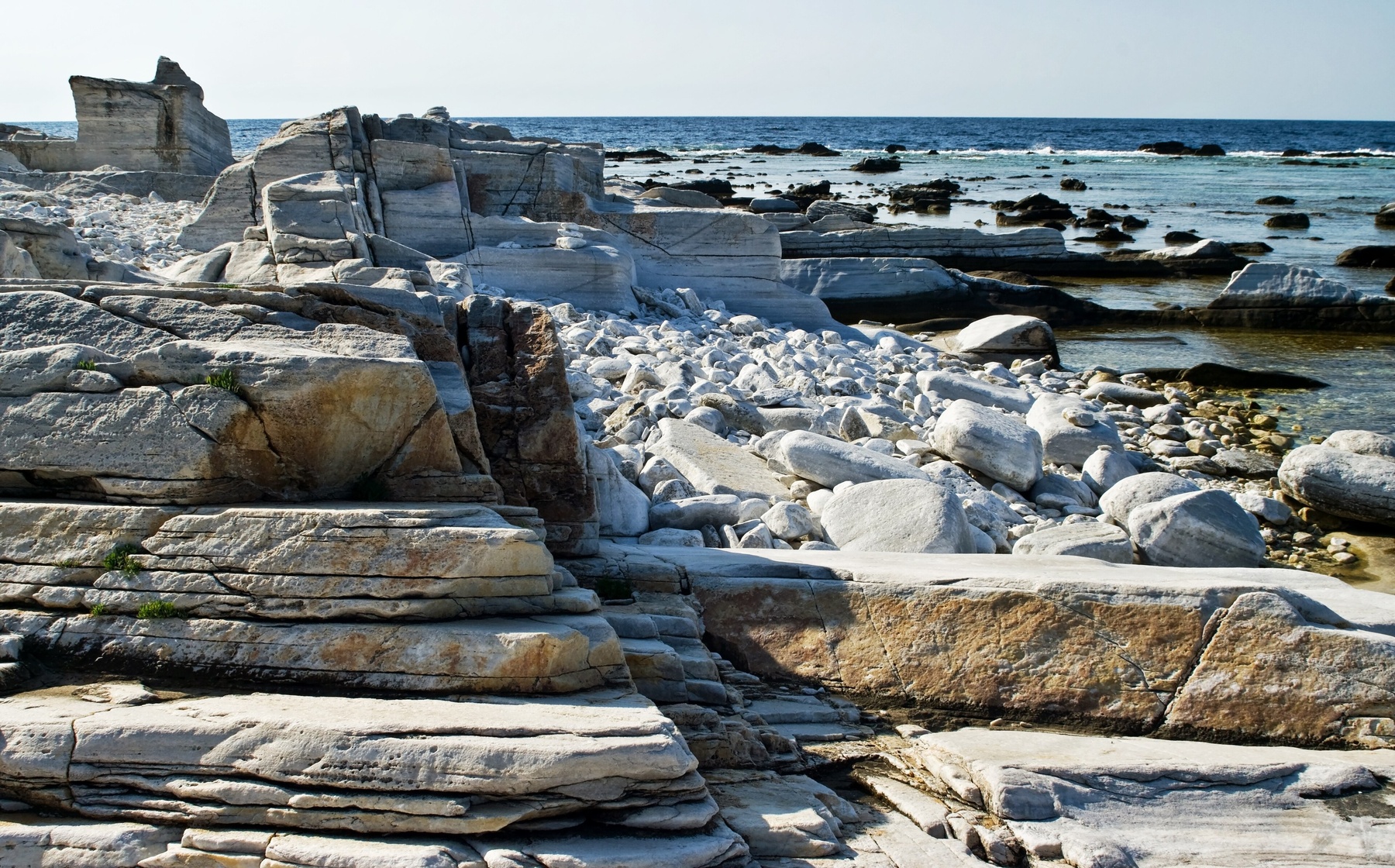
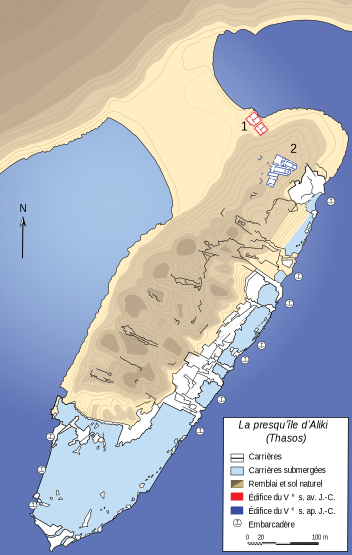
Aliki occupies a narrow peninsula on the southeastern coast of Thasos where geology, religion and maritime transport came together with unusual clarity. Marble extraction cut deeply into the coastal rock, while the two coves beside the peninsula offered sheltered access for boats. Instead of transporting stone long distances overland, workers could move blocks from the quarry directly toward loading points at the water's edge. This simple geographic advantage helped turn Aliki into one of the most important marble-producing sites on Thasos. The landscape is still readable today because extraction scars, abandoned working surfaces, sanctuary buildings and later basilicas remain physically close to one another.
Thasian Marble and the Importance of Aliki
Thasos was famous in antiquity for its marble, and Aliki became one of the island's principal quarry zones. The French School at Athens records exploitation at Aliki from the Archaic period through the proto-Byzantine era. The marble is a coarse-grained calcitic stone ranging from white to light gray, sometimes with bluish veins. Its appearance and durability made it suitable for architectural elements, paving, revetment and columns. The importance of the quarries is not simply a matter of scale: they offer rare archaeological evidence for the full operational sequence of ancient stone production, from extraction faces to maritime shipment.
How the Ancient Quarry Worked
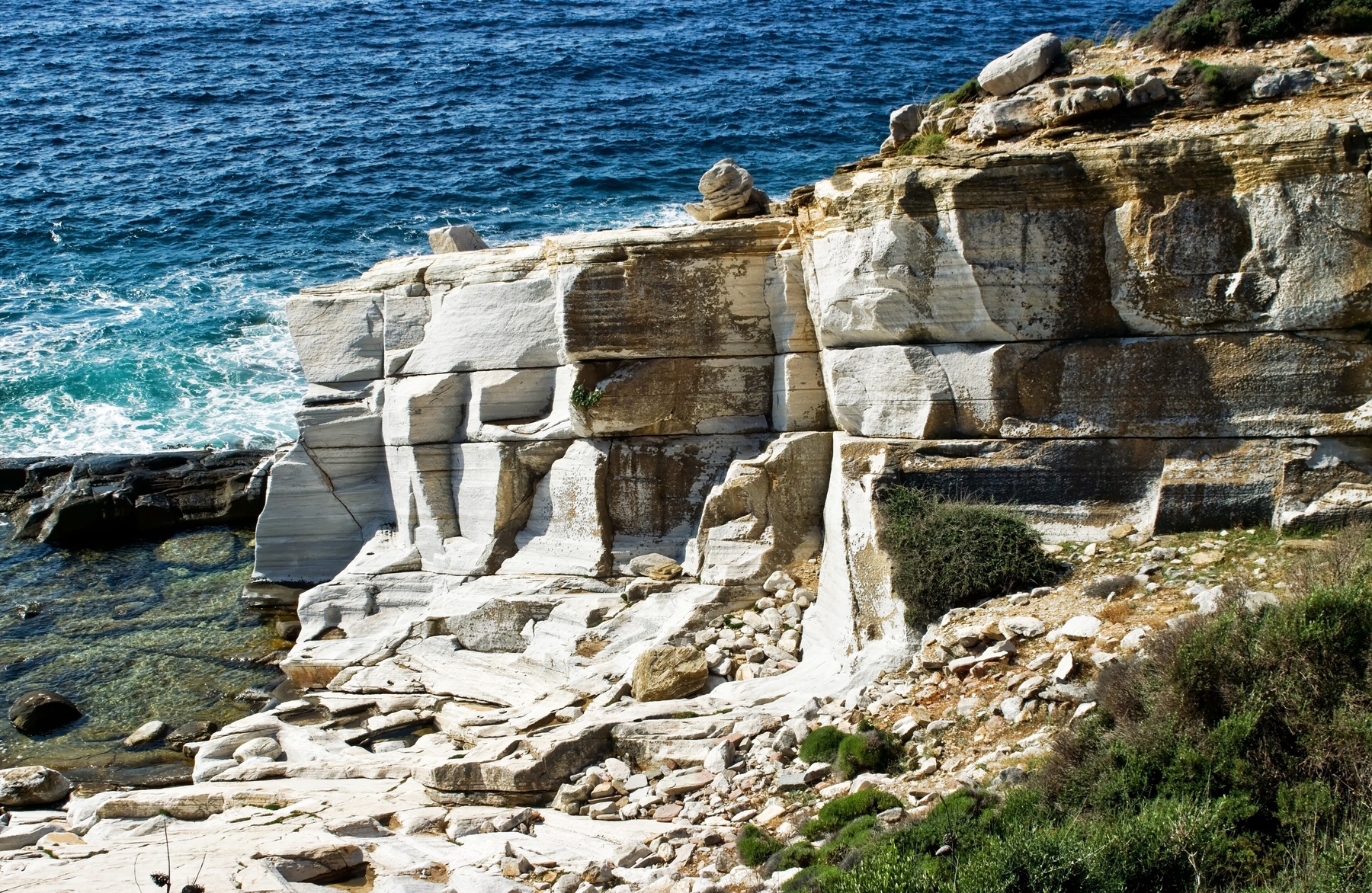
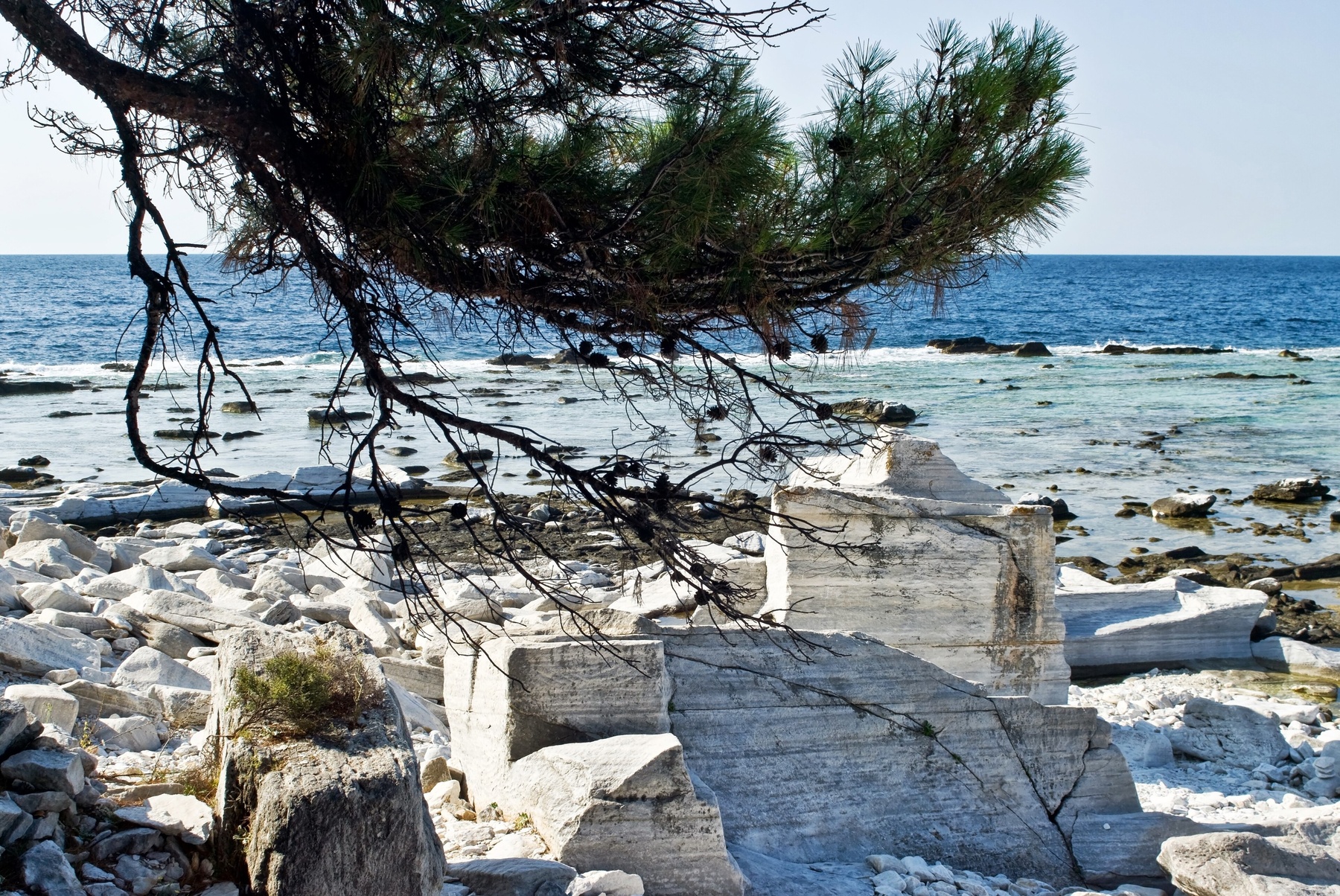
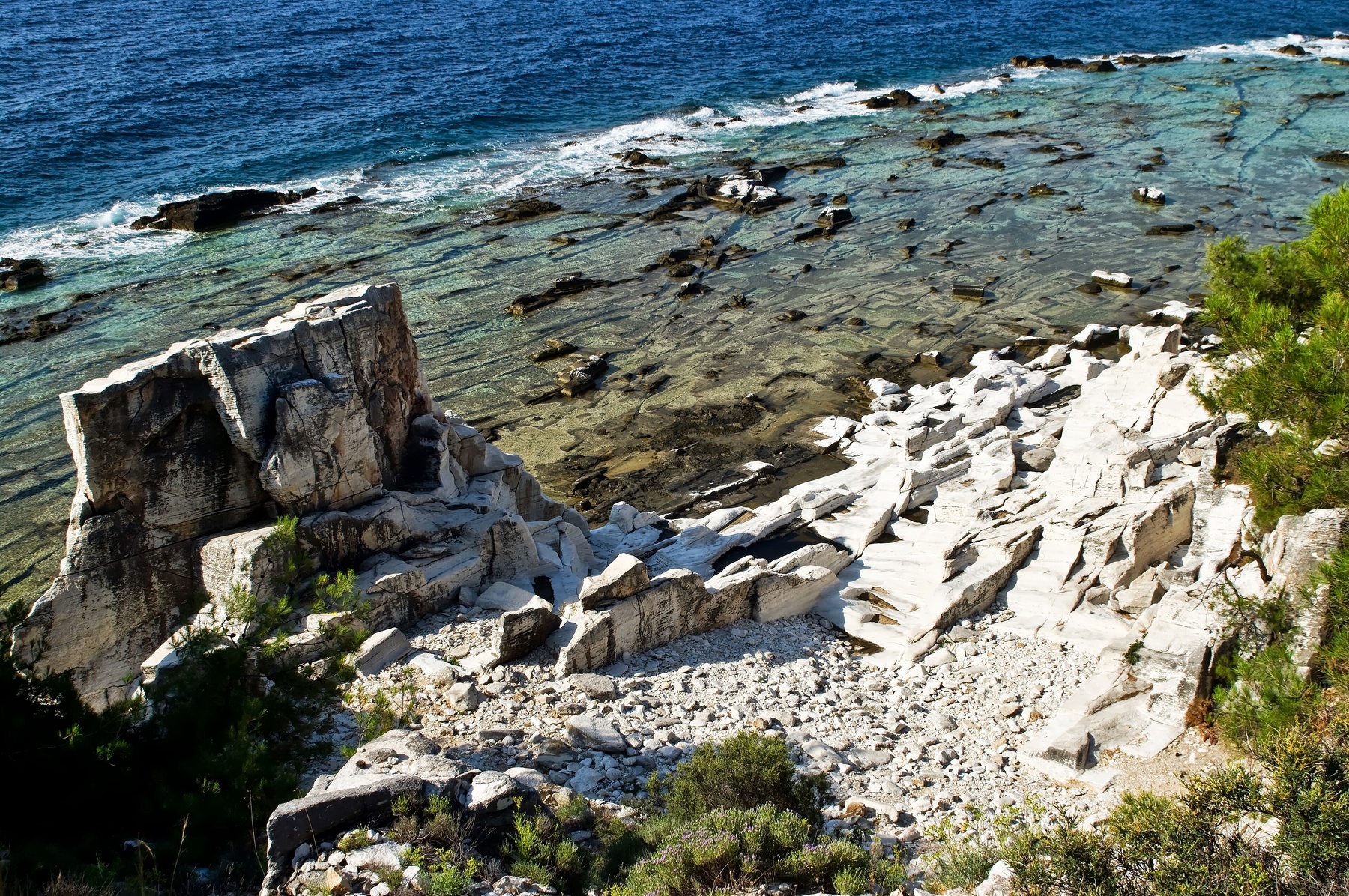
The peninsula preserves the negative architecture of quarrying: broad cut faces, channels around blocks, stepped working platforms and areas where stone was detached from the bedrock. The surviving scars show how quarrymen isolated blocks before levering or splitting them free. Subsequent trimming reduced weight before transport. At Aliki, logistics were simplified by the sea. The quarry descended toward the shore, allowing heavy stone to move downhill toward loading places rather than across difficult inland terrain. Reconstruction work by specialists of the French School has emphasized the organization required at the end of Antiquity, when quarrying, finishing, transport and shipping operated as parts of a coordinated production system.
Loading Stone onto the Mediterranean
Aliki's importance depended on access to ships. The quarrying zone lies immediately beside navigable water, and the peninsula's coves created natural anchorages. This setting allowed heavy marble blocks to be transferred from extraction areas to vessels with relatively little inland haulage. Scientific analysis by John Herrmann and Vincent Barbin has confirmed marble from Aliki at Pergamon, Sardis, Ephesos and Ostia, demonstrating that the stone moved well beyond Thasos. Their study also suggests that in Hellenistic times unworked blocks were exported, while later trade involved a broader range of architectural products. Aliki therefore belongs to the history of Mediterranean shipping as much as to the history of quarrying.
The Coastal Sanctuary
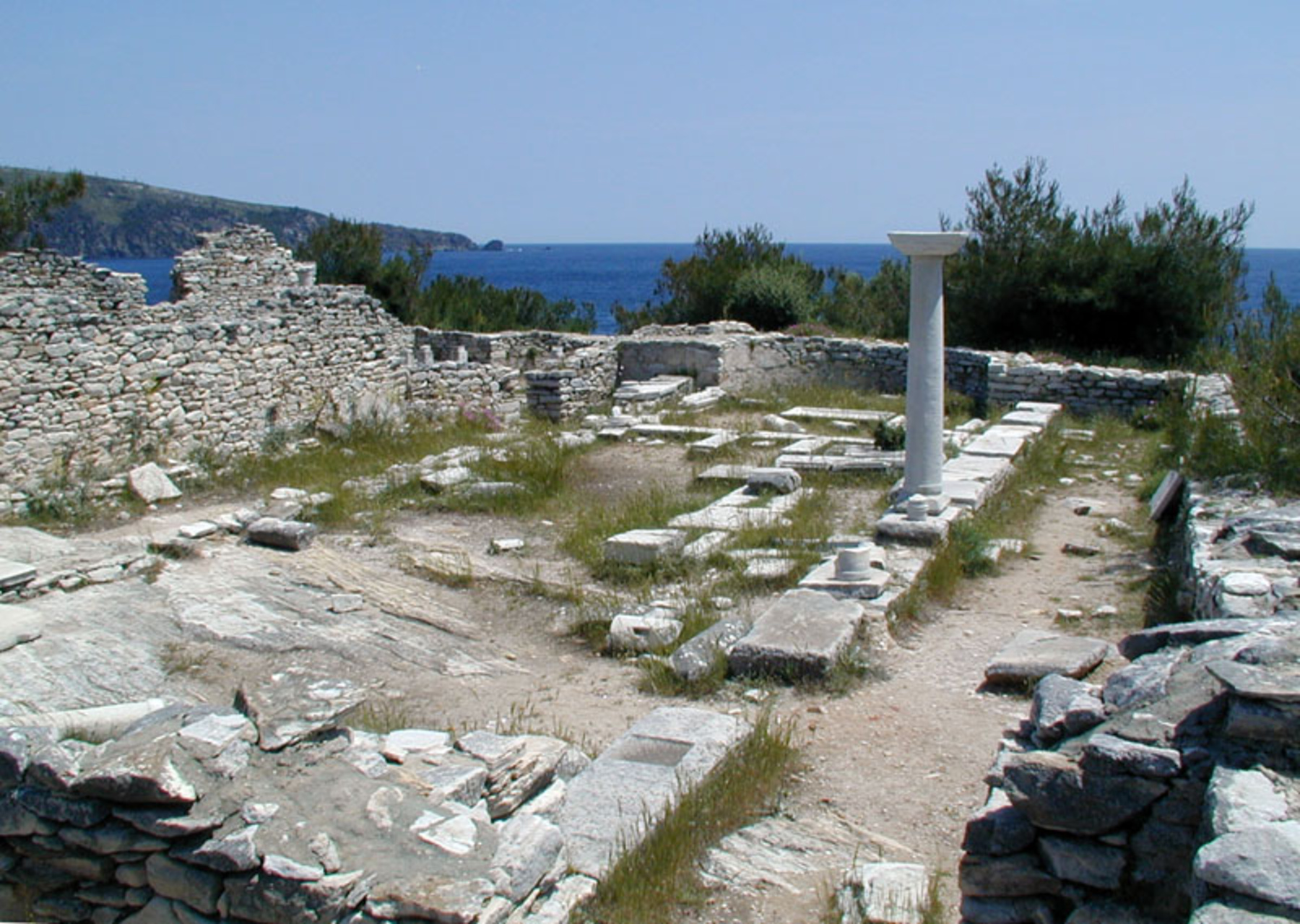
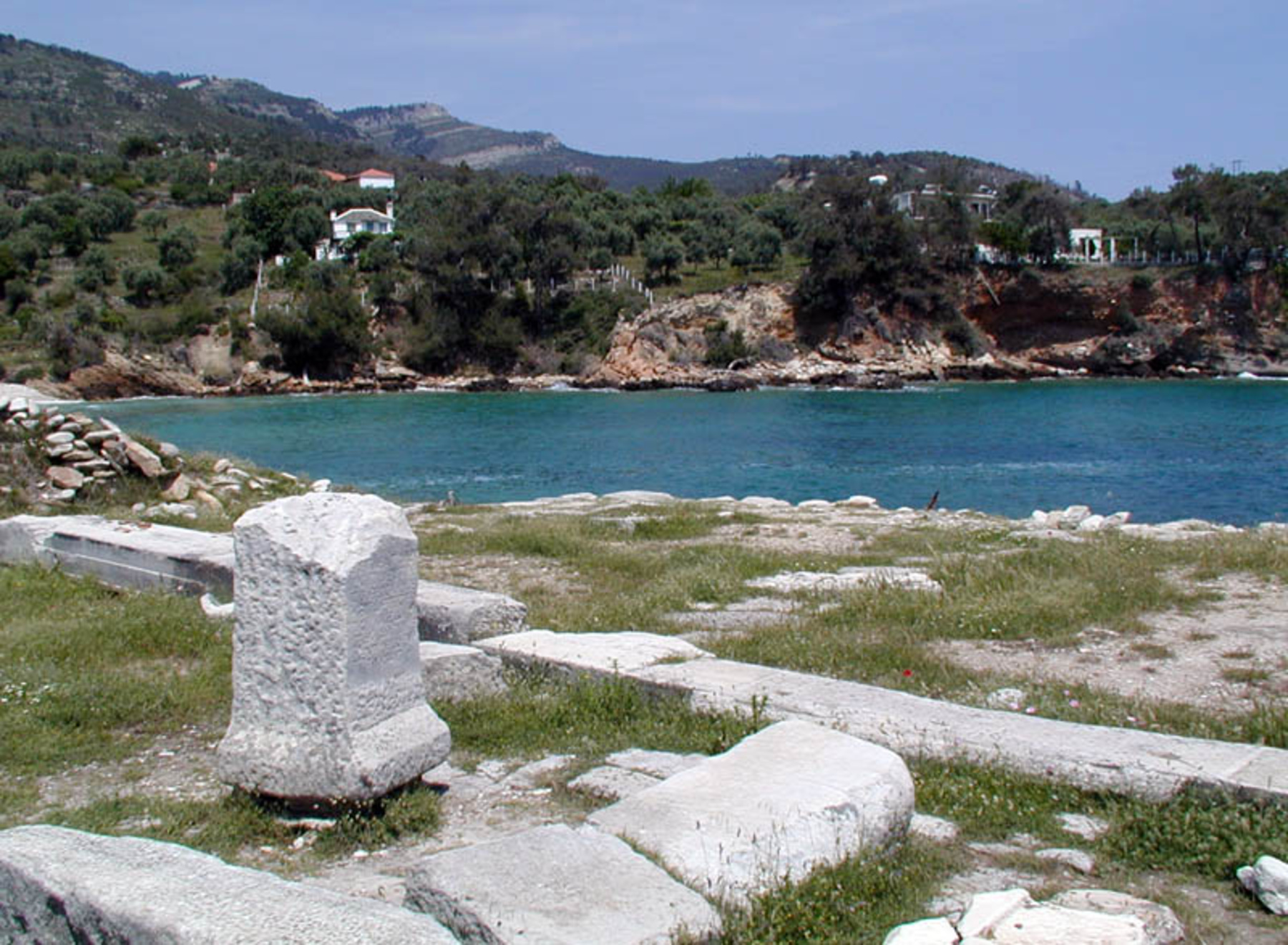
Quarrying and religion were closely linked at Aliki. Beside the northern cove stood a small sanctuary composed of two adjacent buildings with columned porches and rooms used for ritual activity and communal dining rather than conventional temple architecture. Archaeological study dates important phases around the late sixth and early fifth centuries BCE. The sanctuary appears to have served people connected with the quarry and maritime traffic. Its location beside the loading areas made it especially relevant to sailors, merchants and quarry workers who depended on successful sea voyages.
Apollo, the Dioscuri and Safe Navigation
The precise identity of every cult at Aliki is not completely settled, and the site should not be reduced to one deity. Research identifies Apollo and Artemis among the divinities associated with the quarry landscape, while inscriptions also reveal appeals to the Dioscuri and other protective gods. Votive texts include wishes for euploia—safe sailing—left by people connected with ships loading marble. Ship names and ports mentioned in inscriptions illuminate the practical geography of the trade. Nearby cult caves further demonstrate that sacred activity extended beyond the built sanctuary into the rock itself. Religion at Aliki was therefore embedded in work, danger and mobility.
Quarry Workers, Sailors and a Small Coastal Community
Although the settlement associated with Aliki has not been excavated as completely as the sanctuary and quarries, the site's long operation required a resident or seasonal community of quarry workers, craftsmen, transport specialists, sailors and traders. A large Roman sarcophagus and scattered remains attest to occupation beyond the visible sanctuary. The peninsula should therefore be understood as a working landscape rather than as an isolated industrial scar. Production, worship, food, storage, maintenance and shipping all had to function together for centuries.
From Greek Polis to Roman Imperial Economy
Aliki's quarry history spans major political changes. Extraction began while Thasos was an independent Greek polis and continued through Hellenistic and Roman rule. Under the Roman Empire, demand for decorative and architectural stone increased dramatically across the Mediterranean, and Thasian marble entered broad commercial networks. The quarries consequently preserve both continuity and adaptation: methods of extraction changed more slowly than political systems, while the scale and destination of exported stone shifted with markets, patrons and imperial building programs.
The Double Early Christian Basilica
In Late Antiquity the religious focus of Aliki changed from pagan cult to Christianity. Excavations by Jean-Pierre Sodini and collaborators revealed a remarkable double basilica complex built near the summit of the peninsula. Two adjacent basilicas formed a substantial Christian establishment associated with the settlement and quarry community. Study of the architecture and ceramics places the complex within the Early Christian flourishing of Thasos, with phases continuing into the sixth century. Its presence shows that Aliki remained an active and socially organized community long after the Classical sanctuary had lost its original function.
Christianity in a Quarry Landscape
The basilicas did not erase the older industrial landscape; they occupied it. Christian symbols and inscriptions also appear on quarry surfaces, showing that work and worship continued to overlap. Marble from earlier phases was reused in Late Antique construction, just as the quarry itself continued to supply stone. Aliki thus provides a particularly vivid example of religious transformation without complete economic rupture. Pagan sanctuary, Christian basilicas and active quarrying belong to successive layers of the same productive peninsula.
Decline and Abandonment
By the end of the Early Byzantine period the quarry, basilicas and associated settlement ceased to function as they had for more than a millennium. The exact causes cannot be reduced to a single event. Broader changes in Mediterranean trade, political instability, declining demand, warfare and regional disruption all contributed to the contraction of coastal economic centers in the seventh century. Some older accounts attribute abandonment primarily to raids, but the archaeological evidence supports a more cautious interpretation involving multiple pressures. As quarrying stopped, abandoned extraction areas near sea level gradually flooded or eroded, creating the unusual submerged and shoreline remains visible today.
Archaeological Discovery and the French School
Aliki has played an important role in the history of archaeological research on Thasos. Nineteenth-century travelers first recorded the sanctuary and quarries, and the French School at Athens later undertook systematic excavation and architectural study. Work on the sanctuary was completed in the twentieth century, while Jean-Pierre Sodini, Tony Koželj and collaborators carried out detailed investigation of the basilicas and marble quarries. Their publications established Aliki as a reference site for ancient quarry technology, Early Christian architecture and the organization of the Thasian marble trade. Continuing field study still uses the peninsula to reconstruct how ancient quarrying functioned in practice.
Why Aliki Matters beyond Thasos
The significance of Aliki extends far beyond the island because marble exported from here became part of architecture elsewhere in the Mediterranean. Scientific sourcing links Aliki marble to cities in Asia Minor and Italy, while quarry archaeology explains the production system behind that movement. This makes Aliki especially valuable for understanding ancient globalization in material terms: stone extracted from one small Aegean peninsula entered buildings and urban landscapes hundreds of kilometers away. The site therefore connects local labor history with the history of Mediterranean architecture.
Why Visit
Aliki is one of the rare archaeological sites where visitors can understand an ancient industry directly from the terrain. The sanctuary explains how sailors and quarry workers negotiated risk through religion; the quarry faces show how stone was cut; the shoreline explains how it was shipped; and the basilicas reveal how the same community changed in Late Antiquity. Unlike the monumental urban archaeology of Limenas, Aliki is intimate and process-oriented. It complements the general Thasos page by showing not simply that the island exported marble, but how an entire coastal landscape was organized around extracting, sanctifying and moving that stone.
Architecture
- Extensive open-air marble quarry faces cut directly into the peninsula
- Extraction trenches, stepped quarry floors and negative scars left by removed blocks
- Working areas descending to the shoreline for direct maritime loading
- Twin sanctuary buildings with columned porches and ritual rooms
- Cult caves associated with Apollo and other deities
- Rock-cut and inscribed surfaces connected with quarrying and sailors
- Double Early Christian basilica complex overlooking the coastal working landscape
- Reused ancient marble elements within Late Antique religious buildings
- Harbor coves on either side of the peninsula that supported loading and local settlement
Timeline
- Early Archaic period Quarrying and settlement activity began at Aliki as Thasos developed into a major Greek polis and resource-exporting island.
- 6th century BCE Cult activity was established in caves and at the coastal sanctuary; Apollo and other deities were associated with the sacred landscape.
- c. 500 BCE Major sanctuary buildings were constructed or rebuilt beside the northern cove.
- Early 5th century BCE The sanctuary was remodeled while quarrying and maritime traffic continued to expand.
- Classical period Marble extraction continued and ships serving the quarries participated in wider Aegean trade networks.
- Hellenistic period Aliki marble was exported as large unworked blocks and other products to important centers in the eastern Mediterranean.
- Roman Imperial period Quarry activity continued within the much larger Roman market for architectural and decorative stone.
- 4th–5th centuries CE Christian presence became increasingly visible in the quarry landscape as the older sanctuary ceased to function in its original form.
- 5th century CE The Early Christian basilica complex developed on the peninsula.
- 6th century CE The double basilica and quarry community remained active during the flourishing Early Byzantine phase of Thasos.
- Late 6th–7th centuries CE Quarrying, the basilica complex and the associated settlement declined and were eventually abandoned amid broader economic and political disruption.
- 1856–1858 Nineteenth-century scholars and travelers recorded the sanctuary and quarry remains, bringing Aliki into modern archaeological literature.
- 1886–1887 Theodore Bent conducted early excavations and collected inscriptions from the sanctuary area.
- 1924 French School at Athens archaeologists resumed excavation of the sanctuary.
- 1961–1964 Jean Servais and colleagues completed major phases of the sanctuary excavation.
- 1969–1977 Jean-Pierre Sodini directed excavation and study of the double Early Christian basilica.
- 1970s–1980s Tony Koželj, Jean-Pierre Sodini and collaborators systematically documented the ancient quarry landscape.
- 1980 Major French School publications on the Aliki quarries and sanctuaries established the site's importance for ancient marble studies.
- 1984 The double basilica was published in detail as part of the Études thasiennes series.
- 1993 Scientific sourcing studies confirmed Aliki marble at sites including Pergamon, Sardis, Ephesos and Ostia.
- 21st century Aliki continues to serve as a reference site for research into ancient quarrying, marble circulation, sacred landscapes and Early Christian architecture.
Visiting today
Aliki is an open archaeological landscape best understood by walking around the peninsula rather than viewing a single monument. The route links the ancient sanctuary, quarry faces, shoreline loading areas and Early Christian basilicas. Much of the quarry terrain is uneven, exposed and immediately beside the sea, with smooth marble surfaces that can become slippery. The archaeological site has at times been subject to changing access arrangements, so current Ephorate of Antiquities information should be checked. The neighboring beaches and coves are part of the historical setting but should not be confused with the protected archaeological remains.
Expedition guides
Images
References
- École française d’Athènes — Thasos: History of the Excavations
- École française d’Athènes — Thasos and Samothrace Research Program: Aliki
- Jean Servais — Aliki I: Les deux sanctuaires, Études thasiennes
- Jean-Pierre Sodini and K. Kolokotsas — Aliki II: La basilique double
- Jean-Pierre Sodini, Anna Lambraki and Tony Koželj — Les carrières de marbre d'Aliki à l’époque paléochrétienne
- John J. Herrmann Jr. and Vincent Barbin — The Exportation of Marble from the Aliki Quarries on Thasos
- Julien Fournier — Inscriptions and magistrates connected with Aliki and Thasos
- Frontière·s — Sacred spaces and cult places in ancient Greek quarries: Aliki
- Hellenic Ministry of Culture — Archaeological Site of Aliki, Thassos
- Go Thassos — Alyki
Related places
Related Stops
Topics
- Aliki
- Thasos
- Ancient Quarry
- Thasian Marble
- Marble Trade
- Industrial Archaeology
- Ancient Sanctuary
- Apollo
- Dioscuri
- Maritime Religion
- Ancient Harbor
- Roman Trade
- Early Christian
- Double Basilica
- Late Antiquity
- Archaeological Landscape
- North Aegean