Overview
Tiny, rocky Delos became sacred through the myth that Leto gave birth there to Apollo and Artemis. Settlement reaches the third millennium BC and cult in the sanctuary area into the Mycenaean period. By the Archaic age Delos was a major Ionian and Pan-Hellenic sanctuary, monumentalized by Naxians, Athenians, island communities and rulers. In the fifth century BC it became headquarters and original treasury of the Athenian-led Delian League. Between 314 and 167 BC it enjoyed independence and served as capital of the Koinon of the Islanders. Roman policy then placed it under Athenian administration and made the harbor tax-free, helping create one of the greatest commercial centers of the Hellenistic Mediterranean. Merchants, bankers, shipowners, craftsmen and religious associations from Italy, Egypt, Syria, Phoenicia and elsewhere built agoras, warehouses, sanctuaries and luxurious mosaic-floored houses. Attacks in 88 and 69 BC shattered this prosperity. A reduced Christian community survived into Late Antiquity before abandonment. Systematic excavation, principally by the French School at Athens from 1873 with the Greek Archaeological Service, has made Delos one of the best-documented ancient cities and sacred landscapes in the Mediterranean.
Highlights
- Sanctuary of Apollo
The monumental heart of sacred Delos, accumulated through temples, altars, stoas, treasuries and competitive dedications from across the Greek world.
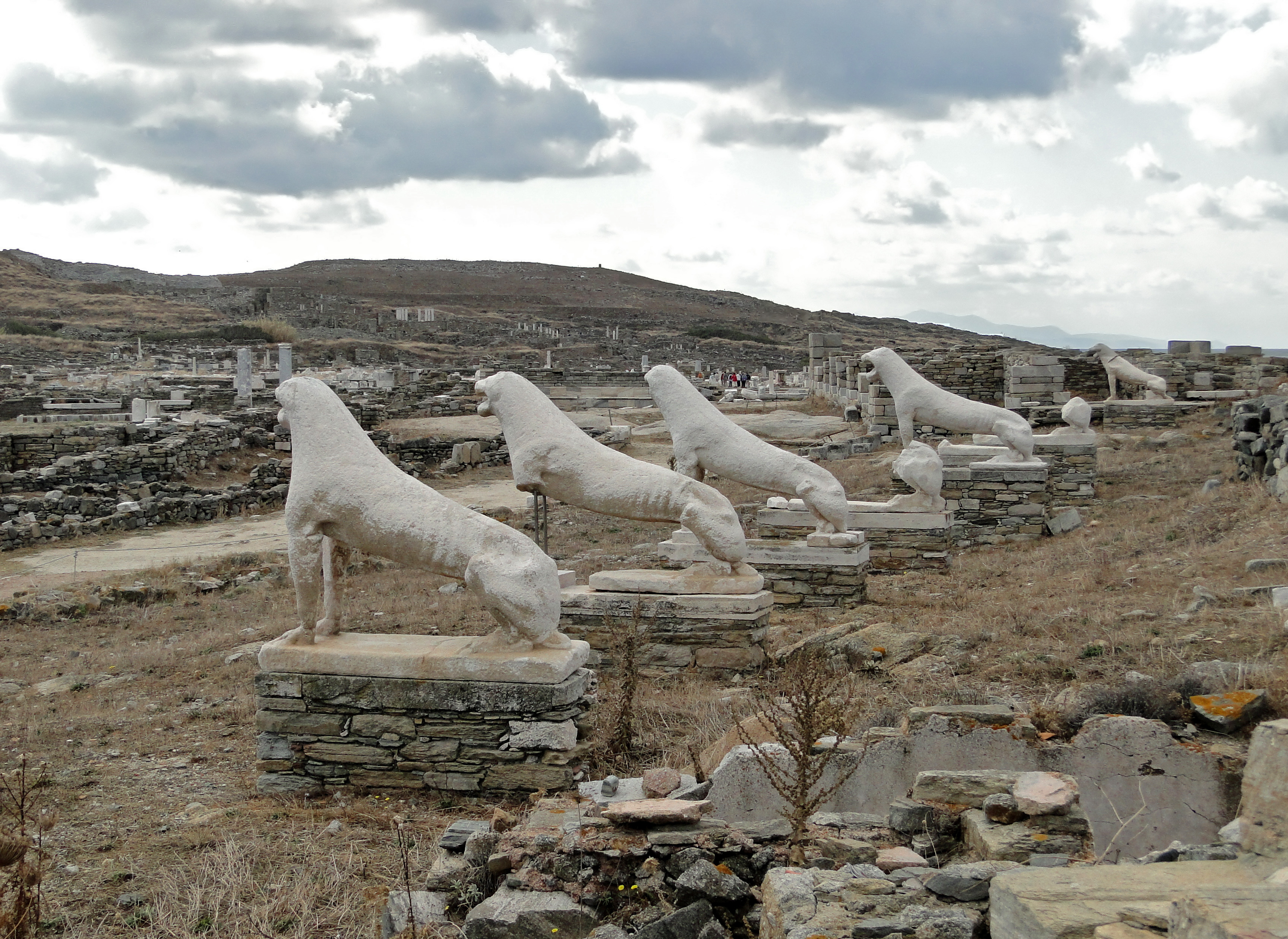
- Terrace of the Lions
A celebrated Archaic Naxian dedication beside the Sacred Lake and one of the defining monuments of Delos.
- Sacred Lake
A landmark in the mythic geography of Apollo and Artemis's birth, surrounded by major sanctuaries and Naxian monuments.
- Theatre Quarter
A dense Hellenistic residential district preserving streets, cisterns, shops and luxurious courtyard houses with mosaics.
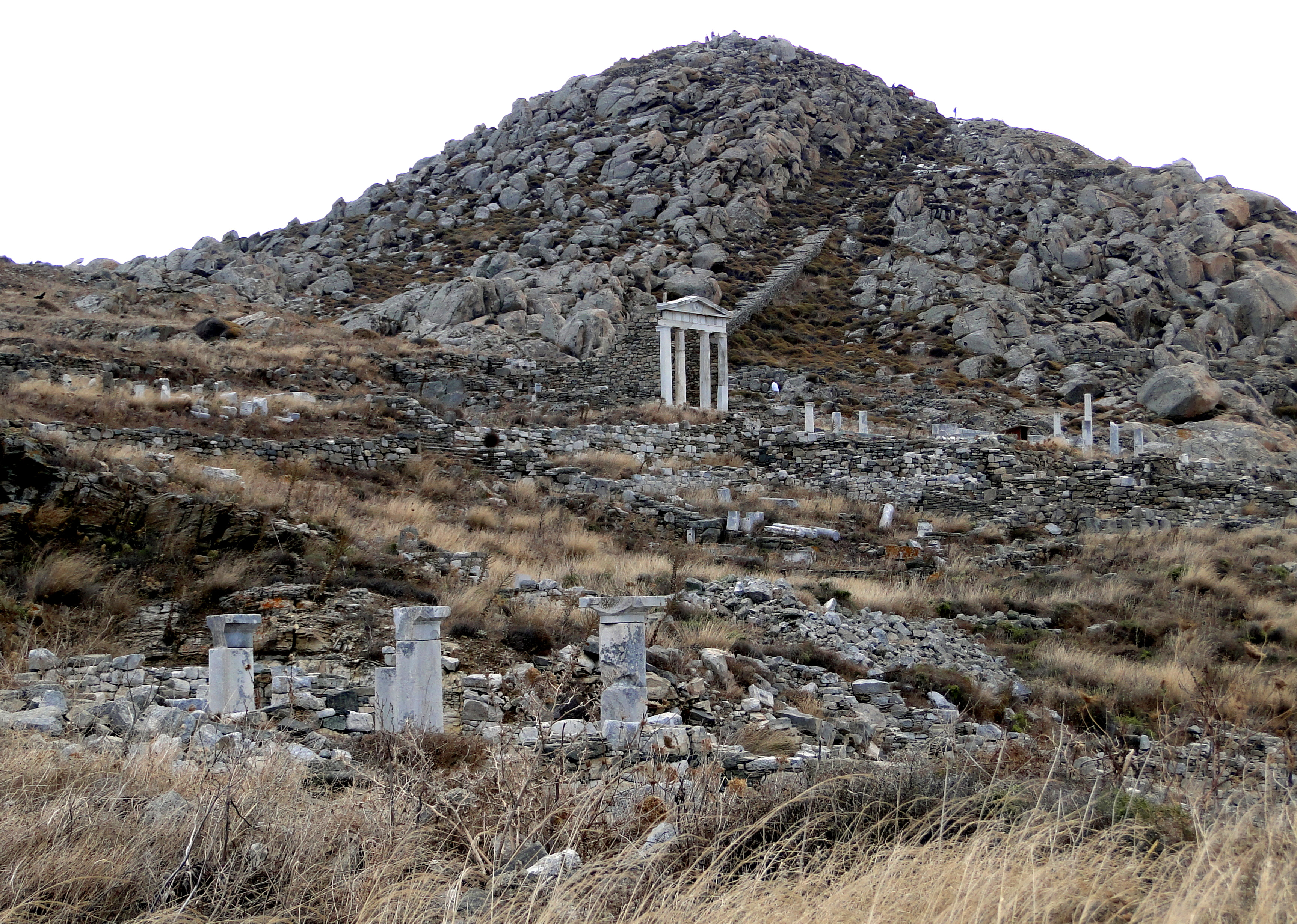
- Mount Kynthos
The island's 112 m summit, sacred in the birth myth and surrounded by sanctuaries, with commanding views over the entire archaeological landscape.
Strategic role
Pan-Hellenic sanctuary of Apollo and Artemis, headquarters of the Delian League, autonomous Hellenistic polis and capital of the Koinon of the Islanders, then a cosmopolitan free port.
Sacred Island
Greek tradition identified Delos as the birthplace of Apollo and Artemis. In the Homeric Hymn to Apollo, Leto finds refuge on the island and gives birth within a landscape whose Mount Kynthos and Sacred Lake became enduring religious landmarks. Settlement reaches the third millennium BC, while the Ministry of Culture records cult in the sanctuary area from the Mycenaean period. By the seventh century BC Delos was a major Ionian and increasingly Pan-Hellenic religious center. Sacred embassies sailed to its harbor for festivals combining sacrifice, procession, music, athletics, equestrian contests, theatre and banquets. Its prestige made control of the sanctuary politically valuable: religious patronage and Aegean power repeatedly became inseparable.
Sanctuary of Apollo
The Sanctuary of Apollo is an accumulated monumental landscape rather than a single temple complex. Temples, altars, treasuries, stoas, sacred roads and votive monuments record centuries of competition among cities and rulers. Archaic Naxos was especially prominent through the House of the Naxians, colossal Apollo and Terrace of the Lions. Athens later asserted itself architecturally and politically, while Hellenistic rulers and island communities continued to monumentalize the sanctuary. The Sacred Harbor received official delegations, and processions moved inland through carefully structured civic and religious spaces. Sculpture, inscriptions and architectural fragments now protected in the museum are essential to reconstructing the sanctuary's history.
Delian League
After the Persian Wars, Delos became headquarters of the alliance conventionally called the Delian League, founded under Athenian leadership in 478/477 BC. The prestigious Ionian sanctuary and central Aegean location gave the alliance powerful religious legitimacy, and allied tribute was initially deposited there. As Athenian leadership hardened into empire, the treasury was transferred to Athens in 454 BC. In 426/425 BC Athens carried out a major purification of Delos: graves were opened, remains and funerary offerings were transferred to Rineia, and births and deaths were prohibited on the sacred island. The episode vividly demonstrates how sacred purity and imperial politics could reinforce one another.
Hellenistic Free Port
Delos experienced two major Hellenistic transformations. During the Period of Independence, 314–167 BC, it governed itself and became capital of the Koinon of the Islanders. After 167 BC Roman policy returned the island to Athenian control and made its harbor tax-free, partly redirecting commerce away from rival ports. For roughly eighty years Delos became one of the Mediterranean's busiest commercial centers. Merchants, bankers, shipowners and associations from Italy, Egypt, Syria, Phoenicia and the Greek East built warehouses, agoras, clubhouses, sanctuaries and richly decorated houses. The city became an exceptional archaeological record of mobility, commerce and multicultural urban life.
World Heritage
UNESCO inscribed Delos in 1990 under criteria ii, iii, iv and vi. It is significant for its influence on Greco-Roman architecture and art, its exceptional testimony to Aegean civilizations from prehistory through the Palaeochristian era, its preservation of a major cosmopolitan Hellenistic port, and its tangible association with the myth of Apollo and Artemis. Because no modern town was built over the ancient city, sanctuary, harbor, residential districts and sacred topography survive together across almost the entire island. UNESCO also emphasizes the site's vulnerability to strong northern winds, marine exposure and heavy visitation.
Prehistoric and Mycenaean Delos
Delos's fame is Classical and Hellenistic, but its human history is much older. UNESCO records settlement from the third millennium BC, and archaeological evidence places communities on the island during the Early Bronze Age. Cult activity in the later sanctuary area reaches into the Mycenaean period, around the fourteenth century BC. These remains are modest beside the later temples but demonstrate that Delos's sacred landscape developed from a long-lived Cycladic setting rather than appearing suddenly in the Archaic age.
Naxian Delos and Archaic Monumentality
In the seventh and sixth centuries BC neighboring Naxos projected wealth and political power onto Delos through some of its most memorable monuments. The Terrace of the Lions, House of the Naxians and colossal Apollo placed Naxian marble, craftsmanship and civic identity in one of the Aegean's most visible sanctuaries. Such dedications were simultaneously acts of piety and political display. Delos can therefore be read as a monumental record of shifting Aegean power, later joined by Athenian, royal and private benefaction.
Sacred Lake and Terrace of the Lions
The Sacred Lake and Terrace of the Lions formed one of the most charged landscapes of ancient Delos. The lake belonged to the mythology of Leto and the divine twins; the Naxian marble lions created a formal guardian presence along its edge. Although the lake was drained in modern times, its basin remains legible. The original lions are protected from weathering while replicas communicate their ancient setting. Lake, processional routes, monuments and Mount Kynthos show how Delian sacred architecture materialized myth through topography.
Independence and the Koinon of the Islanders
From 314 to 167 BC Delos enjoyed the period scholars call Independence. No longer directly governed by Athens, it developed autonomous civic institutions and became capital of the Koinon of the Islanders. Building, dedications, festivals and economic activity continued to expand. This long phase is essential to Delian history: the island was not merely an Athenian possession awaiting Roman commerce but an active Hellenistic polis with its own administration, sacred responsibilities and regional political importance.
A Cosmopolitan Mediterranean City
The free-port city compressed an astonishing range of Mediterranean identities into a tiny island. Inscriptions identify Italians, Athenians, island Greeks, Phoenicians, Syrians, Egyptians and other communities. Professional and religious associations built headquarters; merchants and bankers endowed monuments; sculptors and mosaicists served wealthy patrons. Greek, Egyptian, Syrian, Phoenician and Jewish religious institutions coexisted. UNESCO accordingly treats Delos as an outstanding image of a cosmopolitan Mediterranean port, where religion, business, ethnicity and domestic life can be studied within one exceptionally dense archaeological landscape.
Agoras, Merchants and Associations
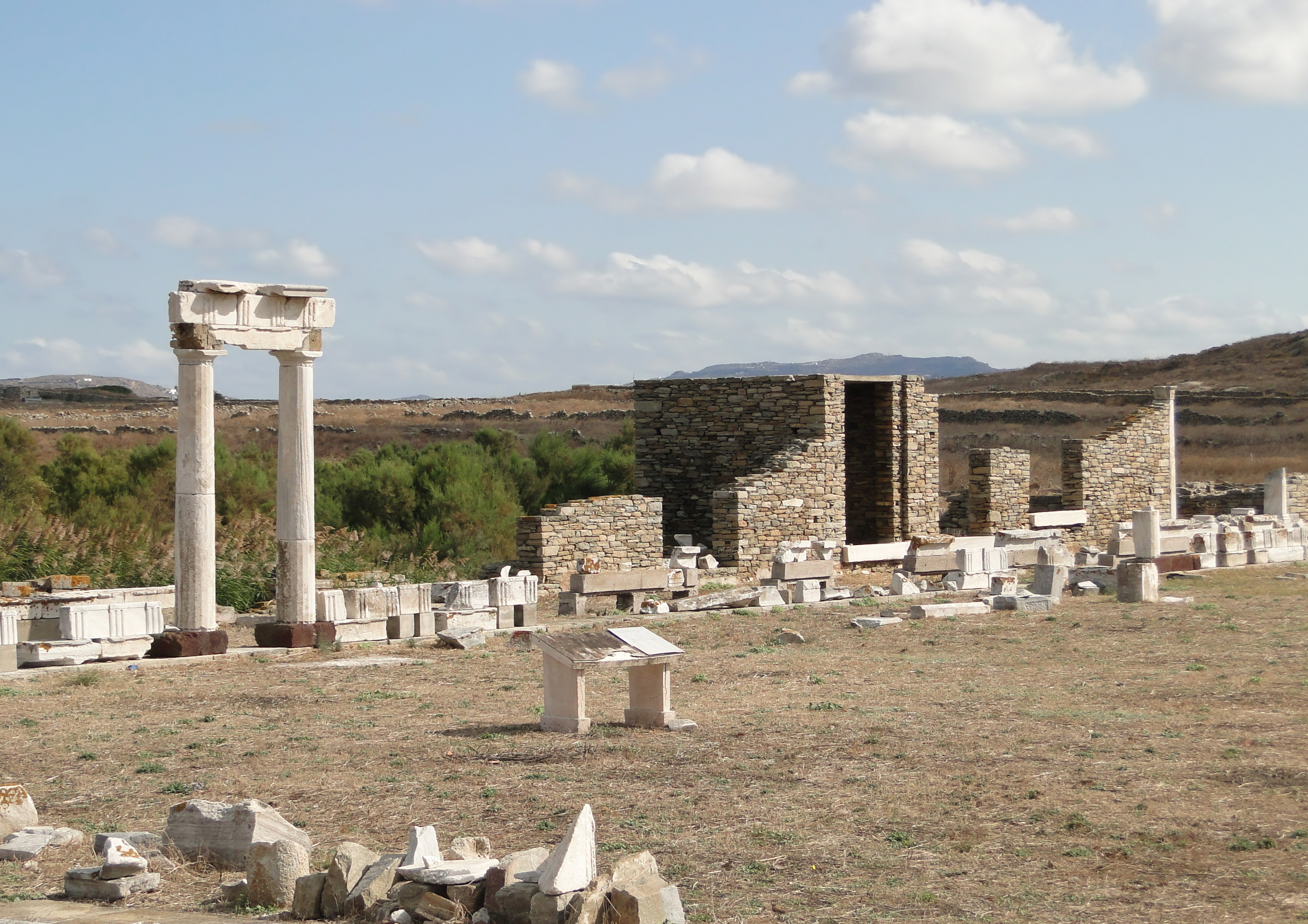
Commerce was organized through monumental public and corporate spaces as well as the harbor. The Agora of the Competaliasts near the waterfront was associated with merchants and freedmen devoted to Roman Compital cults. The enormous Agora of the Italians expressed the growing importance of Italian residents. The Poseidoniasts of Berytos created a complex combining social, commercial and religious functions. Such buildings reveal how migrant communities used associations to trade, worship, maintain networks and represent themselves publicly.
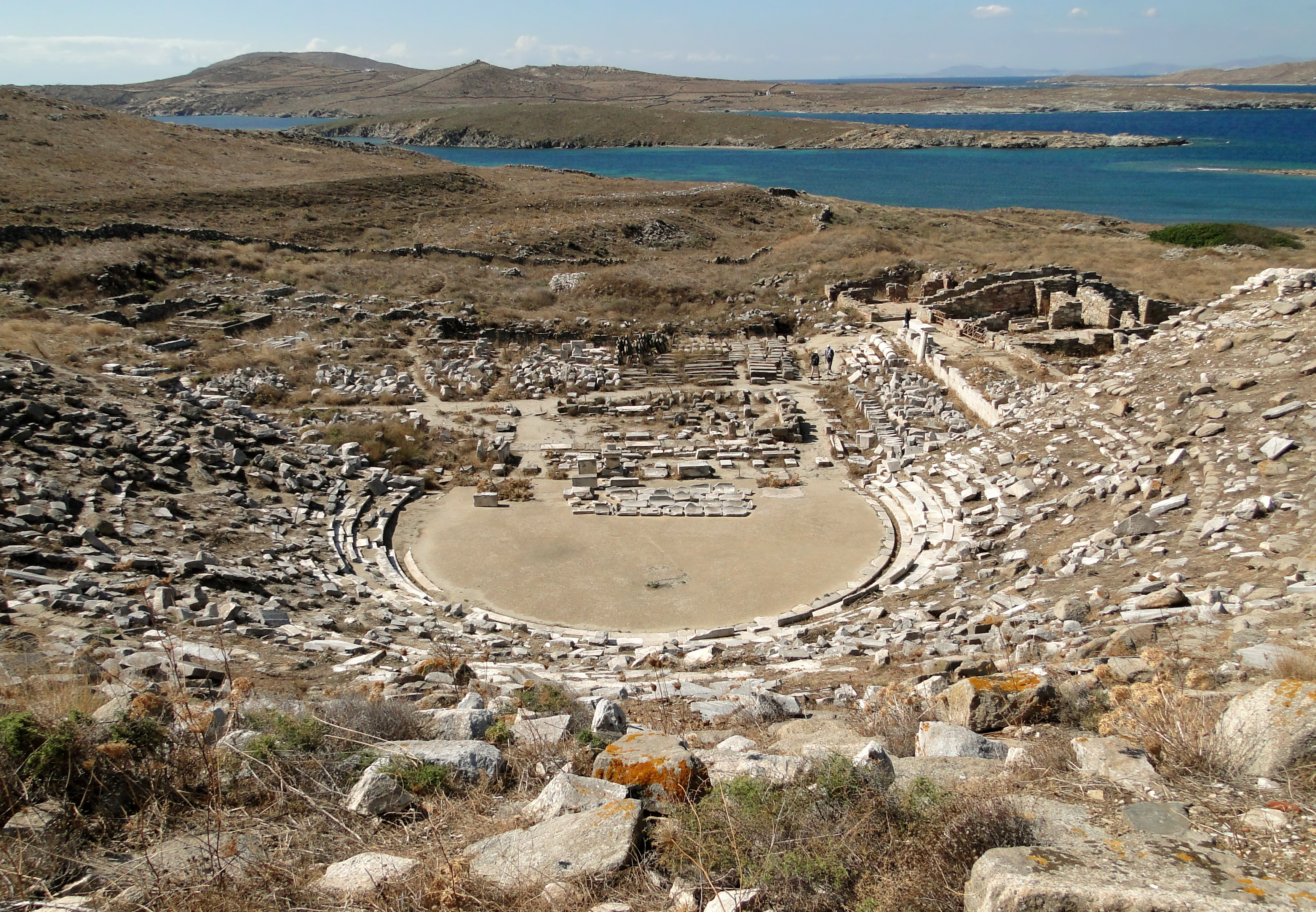
The Theatre and Theatre Quarter
The Hellenistic stone theatre anchors one of Delos's most revealing residential districts. Around it grew a dense network of streets and houses adapted to sloping terrain. The theatre expresses civic and festival culture; the surrounding quarter preserves the texture of urban life through entrances, shops, service rooms, cisterns, peristyle courts and upper-storey arrangements. It is here that Delos becomes most visibly a lived city rather than only a sanctuary.
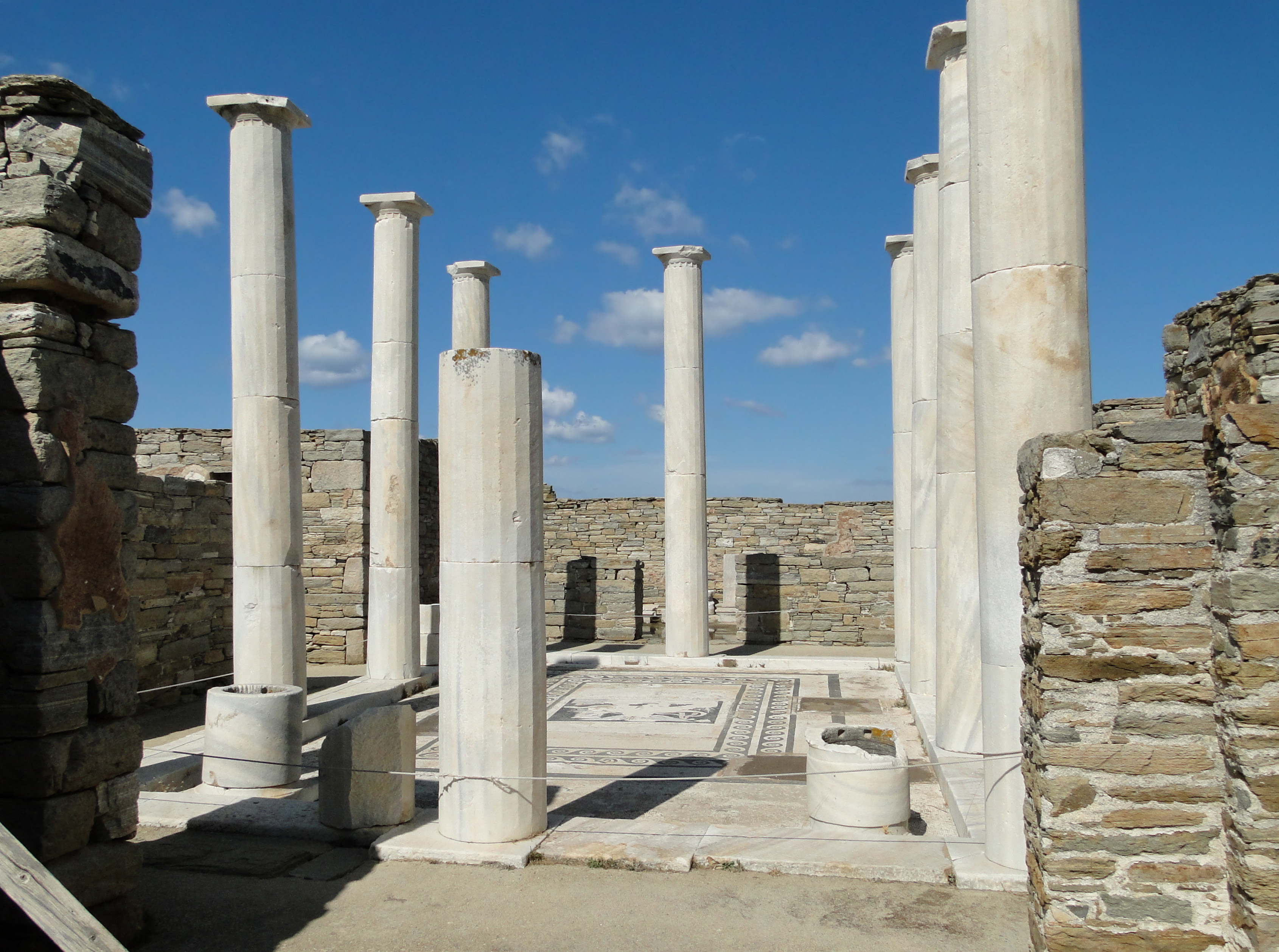
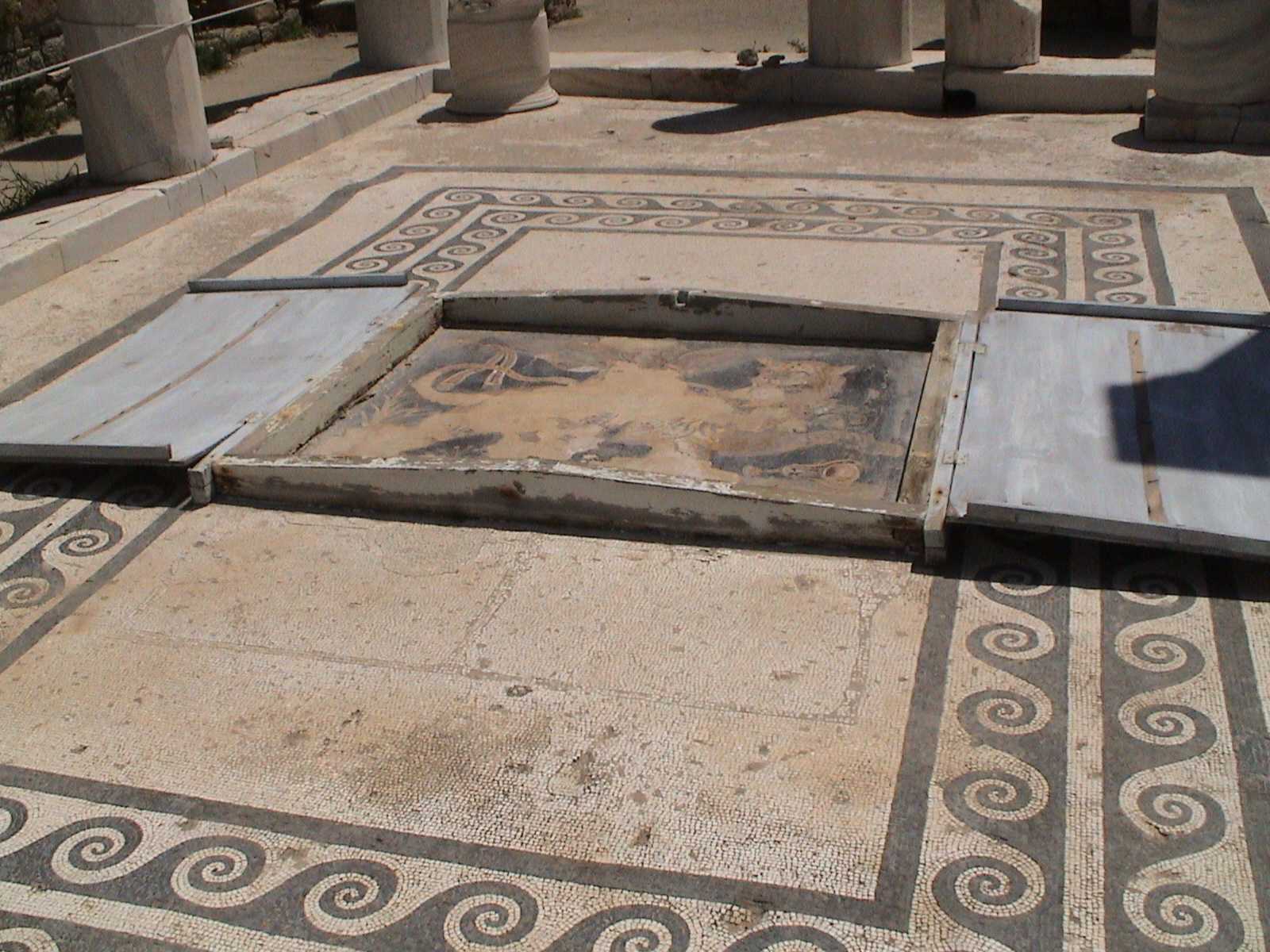
Houses, Mosaics and Domestic Luxury
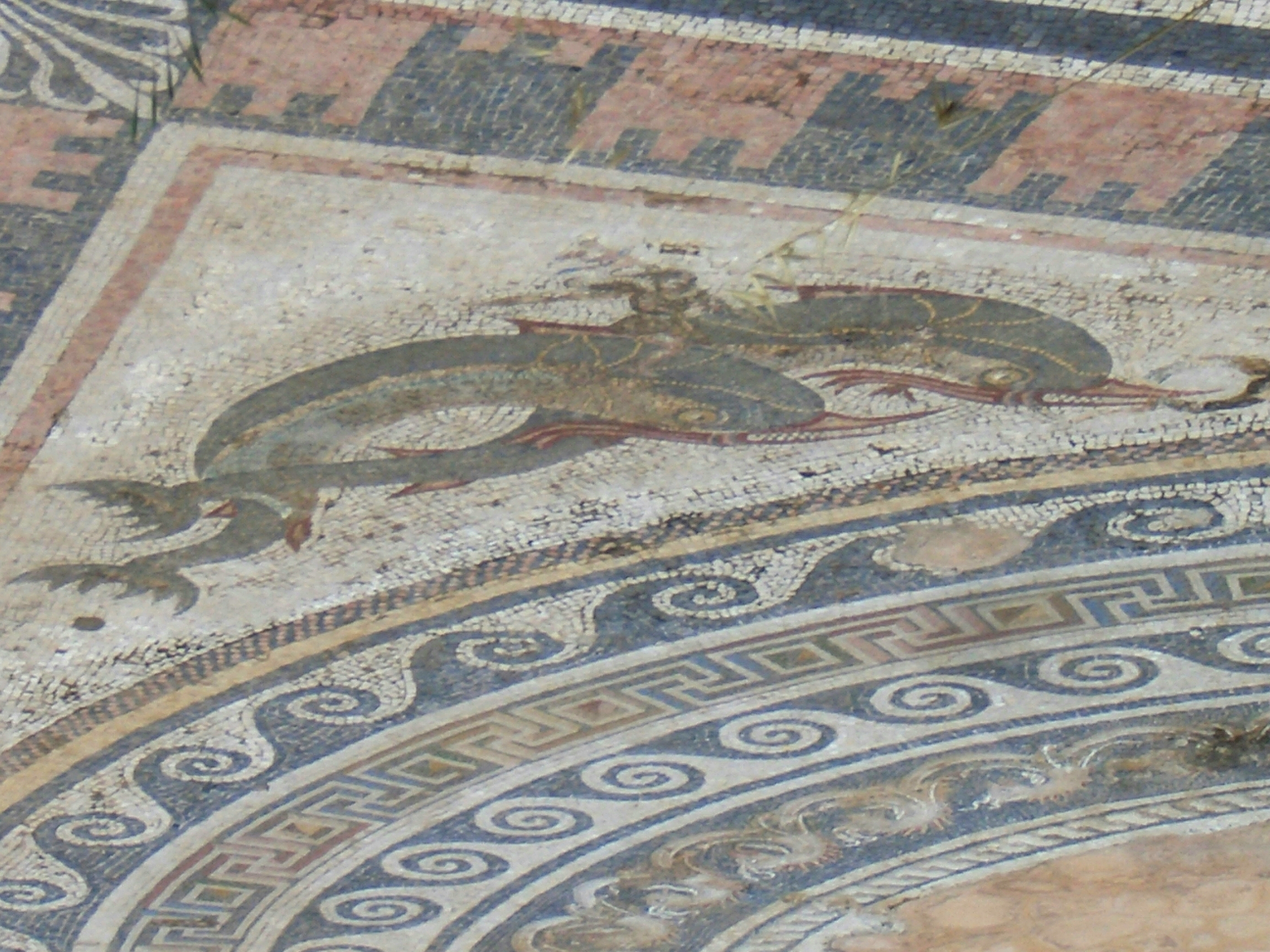
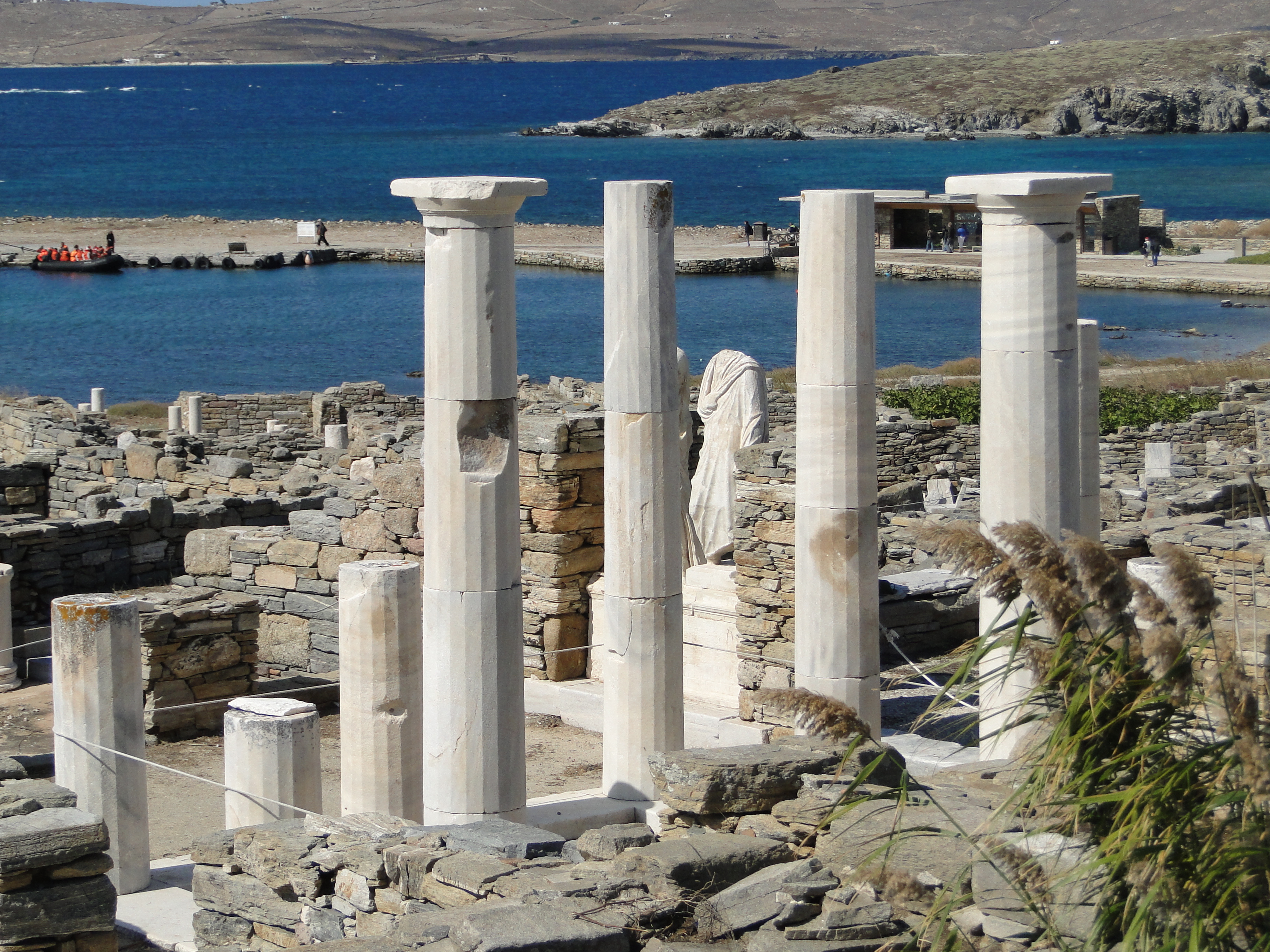
Delos preserves exceptional evidence for elite Hellenistic domestic architecture. Houses of Dionysos, the Masks, Dolphins, Trident and Cleopatra and Dioskourides were organized around courts that brought light and air into compact plots. Columns, painted plaster, sculpture and elaborate mosaics transformed inward-facing houses into displays of status. Dionysiac and marine mosaics belonged to carefully staged reception spaces rather than functioning as isolated artworks. Because excavation exposed whole neighborhoods, Delos is fundamental to the study of both luxury and ordinary urban infrastructure.
Foreign Gods on the Sacred Island
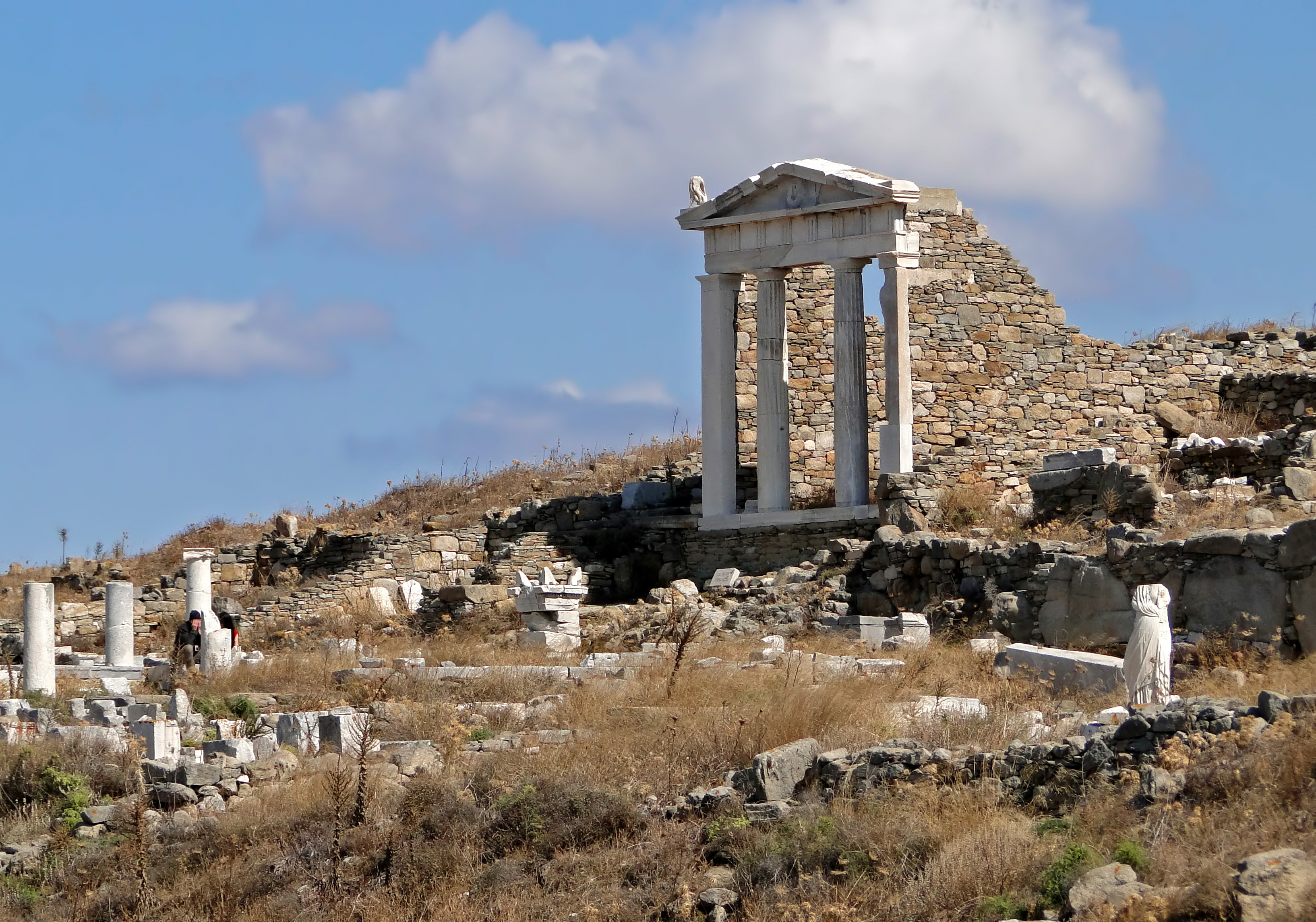
Cosmopolitan Delos expanded its religious landscape without displacing Apollo. Egyptian cults honored Sarapis, Isis and Anubis; Syrian worshippers honored Hadad and Atargatis; Phoenician associations maintained cultic institutions; and a synagogue existed in the northeastern district. Traditional Greek and Roman cults also flourished. The juxtaposition demonstrates how commerce and migration generated religious pluralism in a Hellenistic port. The slopes of Kynthos became particularly dense with sanctuaries.
Rineia and the Purification
Nearby Rineia is essential to understanding Delos. During the Athenian purification of 426/425 BC, graves were removed from Delos and bones and offerings transferred there. With births and deaths thereafter forbidden on the sacred island, Rineia served as the Delian burial ground into Roman times. Excavation of the Purification Pit in 1897 recovered thousands of objects and helped prompt creation of the Archaeological Museum of Mykonos. Sacred status thus reorganized life and death across two islands.
Destruction, Decline and Christian Delos
The Roman connections that enriched Delos also made it vulnerable. In 88 BC forces associated with Mithridates VI attacked and plundered the island; in 69 BC pirates led by Athenodorus struck again. Delos never recovered its former commercial scale, though occupation continued. Christianity became increasingly visible, and Delos eventually became the seat of a bishopric serving neighboring Cycladic islands. Churches and a monastery attest the Late Antique community. Permanent settlement disappeared around the early medieval period.
Abandonment and Rediscovery
After depopulation Delos remained famous but vulnerable. Ancient blocks were quarried, marble was removed or burned for lime, and successive visitors encountered a confusing field of ruins. From the fifteenth century western travelers and antiquarians increasingly sought the island. Major landmarks such as the Colossus of the Naxians, Stoa of Philip and Theatre remained recognizable. This long history of spoliation and observation shaped the archaeological landscape inherited by modern researchers.
150 Years of Archaeology
The French School at Athens began systematic excavation in 1873 when Albert Lebègue worked on Mount Kynthos. Théophile Homolle explored the Sanctuary of Apollo from 1877, and excavation soon expanded into the Theatre Quarter, Inopos valley, waterfront, Agora of the Italians, Poseidoniasts' establishment and gymnasium. Large campaigns exposed enormous areas of the city, accompanied by plans, drawings, photographs, inscriptions and the Exploration archéologique de Délos publication series. French and Greek archaeologists continue excavation, conservation and digital documentation, making Delos a benchmark for Mediterranean archaeology.
Mount Kynthos and the Island Landscape
At about 112 m, Mount Kynthos is modest in height but dominates Delos visually and religiously. Its summit and slopes were woven into Apollo's birth myth and later crowded with sanctuaries. From above, harbor, sanctuary, agoras, Theatre Quarter, Sacred Lake and surrounding islands form a single comprehensible cultural landscape. Exposed rock, intense light, sea and strong northern winds conditioned ancient life and remain major conservation factors. Delos is best read as an entire island whose topography was successively sacralized, urbanized and commercialized.
What to See Today
Prioritize the harbor approach, Agora of the Competaliasts, Sanctuary of Apollo, Naxian monuments, Terrace of the Lions and Sacred Lake, then continue into the Theatre Quarter. The Houses of Dionysos, Masks, Dolphins, Trident and Cleopatra and Dioskourides illuminate domestic architecture and mosaic art. The Agora of the Italians and association buildings explain the commercial city, while Egyptian and Syrian sanctuaries reveal religious diversity. A climb toward Kynthos, when open, transforms understanding of the site's geography. The museum is indispensable when accessible because many vulnerable originals are protected there.
Why Delos Matters
Few archaeological sites unite mythology, religion, geopolitics, commerce and everyday urban life as completely as Delos. It was sacred birthplace, Pan-Hellenic sanctuary, headquarters of the Delian League, autonomous Hellenistic polis, cosmopolitan free port and Christian episcopal center. Because no modern town covered the ruins, sanctuary and city survive together across almost the entire island. Excavation since 1873 has made Delos a benchmark for Greek religion, Hellenistic urbanism, trade, associations, migration, domestic architecture, mosaics, inscriptions and the history of archaeology itself.
Architecture
- Sanctuary of Apollo with successive temples, altars, treasuries, stoas and votive monuments
- Archaic Naxian monuments including the House of the Naxians, colossal Apollo and Terrace of the Lions
- Sacred Way and monumental approaches connecting harbor, sanctuary and civic spaces
- Hellenistic agoras including the Agora of the Italians and Agora of the Competaliasts
- Theatre of Delos and the dense Theatre Quarter
- Luxury courtyard houses including the Houses of Dionysos, Masks, Dolphins, Trident and Cleopatra and Dioskourides
- Exceptional Hellenistic mosaic pavements and painted wall decoration
- Sanctuaries of Sarapis, Isis and Anubis and other non-Greek cults
- Association buildings of Syrian, Phoenician, Italian and other merchant communities
- Port installations, warehouses and shops serving the free-port economy
- Early Christian basilicas and remains of the Late Antique settlement
Timeline
- 3rd millennium BC Early Bronze Age settlement is established on Delos.
- c. 1400 BC Mycenaean-period cult activity is attested in the later sanctuary area.
- 9th–7th centuries BC The sanctuary develops as a major Ionian religious center.
- 7th–6th centuries BC Naxian and other dedications monumentalize Delos during the Archaic age.
- 478/477 BC The Athenian-led Delian League is founded with headquarters and treasury at Delos.
- 454 BC The League treasury is transferred from Delos to Athens.
- 426/425 BC Athens purifies Delos, transfers graves to Rineia and prohibits births and deaths on the sacred island.
- 314 BC The Period of Independence begins; Delos becomes capital of the Koinon of the Islanders.
- 314–167 BC Independent Delos prospers as sanctuary, polis and regional political center.
- 167/166 BC Roman policy places Delos under Athenian administration and establishes the harbor as a tax-free port.
- 2nd century BC The free port expands dramatically and attracts communities from across the Mediterranean.
- 88 BC Delos is attacked and plundered during the wars of Mithridates VI against Rome.
- 69 BC Pirates led by Athenodorus attack the island, accelerating commercial decline.
- Palaeochristian era A Christian community develops and Delos becomes the seat of a Cycladic bishopric.
- 7th–8th centuries AD Permanent settlement disappears and Delos enters a long period of abandonment and spoliation.
- 15th–19th centuries Antiquarian travelers visit while ancient marble continues to be removed or burned for lime.
- 1873 Albert Lebègue begins systematic excavation for the French School at Athens.
- 1877–1894 Excavation expands from the Sanctuary of Apollo into major sectors of the ancient city.
- 1904 Construction begins on the Archaeological Museum of Delos.
- 1990 UNESCO inscribes Delos under criteria ii, iii, iv and vi.
- 2023 The French School at Athens marks 150 years of systematic archaeological research on Delos.
Visiting today
Delos is an archaeological island with no modern town. Most visitors arrive by seasonal excursion boat from Mykonos. The principal circuit links the Sacred Harbor, Agora of the Competaliasts, Sanctuary of Apollo, Terrace of the Lions and Sacred Lake; a fuller visit should include the Theatre Quarter, foreign sanctuaries and, when open and conditions permit, Mount Kynthos. The museum and individual sectors may close for conservation. Strong sun, wind, exposed terrain and limited shade make water, sun protection and suitable footwear important. Verify current boats, opening hours, museum access and site routes with the Ephorate of Antiquities of the Cyclades.
Expedition guides
Images
References
- UNESCO World Heritage Centre — Delos
- Ephorate of Antiquities of the Cyclades — The Archaeological Site and Museum of Delos
- Ephorate of Antiquities of the Cyclades — Delos archaeological guide (English PDF)
- École française d’Athènes — A Brief History of Delos, Véronique Chankowski (2024)
- École française d’Athènes — Delos: A History of the Excavations
- École française d’Athènes — Delos 1873–2023: 150 Years of Research
- Ephorate of Antiquities of the Cyclades — Archaeological Museum of Mykonos (Rineia purification context)
Related places
Related Stops
Topics
- Cyclades
- Historic Island
- Unesco World Heritage
- Archaeological Site
- Apollo
- Artemis
- Pan Hellenic Sanctuary
- Delian League
- Hellenistic
- Free Port
- Ancient City
- Mosaics
- Maritime Trade
- Religious Pluralism
- Early Christian