Highlights
- A rare surviving Byzantine palace
Mystras preserves one of the few surviving Byzantine palace complexes, developed over centuries to house regional government and the rulers' court.
- A city shaped by its hillside
Mystras's steep hillside makes the relationship between defense, government, and an inhabited city visible in its urban form.
- Art and learning in a court city
Mystras's churches preserve evidence of artistic exchange, while local manuscript copying connected religious and courtly life to wider intellectual networks.
Strategic role
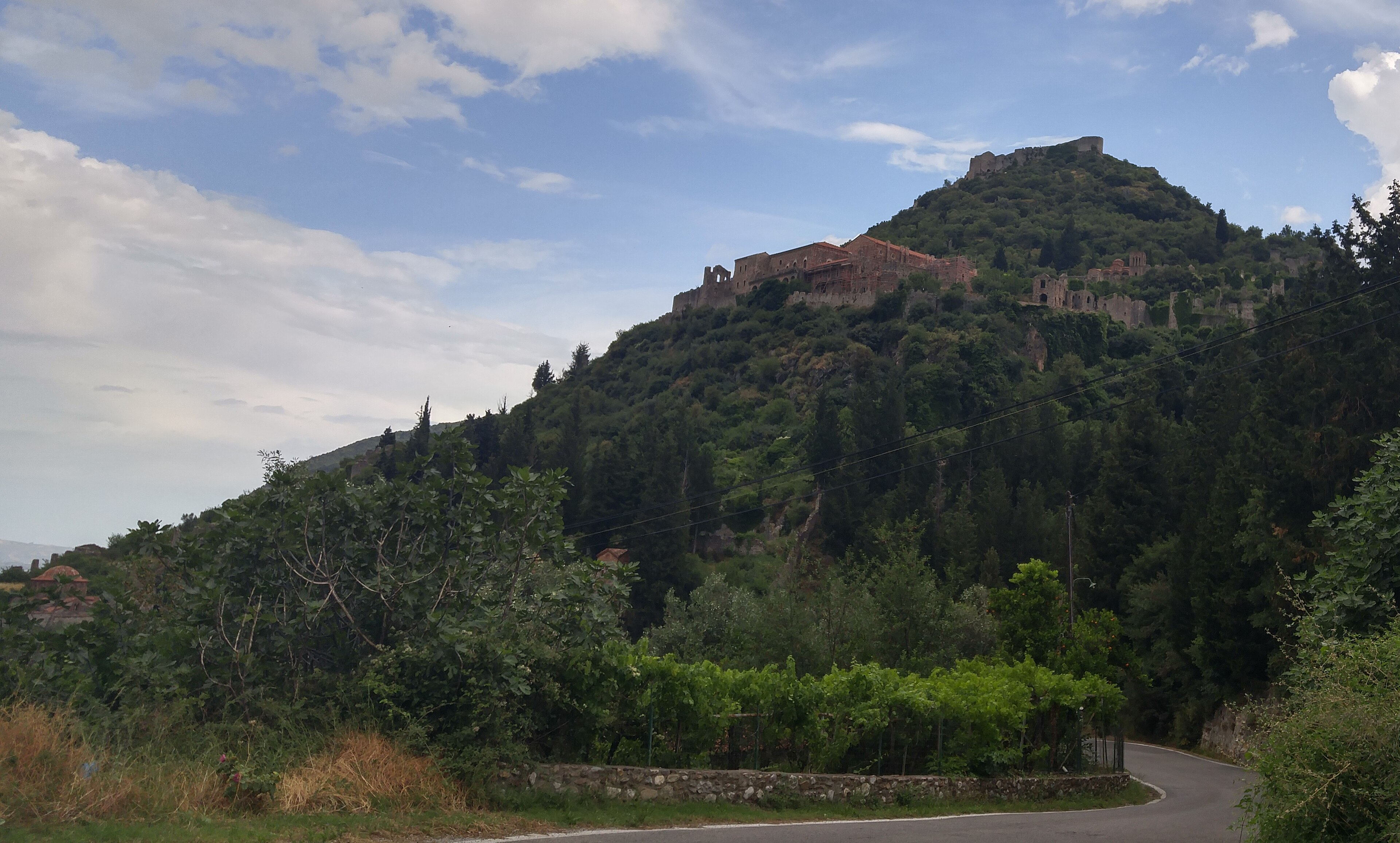
A fortified regional court and administrative city whose defenses, institutions, and neighborhoods developed across a steep landscape.
From castle to city
William II of Villehardouin is credited with building the summit castle in 1249; that date marks the citadel, not the founding of the later city. After the castle passed to Byzantine control in a negotiated surrender in 1262, settlement spread beyond the summit to form a fortified city on the slope. Its urban form took shape through successive expansion rather than a single plan. Earlier archaeological finds are isolated and do not demonstrate a continuously inhabited pre-castle town.
Imperial authority and the court
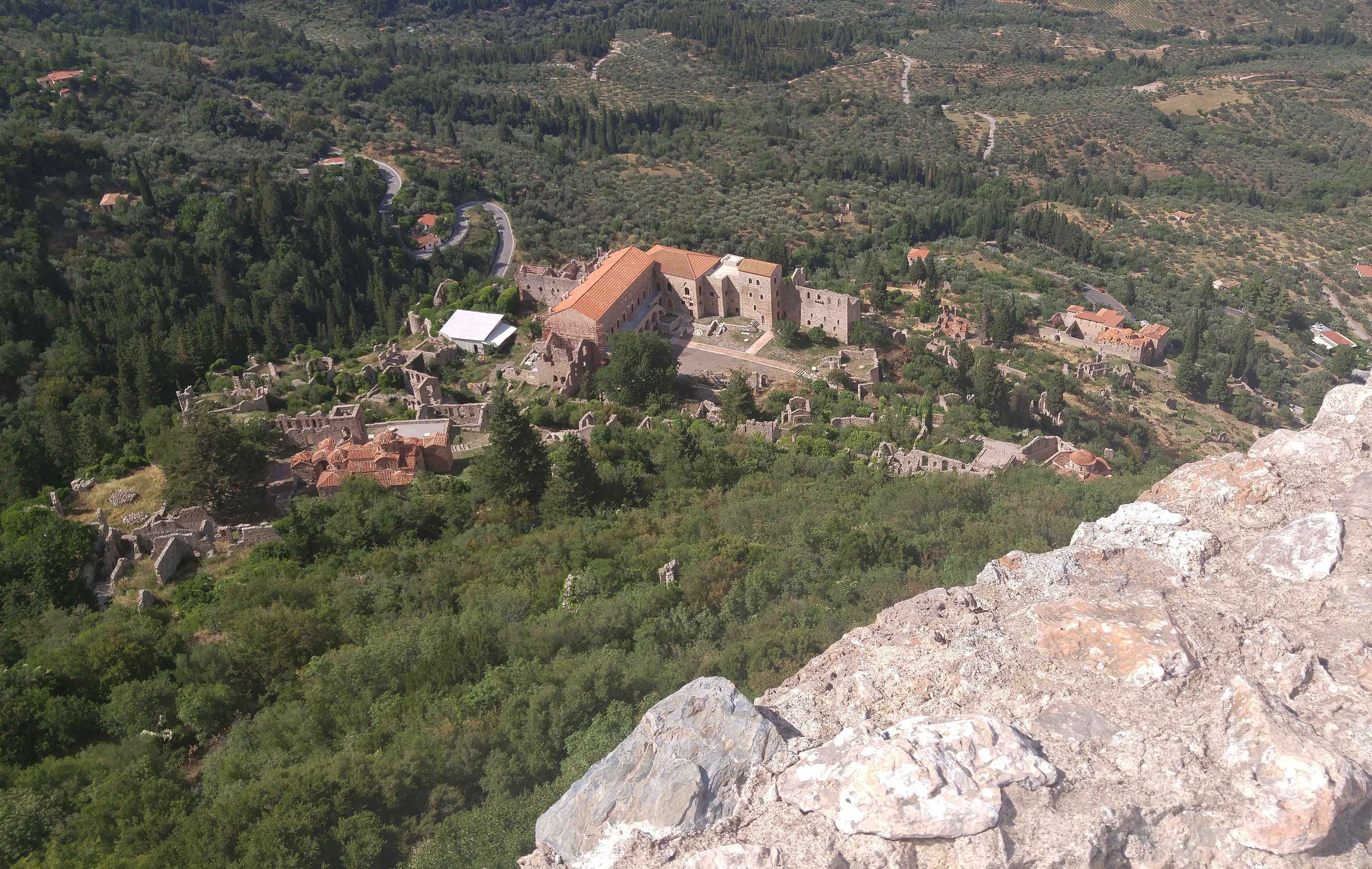
From the fourteenth century Mystras became a center of Byzantine regional government. Manuel Kantakouzenos was appointed despot in 1348; administration of the Morea from Mistra is dated from 1349. The dates refer to different stages. The title and court connected local rule to the imperial dynasty: Mystras exercised regional authority within Byzantine rule, not as an independent state. In the fifteenth century Constantine Palaiologos resided here as despot before his accession as Constantine XI. The Palace of the Despots is one of the few Byzantine palace complexes to survive. Developed from the late thirteenth through the fifteenth century, it formed an L-shaped complex with a two-storey Kantakouzenos wing and a three-storey Palaiologos wing; the elongated Chrysotriklinio, or throne hall, occupied the latter's top floor. Administrative spaces formed part of the complex. In front of the Palace, the Phoros served as a forecourt crossed by the Upper Town's main road, where inhabitants assembled before the ruler. The Ministry describes the Palace's complex building history as reflecting the transition from Frankish to Byzantine control and the development of the Despotate. It reopened in May 2026 after a long restoration and presentation program. The permanent physical and digital exhibition “Hegemonic Narratives” interprets the role of imperial families in Mystras's administration and intellectual flourishing. Its surviving form combines historic fabric and later intervention; individual features are not all assigned to a single phase. The Palace was one element of a wider fortified city that also included the citadel, distinct settlement precincts, ecclesiastical institutions, homes, streets, and shared infrastructure.
Terrain, urban hierarchy, and defense
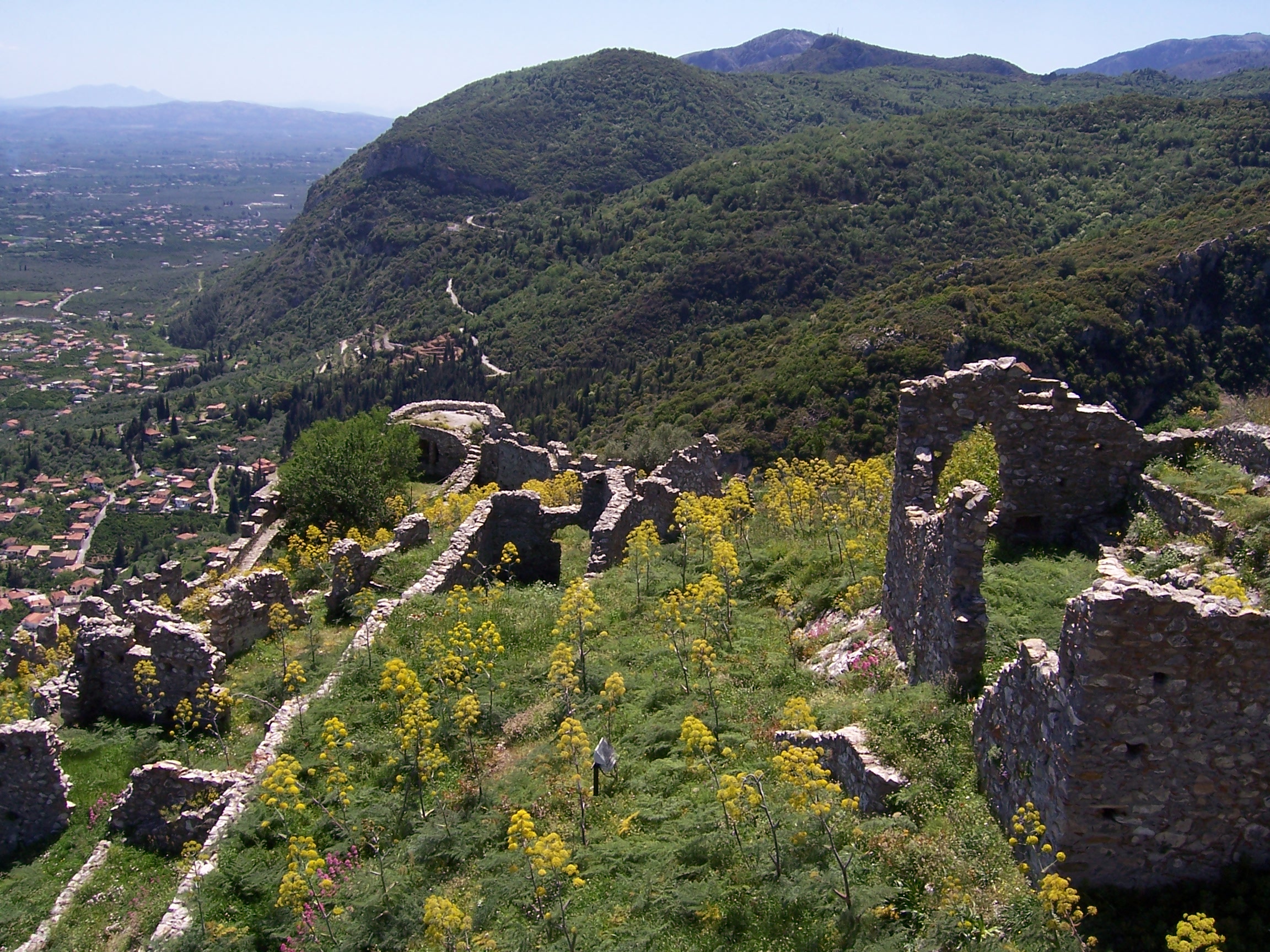
The steep terrain helps visitors read the city's broad spatial hierarchy: a summit citadel, an upper fortified precinct around the palace and court, and the more extensive lower settlement within its own defensive boundary. Churches, monasteries, homes, routes, and open spaces occupied this connected landscape. The arrangement made use of slope and defensible approaches, but was not one uniform fortress design. The visible defenses belong to different phases, and many individual walls and gates remain undated. The lower town's principal gate has not survived; its proposed location near the later Marmara opening remains uncertain. The present archaeological entrance is later than the original gate.
Court, worship, homes, and water
The palace and churches are among the city's most legible monuments, but they do not represent the whole community. The Metropolis and monastic compounds locate religious and ecclesiastical life within the urban fabric; houses, streets, workshops, cisterns, and open areas point toward domestic activity, movement, work, and shared resources. The upper-town Phoros stood at a junction of main roads. Cisterns and drainage show how water management formed part of city life, though the network's precise routes and household use remain uncertain.
Intellectual and artistic life
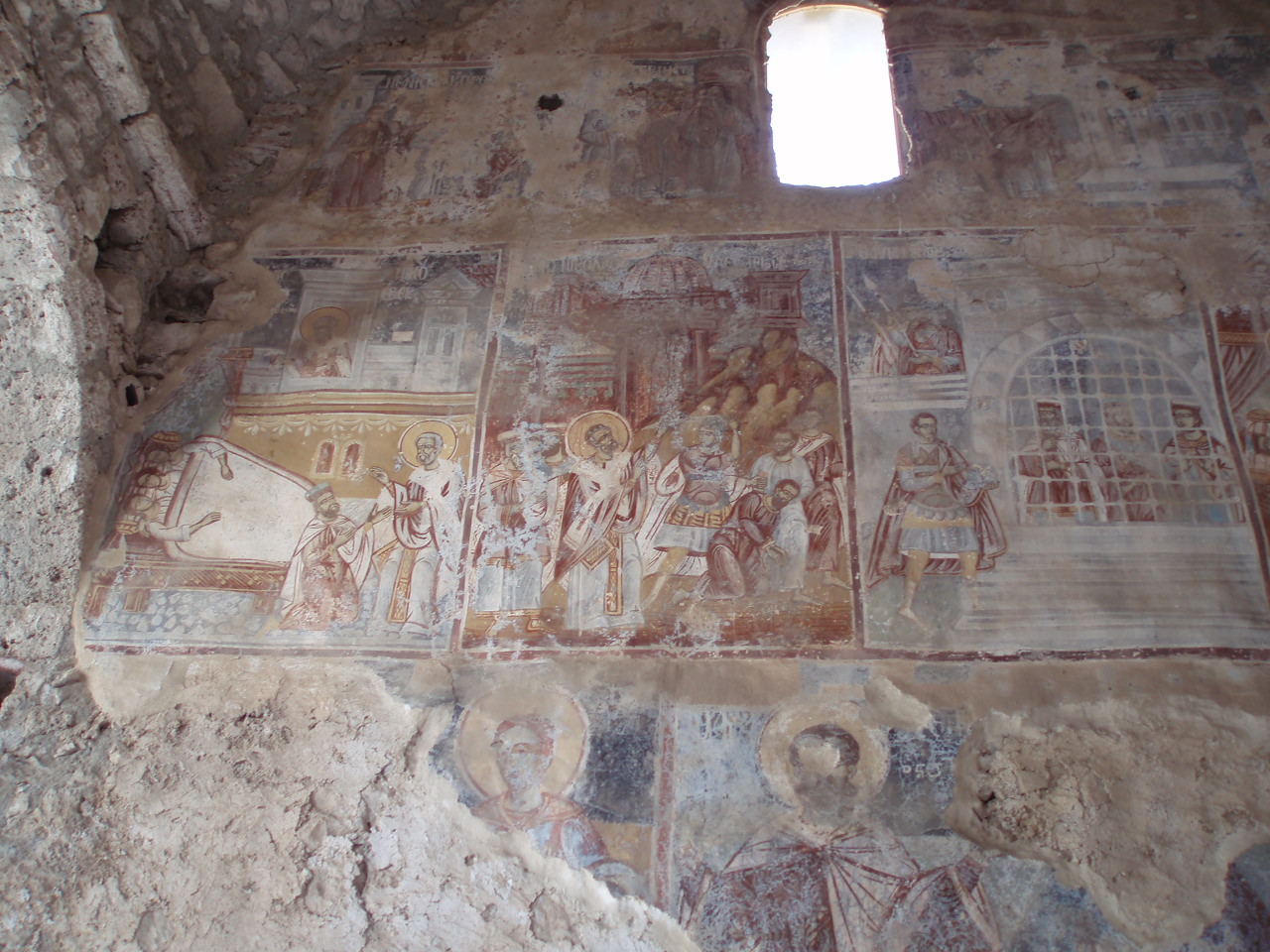
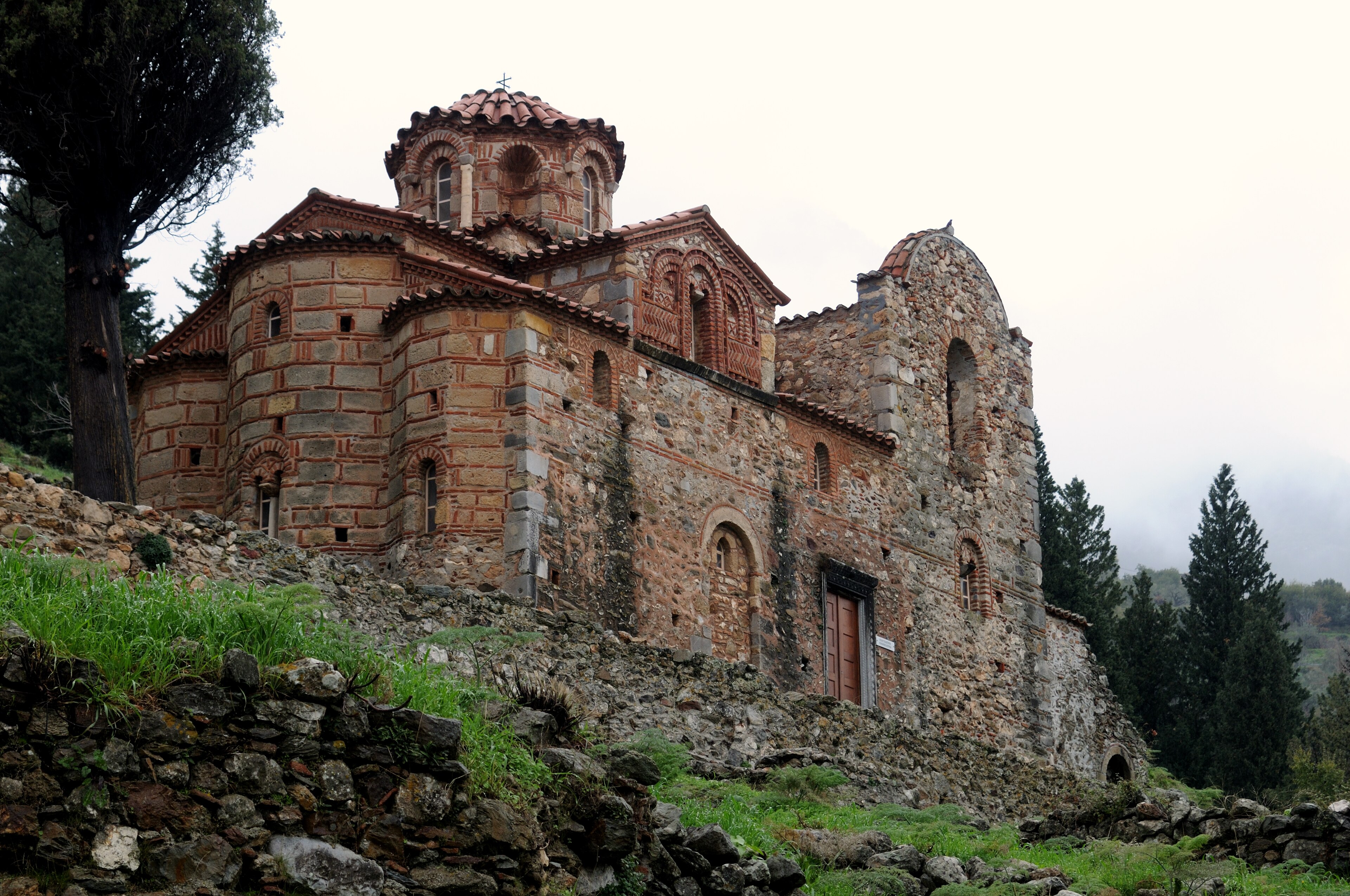
Mystras was an artistic and intellectual center of late Byzantine society. Its churches combine Byzantine, Constantinopolitan, Helladic, Romanesque, and Gothic features, reflecting contact among artistic traditions. Manuscript copying is documented in distinct periods. A 1289 addition to the Gospel section of the composite Ambrosiana codex Z 34 sup. names its scribe, Georgios, and commissioner, Metropolitan Nikephoros Moschopoulos. From 1362, colophons locate copying by Manuel Tzykandylis at Mistra, including Ambrosiana D 538 inf., completed in the castle on 7 April 1362. Copies of works by John VI Kantakouzenos and classical authors show the range of texts copied in this courtly and ecclesiastical setting. These records identify particular local scribes and patrons; authorship, ownership, and production location are not the same, and not every associated person or text belonged to Mystras.
Later occupation and gradual change
The surrender of 1460 ended Byzantine political rule at Mystras, not urban life. Ottoman and Venetian periods brought continued occupation and changes in use across the city's buildings and precincts. Modern Sparta was established in 1834, and migration from Mystras was gradual. Following later expropriations, remaining residents were reported to have departed or been relocated in 1953. These were separate stages; neither the surrender of 1460 nor Sparta's establishment emptied Mystras at once.
Archaeology, conservation, and what survives
The site visitors see has been shaped by archaeological study, restoration, conservation, visitor infrastructure, and later interpretation. Early twentieth-century restoration was followed by work on buildings, church paintings and sculpture, and visitor facilities. The Ministry reported that the Palace reopened in May 2026 after 42 years of restoration and presentation work; this project milestone does not establish the treatment history of every architectural feature. The reopening also marked the installation of “Hegemonic Narratives,” a permanent physical and digital exhibition. Other reported site works included a modern fire-suppression network in the Upper and Lower Towns, restoration of the central paved route linking them, and an external lift at the southwest Palaiologos wing. These modern systems are distinct from the city's historic cisterns and drainage. The Palace's surviving fabric reflects successive phases and interventions; individual walls, rooms, and surfaces cannot all be assigned confidently as original or reconstructed.
Why Mystras matters
Mystras offers a glimpse into the world of a Byzantine ruling community: its palace, churches, religious art, and manuscripts reveal the lives and ambitions of rulers, clergy, and patrons. Around them, houses, streets, and water installations reveal the wider city that supported court and religious life. Walking between these spaces helps visitors understand how authority, faith, learning, and everyday life came together.
Architecture
- Summit citadel on the steep Myzithra hill
- Distinct upper and lower defensive precincts, developed in phases
- Palace complex and associated court buildings
- Urban residences, streets, and open spaces
- Metropolis, churches, monasteries, and ancillary religious buildings
- Cisterns and other water-related infrastructure
- Later Ottoman and Venetian adaptations, with phases varying across individual buildings
Timeline
- 1249 William II of Villehardouin is credited with building the summit castle; the urban settlement later grew around and below it.
- 1262 The summit castle passed from Frankish to Byzantine control in a negotiated surrender; settlement subsequently expanded beyond the citadel.
- Late 13th–14th centuries The urban settlement expanded beyond the citadel; palace, churches, monasteries, houses, and defensive precincts developed over successive building phases.
- 1348–49 Manuel Kantakouzenos was appointed despot in 1348; administration of the Morea from Mistra is dated from 1349. His court remained part of Byzantine imperial rule.
- 15th century The Palaiologan court and institutions continued to shape Mystras; Constantine, later Constantine XI, resided here as despot before becoming emperor.
- 1460 The last Byzantine rulers surrendered Mystras to the Ottomans. Urban life and use of buildings continued under later rulers.
- 1460–19th century Ottoman and, during a later interval, Venetian rule brought further occupation and adaptation. Changes varied by building and period; 1460 did not end the city's life.
- 1770 and 1821 Mystras experienced separate periods of upheaval during the Orlov revolt in 1770 and the Greek War of Independence in 1821.
- 1833 A kingdom-wide administrative decree listed Mistra under the name Sparta. This renaming was distinct from the later establishment of modern Sparta.
- 1834 onward A separate royal and municipal process established modern Sparta, and inhabitants of Mystras gradually migrated there; the movement was not an immediate abandonment.
- Early 20th century Systematic archaeological study began to shape modern understanding of the site.
- 1921 Mystras received national protection as a prominent Byzantine monument.
- 1930 Architect Anastasios Orlandos carried out restoration work in 1930, following earlier archaeological study and the 1921 protection designation.
- 1953 After expropriations, remaining residents were reported to have departed or been relocated.
- 1989 Mystras was inscribed on UNESCO's World Heritage List in recognition of the historic city and its monuments.
- 21–22 May 2026 The Palace reopened to visitors after a long restoration and presentation program; the Ministry announced its permanent physical and digital exhibition, “Hegemonic Narratives.”
Visiting today
Mystras is a large, steep hillside site; allow time for elevation changes between precincts. Hellenic Heritage, checked 2 November 2026, listed winter hours of 08:30–15:30 (1 November–31 March), last admission 20 minutes before closing, full and reduced admission at €20 and €10, and Palace access on Tuesdays from 11:00 until closing. The Palace reopened in May 2026 with a permanent physical and digital exhibition, “Hegemonic Narratives.” The Ministry reports a restored central paved route between Lower and Upper Town and an external lift at the southwest Palaiologos wing. These works improve access but do not establish that every monument or route is step-free, open, or accessible. Check current hours, ticketing, route conditions, closures, works, and mobility access with Hellenic Heritage and the Ephorate of Antiquities of Laconia.
Historical contexts
- Late Byzantium
- Frankish Greece
- Ottoman Period
- Rise of Modern Greece
Expeditions
- Expedition I
Images
References
- UNESCO World Heritage Centre — Archaeological Site of Mystras (Outstanding Universal Value and periodic reporting)
- Hellenic Ministry of Culture — Castle Network: Mistras
- Hellenic Heritage — Mystras: opening hours, tickets, visitor information, and historical summary (checked 2 November 2026)
- Kyramargiou et al. — Changing the Map in Greece and Italy: Place-name Changes in the Nineteenth Century, The Historical Review 17 (2020), pp. 217–219
- Sparti 2034 — 20 October 1834 timeline and Royal Decree on the erection of Old Sparta
- Harris — Institutional Settings: The Court, Schools, Church, and Monasteries, in The Cambridge Intellectual History of Byzantium, pp. 27–36
- Nicol — Constantine: Despot at Mistra, in The Immortal Emperor, pp. 21–35
- Rodoniki Etzeoglou — ‘Ἐγράφη ἐν τῷ Μυζιθρᾶ’: Bibliographical activities at Mistra during the thirteenth and fourteenth centuries, Deltion ChAE 26 (2005), pp. 181–192; full text and manuscript colophons
- Panagiotidis and Zacharias — Digital Mystras: An Approach Towards Understanding the Use of an Archaeological Space, Scientific Culture 8(3) (2022), Figs. 2, 8–15
- Arvanitopoulos — The City of Mystras (1262–1460), doctoral dissertation, National and Kapodistrian University of Athens, 2004
- Arvanitopoulos — The City of Mystras (1262–1460), two-volume ODAP edition publication notice
- UNESCO World Heritage Centre — Periodic Reporting Cycle 3, Section II: Mystras conservation and management
- Athanasios and Marina Martinos Foundation / AEGEAS — Palace of the Despots project account and 2026 exhibition presentation
- Hellenic Ministry of Culture — National Strategy for the Protection of Cultural Heritage from the Impacts of Climate Change, Mystras fire-protection project, pp. 50–52
- Committee for the Restoration of the Monuments of Mystras, ed. Stefanos Sinos — The Monuments of Mystras (2009), catalog record
- Hellenic Ministry of Culture — 2026–27 winter opening-hours notice (dated 27 October 2026)
- Hellenic Ministry of Culture — Mystras protection and presentation works; Palace reopening (22 May 2026)
Related places
Topics
- Byzantine
- Despotate Of Morea
- Frankish Greece
- Fortified City
- Ottoman Period
- Venetian Period
- Urban History
- Peloponnese
- Archaeological Site
- Conservation