Highlights
- A strongpoint at the approach to Mani
The ruined enclosure stands above the route leading from the Gytheio area toward Areopoli and Oitylo.
- The Frankish barony and uncertain origins
The name Passavant belongs to the Frankish organization of the Morea and is associated with the de Neuilly family.
- Reading what survives
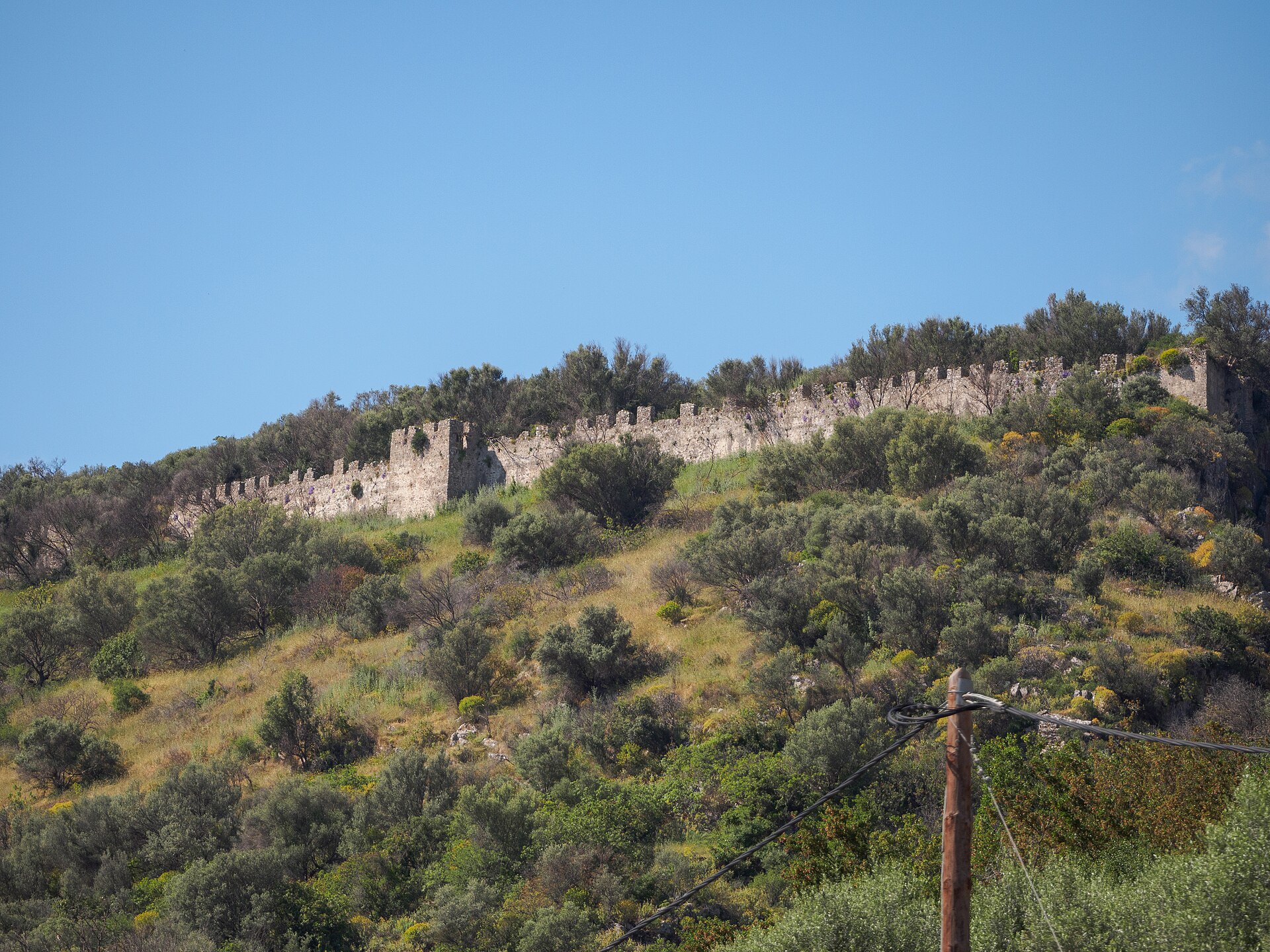
The roughly trapezoidal enclosure retains sections of wall, entrances and tower remains.
- Later conflict and inherited memory
Local historical accounts describe Ottoman possession, Venetian-era conflict and a Maniot capture in 1780.
Strategic role
A small frontier strongpoint overlooking a contested route into Mani.
A strongpoint at the approach to Mani
The ruined enclosure stands above the route leading from the Gytheio area toward Areopoli and Oitylo. Its position made movement through the landscape politically important: a garrison could watch an approach even when wider control of Mani remained contested. This relationship between a small defended place and a resistant hinterland is more useful than describing the castle as an all-powerful barrier across the entire peninsula.
The Frankish barony and uncertain origins
The name Passavant belongs to the Frankish organization of the Morea and is associated with the de Neuilly family. Local accounts give a mid 13th-century construction date, but foundation chronology and the derivation of the name are not fully settled. Explanations involving a French phrase belong to a history of interpretation, not secure proof of the builders’ intentions. The barony’s existence and the standing walls should also be distinguished: not every surviving feature must date from the first lordship.
Reading what survives
The roughly trapezoidal enclosure retains sections of wall, entrances and tower remains. The municipality identifies traces of barracks, a cistern and a mosque inside. These different functions show the needs of an occupied garrison: movement, accommodation, water and worship. Their ruined condition and later interventions make precise phasing difficult. A visitor can understand the organization of a small strongpoint without assigning each fragment to an exact ruler or campaign.
Later conflict and inherited memory
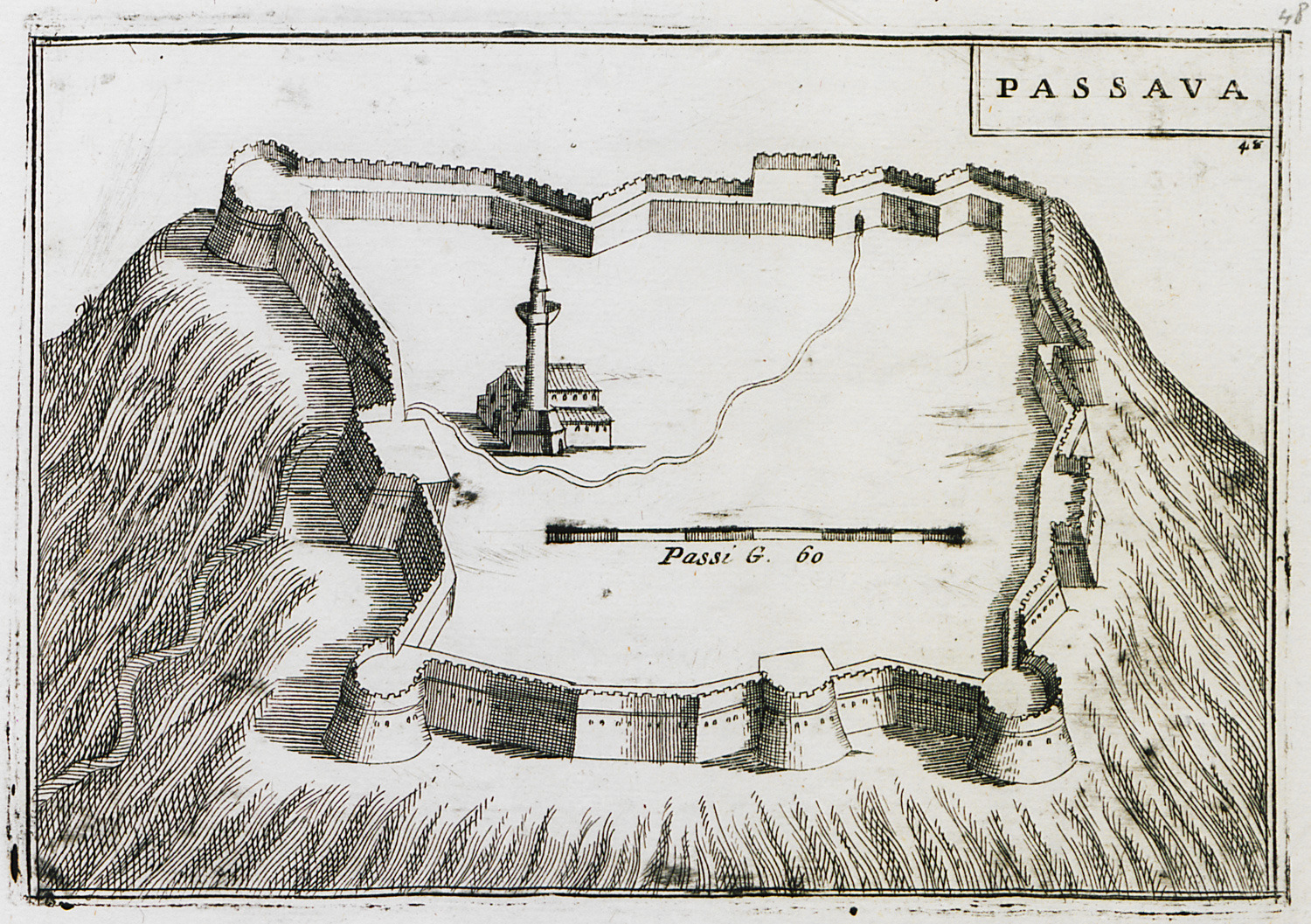
Local historical accounts describe Ottoman possession, Venetian-era conflict and a Maniot capture in 1780. Such episodes explain why an older castle could remain part of a disputed landscape long after its Frankish setting had changed. They do not establish continuous occupation or an unchanged garrison throughout every intervening period. Historical engravings offer another view of how the strongpoint was represented, rather than an exact survey of its present ruins.
A ruin with conservation needs
A Ministry of Culture contract published in 2022 included structural assessment for fire-affected Mani monuments, naming Passava. This records a conservation need and planned protective assessment; it does not prove that repairs were completed or that unrestricted access is safe today. Before attempting an approach, seek current local and archaeological-service guidance. Avoid unstable walls, overgrown interiors and exposed edges, and do not interpret the absence of a ticket office as permission to enter every part.
Architecture
- Roughly trapezoidal ruined enclosure
- Wall and tower remains above the approach route
- Main and secondary entrances identified in local documentation
- Cistern, barracks and mosque remains described by the municipality
Timeline
- 13th century Passavant was associated with a Frankish barony and a fortress linked to the de Neuilly family.
- Later medieval period The strongpoint became part of changing control on the approach to Mani; detailed phasing remains uncertain.
- 1685 Local accounts associate the castle with conflict involving Venetian and Maniot forces.
- 1780 The municipality records a Maniot capture of the castle.
- 2022 A Ministry contract included assessment for protective measures at fire-affected Passava.
Visiting today
Current managed access has not been established. Seek local and archaeological-service guidance before an approach; avoid unstable, overgrown or fire-affected fabric. The 2022 assessment record is not evidence of completed repairs or safe unrestricted entry.
Historical contexts
- Frankish Greece
- Ottoman Period
- Rise of Modern Greece
Expeditions
- Expedition I
Images
References
Related places
Topics
- Mani
- Frankish Greece
- Frontier Fortress
- Ottoman
- Ruins
- Conservation