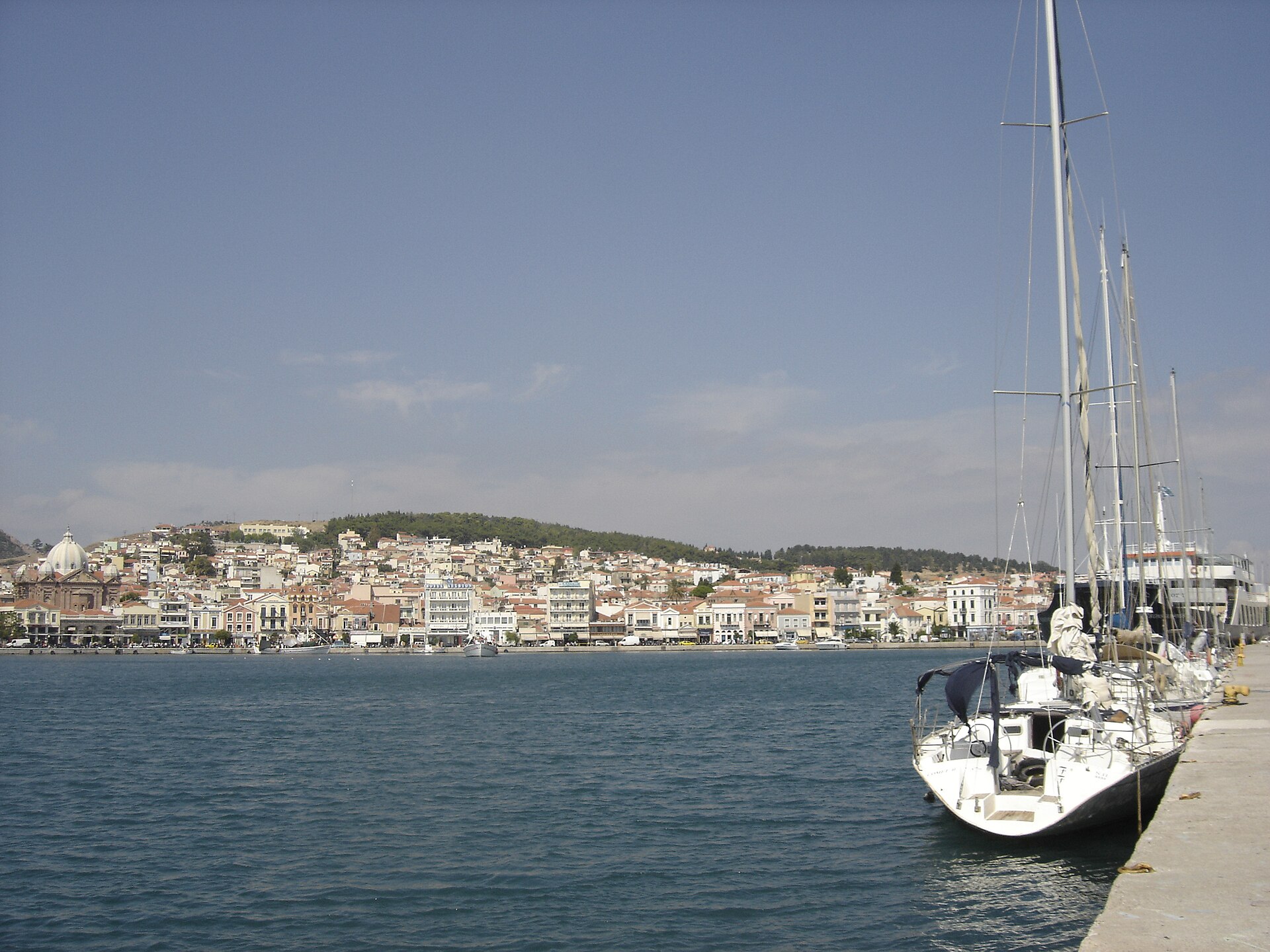
Highlights
- A city shaped by two harbors
In antiquity a narrow channel separated the castle peninsula from the adjoining land and connected the two harbor basins.
- The castle as a changing urban quarter
The fortress incorporates Byzantine remains but owes much of its visible form to the Gattilusi and subsequent Ottoman interventions.
- Roman houses in the archaeological museum
The New Archaeological Museum presents Hellenistic and Roman Lesvos through sculpture, pottery, mosaics and wall paintings, many from wealthy houses.
- Religious buildings and changing institutions
Mytilene’s religious architecture belongs to several communities and periods.
Strategic role
A harbor city whose peninsula links maritime infrastructure, fortification, religious institutions and cultural exchange.
A city shaped by two harbors
In antiquity a narrow channel separated the castle peninsula from the adjoining land and connected the two harbor basins. The Ephorate’s account identifies the northern harbor as commercial and the southern as military; later uses and shorelines changed. Remains of the northern harbor at Epano Skala preserve parts of this ancient infrastructure. They broaden the city’s defensive story: walls were connected to the movement of ships, people and goods, while the channel itself contributed to protection. The modern waterfront is therefore one stage in a much longer maritime landscape.
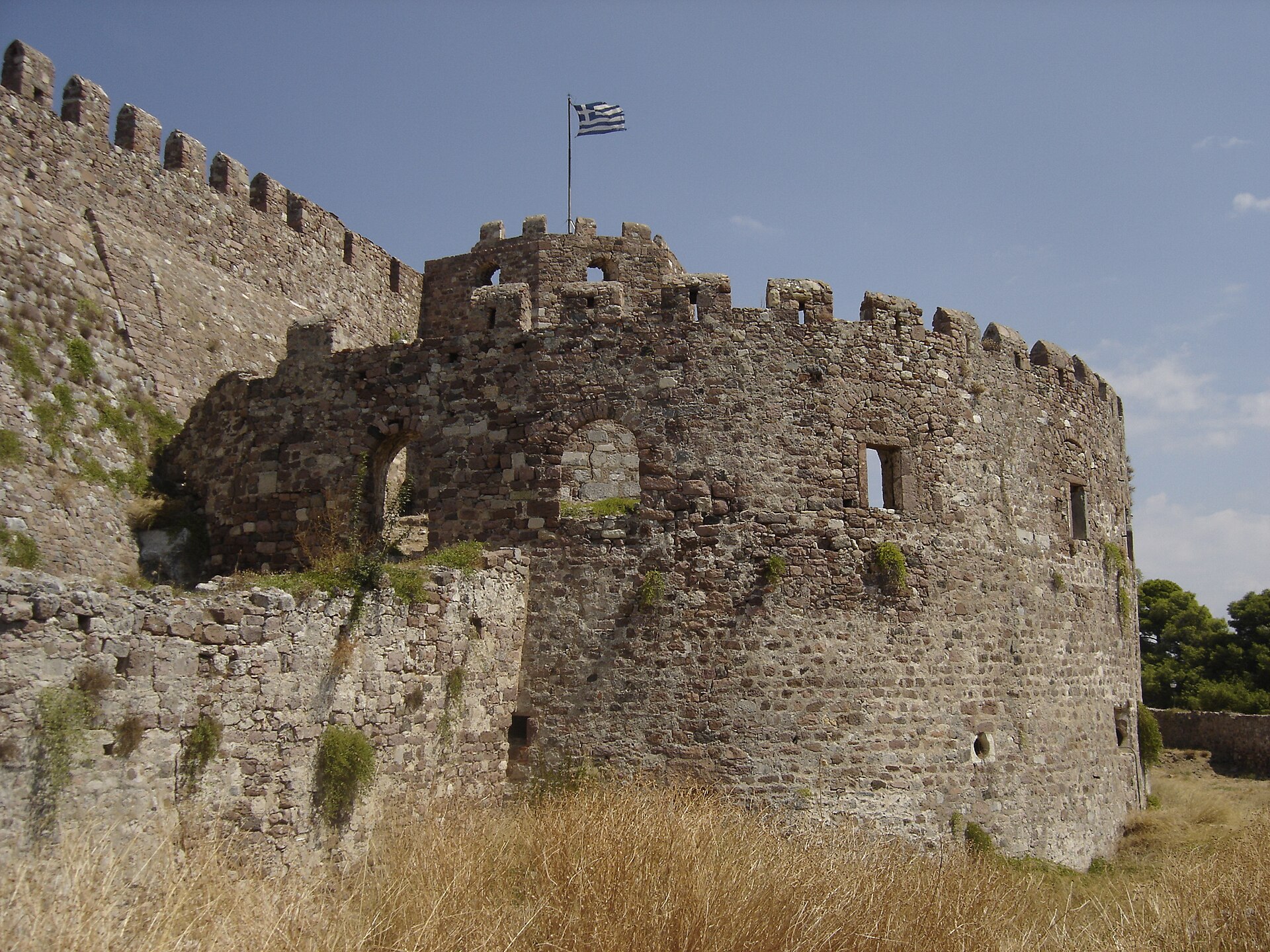
The castle as a changing urban quarter
The fortress incorporates Byzantine remains but owes much of its visible form to the Gattilusi and subsequent Ottoman interventions. Heraldry records the relationship of the Genoese dynasty with the Palaiologoi, while later gates, outworks and circular towers altered the defenses. Inside were not only military structures but water storage, worship, education and habitation. Upper, Middle and Lower Castle are different parts of this complex. Follow their relationship to the northern harbor rather than imagining a single isolated keep with an unchanging garrison.
Roman houses in the archaeological museum
The New Archaeological Museum presents Hellenistic and Roman Lesvos through sculpture, pottery, mosaics and wall paintings, many from wealthy houses. The floors associated with the House of Menander connect performance, literary culture and elite domestic display. These objects bring another social world into view beside the fortress: comfortable residences and artistic patronage rather than military occupation alone. The museum’s regional scope matters. Not every object was found at the spot where the museum now stands, and the collection is not a substitute for distinguishing individual archaeological sites.
Religious buildings and changing institutions
Mytilene’s religious architecture belongs to several communities and periods. Agios Therapon remains a conspicuous Christian landmark; mosques, schools and baths preserve another layer of the Ottoman city. In 2026 the Ministry of Culture reported completion of work on the church’s roofs and domes and on the mosque long known as Valide. Archival research identifies the latter as the Balizade Hasan Bey Mosque of 1620–1621. Its restoration and cultural reuse should be distinguished from the condition of other mosques: one completed project does not establish access to every historic religious building.
Theophilos and Teriade beyond the center
The city’s cultural geography extends toward Vareia, where the Theophilos and Teriade museums are separate destinations. The Teriade institution connects the local-born publisher Stratis Eleftheriadis with twentieth-century art and the book as an artistic medium. Its collection includes publications and work associated with major modern artists, alongside Greek painters. These museums add another meaning to Mytilene’s outward connections: movement across the Aegean and Europe carried images and ideas as well as commodities. They should not be confused with the archaeological museum near the castle.
Conservation is part of the present landscape
Modern restoration is changing the legibility of the fortress and city. The Ministry’s 2026 report records completion of the castle’s northern enclosure works and other individual projects, while work on the Great Enclosure remains a separate undertaking. Completed stretches should not be described as the completion of the entire castle. This distinction is useful on a visit: a conserved wall, a restricted work area and a building newly adapted for cultural use can stand near one another, each with a different history and management arrangement.
Connecting the city’s different scales
A considered visit combines the waterfront, permitted castle routes and archaeological museum, then gives separate time to the older religious and commercial districts and the museums toward Vareia. The contrast between these places explains Mytilene more fully than any one landmark. Check current opening and work-area restrictions with each operator; castle admission does not include every urban institution. The ancient northern harbor can be viewed as archaeological remains, while modern port operations and waterfront traffic require ordinary care.
Architecture
- Peninsula and ancient twin-harbor infrastructure
- Byzantine, Gattilusi and Ottoman fortress layers
- Ottoman gates, religious and service buildings within the castle
- Roman domestic mosaics interpreted in the archaeological museum
- Christian and Islamic religious landmarks in the wider city
Timeline
- Antiquity Two harbors and a connecting channel structured the city’s maritime and defensive landscape.
- 1355–1462 Gattilusi government brought major extensions and heraldic interventions to the inherited fortress.
- 1462 Ottoman conquest began a long period of additions to the castle and urban institutions.
- 1620–1621 Archival research cited by the Ministry identifies the mosque long called Valide with Balizade Hasan Bey.
- 1979 The Teriade museum opened to the public.
- 1999 The New Archaeological Museum opened, presenting Hellenistic and Roman Lesvos.
- 2026 The Ministry reported completed restoration of individual castle and city monuments, with other castle work continuing.
Visiting today
A considered visit combines the waterfront, permitted castle routes and archaeological museum, then gives separate time to the older religious and commercial districts and the museums toward Vareia. The contrast between these places explains Mytilene more fully than any one landmark. Check current opening and work-area restrictions with each operator; castle admission does not include every urban institution. The ancient northern harbor can be viewed as archaeological remains, while modern port operations and waterfront traffic require ordinary care.
Historical contexts
- Late Byzantium
- Genoese Aegean
- Ottoman Period
- Rise of Modern Greece
- Harbor Defense and Sea-Lane Control
Expeditions
- Expedition III
Images
References
- Ephorate of Antiquities of Lesbos — Northern ancient harbor
- Ephorate of Antiquities of Lesbos — Mytilene Castle
- Hellenic Heritage — New Archaeological Museum of Mytilene
- Ministry of Culture — Completed Mytilene conservation projects
- Ministry of Culture — Restoration and identification of Balizade Hasan Bey Mosque
- Municipality of Mytilene — Teriade Museum
- Municipality of Mytilene — Museums
- Ministry of Culture — New Archaeological Museum directory
Related places
Topics
- Mytilene
- Historical Landscape
- Material Culture
- Visitor Context