Highlights
- A coastal town with an Ionian outlook
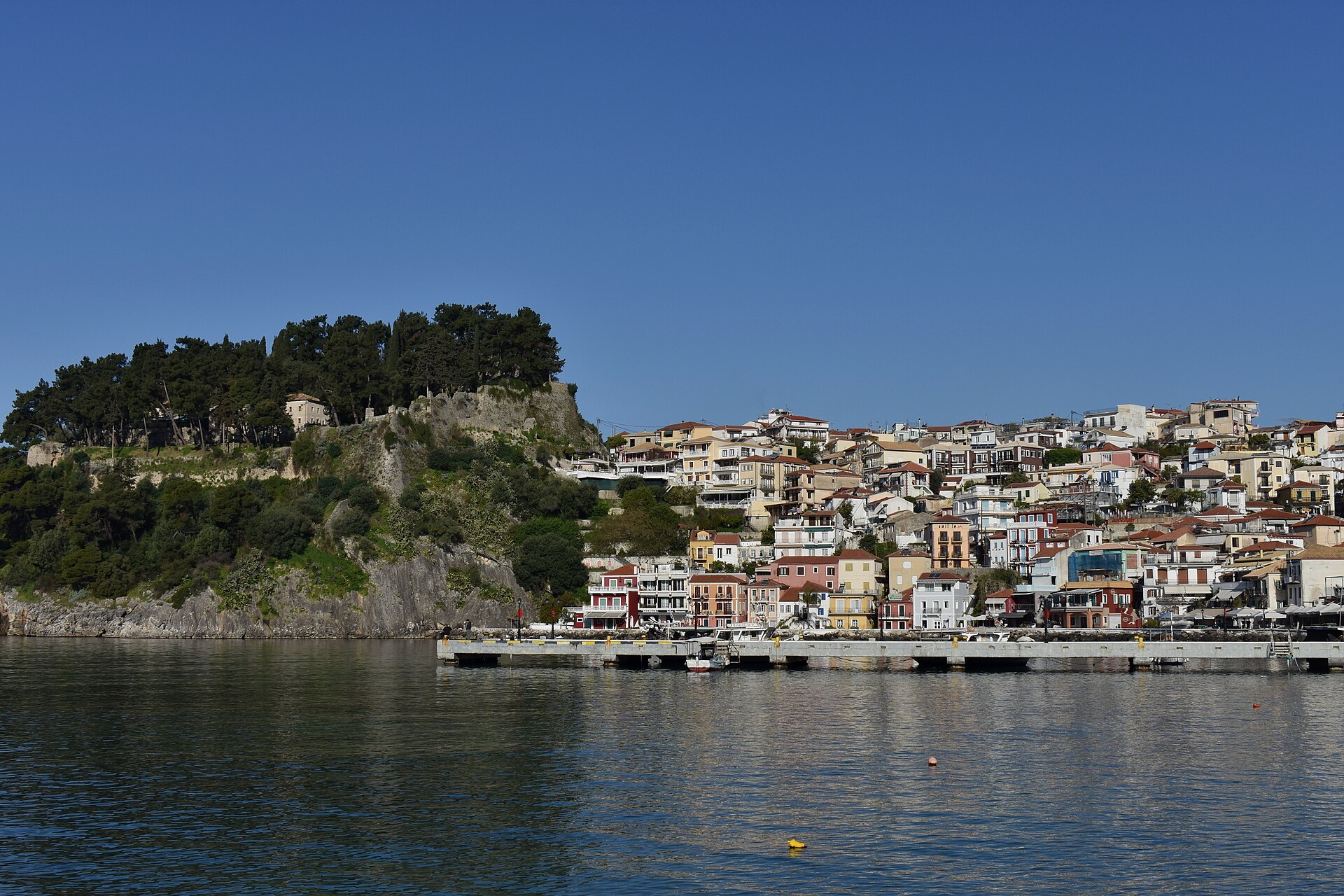
The town climbs around its bay beneath the castle peninsula, with Panagia islet close to the waterfront.
- Protection, privilege and trade
In 1401 Parga’s inhabitants entered an agreement with Venice.
- Two layers of military authority
The approach passes through defended gateways and a covered passage, with inscriptions and the Venetian lion expressing the town’s relationship to its protectors.
- The transfer and departure of 1819
After the fall of Venice, Parga passed through successive arrangements involving France, Russia, the Ottoman Empire and Britain.
Strategic role
A mainland coastal town linked to Corfu through protection, exchange and the memory of 1819 displacement.
A coastal town with an Ionian outlook
The town climbs around its bay beneath the castle peninsula, with Panagia islet close to the waterfront. Lanes and houses connect the shore with the defended height. This is a mainland community whose built character and historical connections look toward the Ionian islands. The view across water matters, but so does the town’s position between coastal movement and the Epirote hinterland.
Protection, privilege and trade
In 1401 Parga’s inhabitants entered an agreement with Venice. Protection and privileges helped make the town a commercial and strategic partner of Corfu rather than simply a subordinate fortress. Repeated attacks and rebuilding shaped the defenses. Much of the surviving castle dates from Venetian work after 1571, while the settlement expanded beyond its walls during a later period of prosperity.
Two layers of military authority
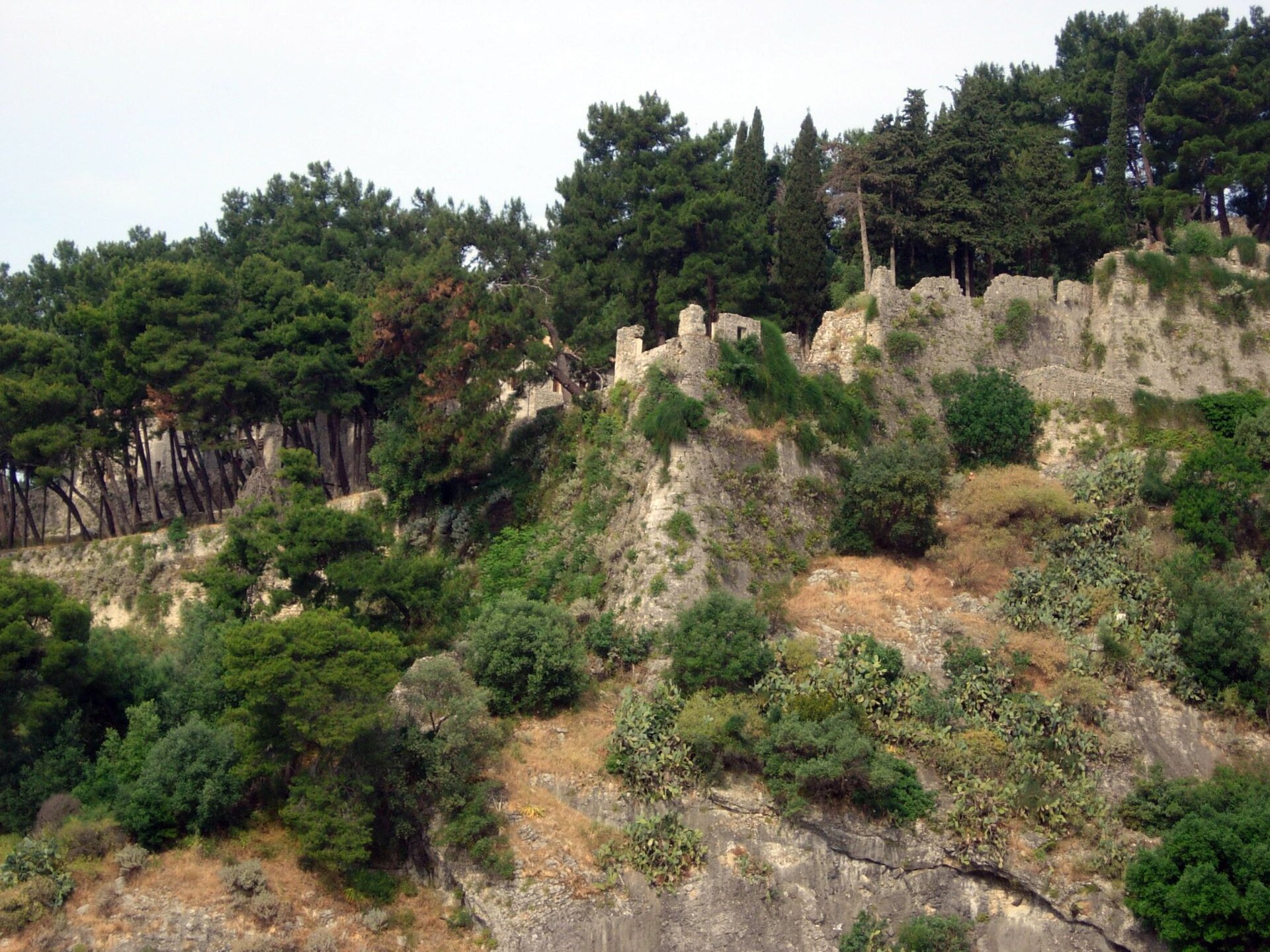
The approach passes through defended gateways and a covered passage, with inscriptions and the Venetian lion expressing the town’s relationship to its protectors. Above the broader enclosure, Ali Pasha created an internal citadel in 1819–1820. Its separate wall and service spaces mark a new concentration of military authority. The ruins are therefore more than a uniformly Venetian outline: their internal hierarchy records a later political transformation.
The transfer and departure of 1819
After the fall of Venice, Parga passed through successive arrangements involving France, Russia, the Ottoman Empire and Britain. The British agreement to transfer it to Ali Pasha led to the departure of most inhabitants in 1819, many for Corfu. The episode is central to local memory. The transfer changed both authority over the fortifications and the community whose lives had been tied to them.
Religious and cultural places in the living town
Agios Nikolaos and the ecclesiastical collection in the town center offer a different register of Parga’s history from its walls. The municipality also identifies nearby religious sites and the separate castle of Ali Pasha at Anthousa. Anthousa is not the citadel inside Parga’s main castle. Keeping those destinations distinct allows the town’s religious, residential and defensive landscapes to remain legible without combining every sight into one monument.
Reading the town and castle together
Explore the waterfront and lanes as well as the climb to the castle. Inside, observe changes of level, ruined domestic and religious spaces, and the separation of the upper citadel. Check current access and collection opening before relying on interiors; no permanent timetable is assumed here. Respect residential streets and worship spaces. The nearby bays are part of the coastal setting, not proof of safe landing or berthing conditions.
Architecture
- Fortified peninsula between town bay and Valtos
- Defended gateways and vaulted entry passage
- Venetian insignia and inscriptions
- Separate early 19th-century upper citadel
- Ruined residential and religious spaces
- Stepped lanes and houses below the castle
Timeline
- Early 14th century Parga appears in written sources; the precise earliest castle remains uncertain.
- 1401 An agreement placed Parga under Venetian protection.
- After 1571 Venetian rebuilding contributed much of the surviving castle form.
- 17th century The settlement expanded beyond the walls.
- 1817–1819 British arrangements transferred Parga to Ali Pasha; most inhabitants departed before the handover.
- 1819–1820 Ali Pasha created the upper citadel within the castle.
Visiting today
Combine town lanes, waterfront and castle rather than visiting the viewpoint alone. Confirm current castle and ecclesiastical collection access. Anthousa’s Ali Pasha castle is a separate destination; do not confuse it with the citadel within Parga Castle.
Historical contexts
- Venetian Maritime Empire
- Ottoman Period
- Rise of Modern Greece
- Harbor Defense and Sea-Lane Control
Expeditions
- Expedition IV
Images
References
Related places
Topics
- Epirus
- Ionian Connections
- Venetian
- Coastal Town
- Migration Memory
- Ottoman
- Religious Heritage