Overview
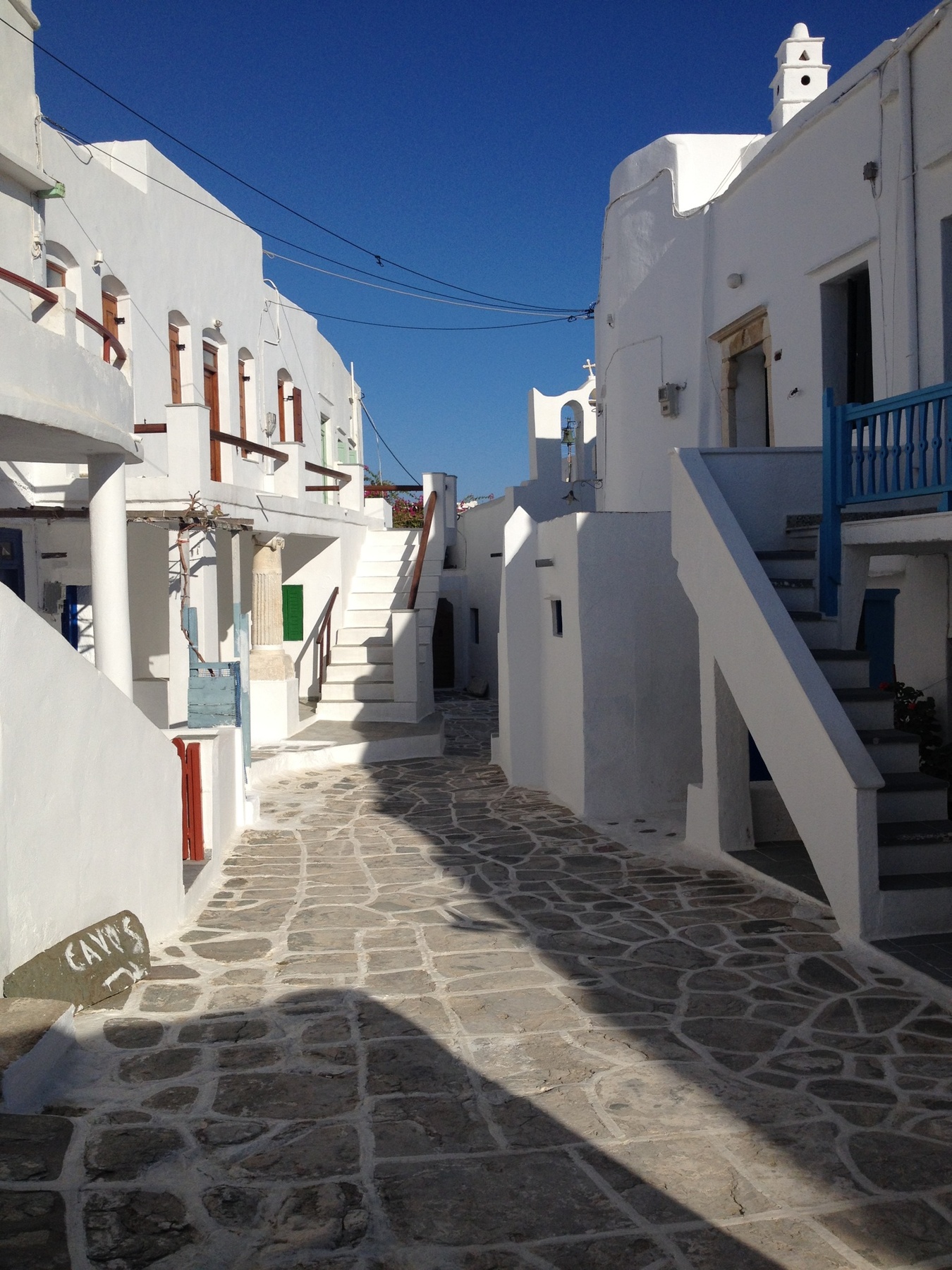
Sifnos occupies a distinctive place in the western Cyclades. Archaeological evidence documents activity from the Neolithic and Early Bronze Age, when communities already exploited the island's metal-bearing geology. At Agios Andreas a strongly fortified acropolis was established at the end of the 13th or beginning of the 12th century BC; after a period of abandonment it was resettled in the Geometric period and flourished into the Archaic age. By the 6th century BC Sifnos had become one of the wealthiest island communities in the Aegean, a prosperity associated in ancient tradition and modern archaeology with gold, silver and lead mining. The Siphnians famously dedicated a richly sculpted treasury at Delphi. Across the island, dozens of stone towers—many dating to the Classical and Hellenistic periods—formed a conspicuous rural and defensive landscape whose precise functions probably included observation, refuge, communication and control of agricultural and mining territories. Kastro, built over the ancient city and acropolis, remained the political center into the nineteenth century. Its medieval form developed through close-packed houses arranged as defensive rings, with an inner fortified nucleus and limited gates. Latin families including the Da Corogna and Gozzadini shaped its later medieval history before Ottoman sovereignty. Elsewhere, Apollonia, Artemonas, Exambela and the other central settlements developed a vernacular architecture of whitewashed houses, cistern roofs, flaroi chimneys, paved lanes, dovecotes and terraces. Sifnos's identity is equally tied to ceramics, religious festivals, monastic foundations and foodways—most famously revythada and mastelo, dishes inseparable from local clay vessels. The result is an island where archaeology, architecture, craft and ritual remain visibly connected.
Highlights
- Agios Andreas Acropolis
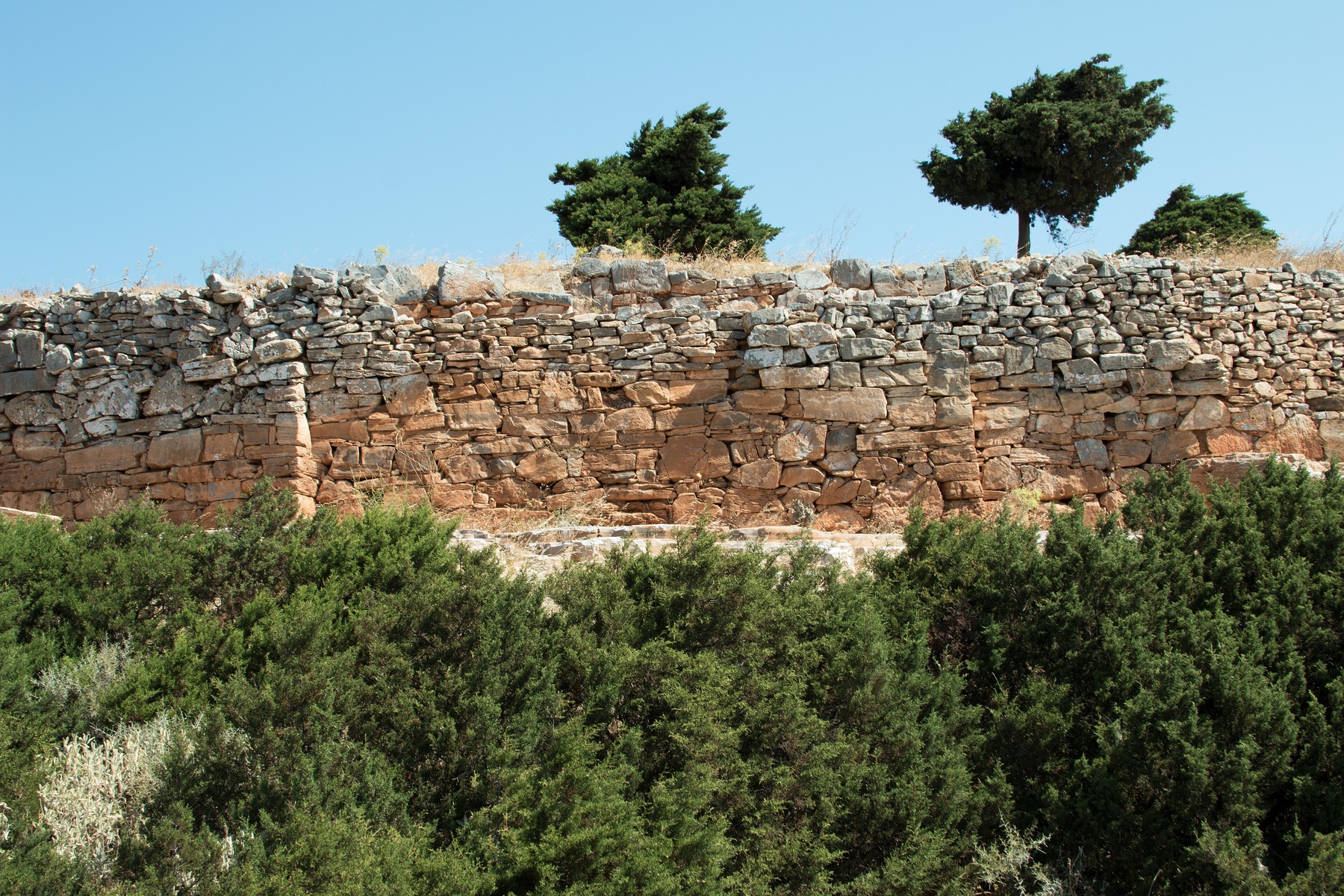
A major Mycenaean fortified settlement with Cyclopean walls, bastions and gates, later resettled in the Geometric and Archaic periods.
- Archaic Mineral Wealth
Ancient silver, lead and gold resources helped make Sifnos exceptionally prosperous and financed the celebrated Siphnian Treasury at Delphi.
- Kastro
One of the Cyclades' best-preserved medieval defensive settlements, built over the ancient city and organized through rings of fortified houses.
- Ancient Towers
Dozens of Classical and Hellenistic stone towers form an island-wide landscape of surveillance, refuge and territorial control.
- Panagia Chrysopigi
The island's patronal sanctuary occupies a spectacular rocky promontory and anchors a living cycle of procession, pilgrimage and communal feasting.
- Sifnian Pottery
A craft with prehistoric roots remains active today, linking clay, architecture, cooking vessels and the island's culinary identity.
- Revythada and Mastelo
Signature dishes demonstrate the close connection between local foodways, wood-fired ovens and Sifnian ceramic vessels.
- Nikolaos Tselementes
The influential twentieth-century chef and cookbook author was born in Exambela and became a defining figure in modern Greek culinary history.
- Churches and Monasteries
Hundreds of sacred buildings create an unusually dense religious landscape that includes educational, artistic and communal institutions.
- Terraced Landscape
Dry-stone terraces, cistern roofs, windmills, dovecotes and paths reveal centuries of adaptation to limited water and steep terrain.
Strategic role
A metallurgical and maritime island community whose ancient wealth, fortified settlements, tower network, religious institutions, ceramics and vernacular architecture reveal long adaptation to the resources and insecurities of the western Cyclades.
Sifnos in the Western Cyclades
Sifnos belongs to the western Cycladic group and occupies about seventy-four square kilometers of rugged terrain broken by ravines, cultivated valleys and deeply indented bays. Kamares, Vathy, Platy Gialos, Kastro and Cherronisos offer sheltered maritime approaches, while the island's highest ridges rise toward Profitis Elias. This geography helps explain the unusual density of archaeological sites. Metal-bearing geology encouraged extraction and exchange from prehistory; elevated hilltops favored acropoleis, towers and monasteries; limited arable land produced a landscape of terraces; and protected bays connected inland villages with Aegean routes. Sifnos is therefore best understood not as a single fortified settlement but as an island system in which mines, acropoleis, rural towers, harbors, pottery workshops, sacred sites and compact villages developed in close relationship.
Prehistoric Metallurgy and the Earliest Communities
The island's archaeological importance begins in prehistory. The Ephorate of Antiquities of the Cyclades records activity from the Neolithic and the creation of settlements during the late fourth and third millennia BC at places including Akrotiraki and Vathy, as well as on the hills later occupied by the acropoleis of Kastro and Agios Andreas. Mining was crucial. Sifnos possessed deposits of silver, lead and copper, and early exploitation helped connect the island to broader Aegean metallurgical networks. The Ephorate explicitly links Sifnian mining with the technological transformation of Early Bronze Age society, when access to metal ores encouraged specialized knowledge, exchange and new forms of economic organization. The scale and chronology of individual workings remain subjects of archaeological study, but there is no doubt that metallurgy was one of the structural foundations of ancient Sifnian prosperity.
Agios Andreas: A Mycenaean Fortified Acropolis
The acropolis of Agios Andreas is the most important organized archaeological site on Sifnos. Human activity on the hill is documented from at least the end of the fourth millennium BC, but the great fortified settlement belongs to the transition from the Late Bronze Age to the Early Iron Age. According to the Ephorate, the strongly fortified acropolis was founded at the end of the thirteenth or beginning of the twelfth century BC. Its defenses included a massive inner Cyclopean wall with square, semicircular and angular bastions, multiple gates and, in a later phase, a second outer wall that created a deep defensive interval between the two lines. The settlement within was densely built and organized by streets. After abandonment in the eleventh century BC, the hill was resettled around the middle of the eighth century, when old buildings and defenses were repaired and new structures, including a sanctuary, were created.
From Geometric Settlement to Archaic Sanctuary
Agios Andreas did not disappear with the collapse of the Mycenaean world. After roughly three centuries of abandonment, the hill was occupied again in the Geometric period and developed into a substantial settlement. The sanctuary founded in the eighth century BC continued in use into Hellenistic times, even after much of the residential settlement ceased to flourish. This continuity makes Agios Andreas especially valuable because it documents a long transition from Bronze Age fortified community to historical Greek settlement. The ancient name of the site has not been securely identified. Literary sources attest three Sifnian cities—Siphnos, Minoa and Apollonia—and because ancient Siphnos is securely associated with Kastro, Minoa or Apollonia remain possibilities for Agios Andreas. The uncertainty is important and should be retained rather than resolved through conjecture.
The Wealth of Archaic Sifnos
By the sixth century BC Sifnos was famous for wealth. Herodotus describes the islanders as exceptionally prosperous because of gold and silver mines and recounts both their monumental public building and the dramatic episode in which Samian exiles extorted a large payment from them. The Siphnians dedicated at Delphi one of the most celebrated treasuries of the Archaic Greek world, an Ionic building richly decorated with sculpted friezes and caryatid-like korai. The monument's quality demonstrates how mineral wealth could be converted into pan-Hellenic prestige. Ancient tradition must still be handled critically—specific mine locations, production volumes and the timing of depletion remain debated—but archaeology independently confirms intensive ancient metallurgy and a high level of material culture. Sifnos was not merely rich by island standards; for a time it participated conspicuously in the competitive monumental culture of the wider Greek world.
The Ancient City at Kastro
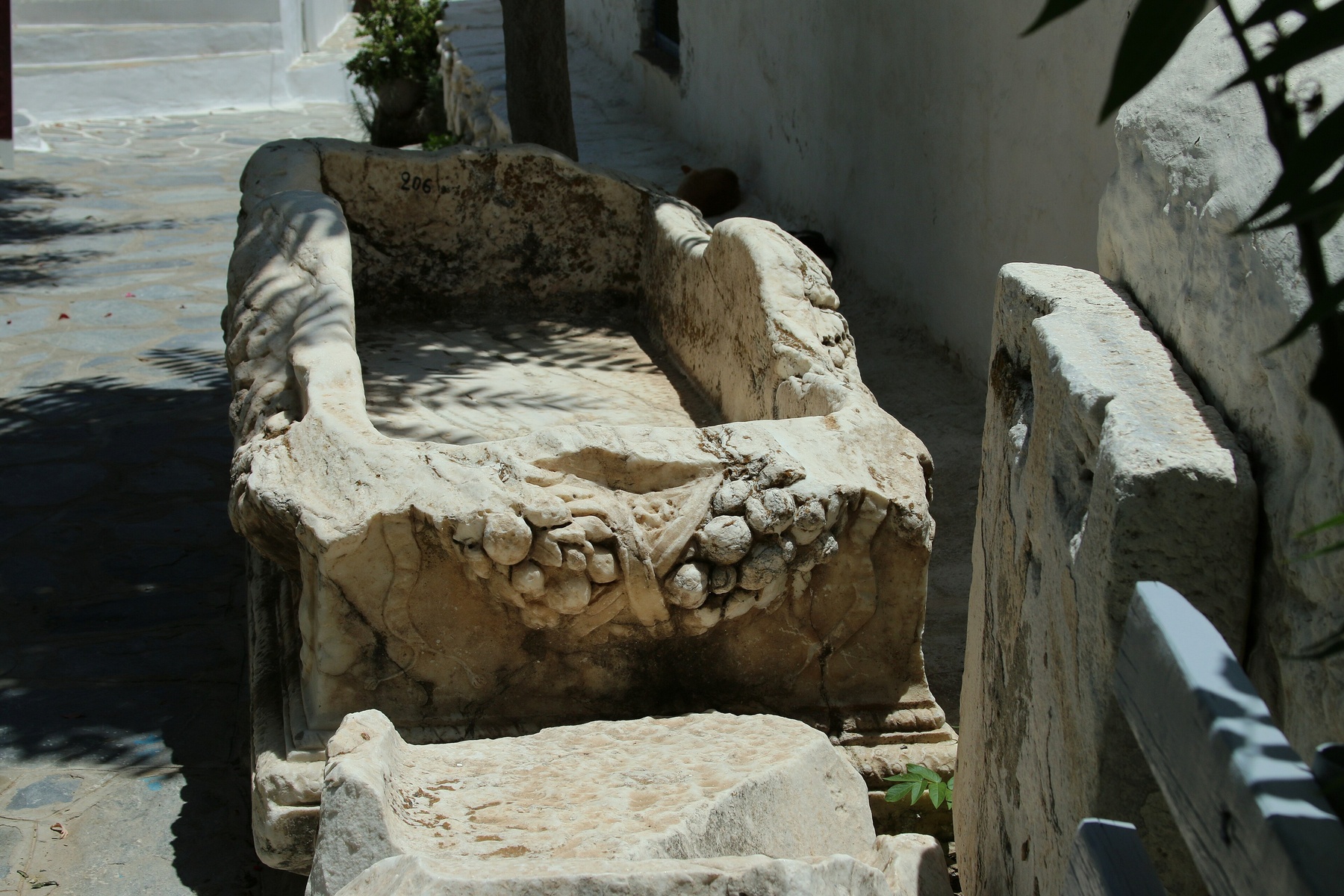
The hill of Kastro was already a major settlement long before the medieval castle-town. The ancient acropolis occupies the northwestern portion of the hilltop and survives in wall sections incorporated into the fabric of the present village. The Municipality and Ephorate identify Kastro with the ancient city of the Sifnians mentioned by Herodotus. It flourished particularly in the sixth century BC, with monumental public architecture and a religious and civic life appropriate to a wealthy polis. The settlement's maritime orientation is evident in the harbor area at Seralia below. Later Hellenistic and Roman remains, including sarcophagi now encountered within the village, demonstrate continued occupation. Few Cycladic places reveal continuity so vividly: ancient fortification stones, medieval houses, churches and modern dwellings occupy the same constrained hill.
The Island of Towers
One of Sifnos's most distinctive archaeological features is the extraordinary number of ancient stone towers scattered through the countryside. Local inventories traditionally count more than seventy. Many belong to the Classical and Hellenistic periods and were erected at elevated or strategically useful points near agricultural zones, mines and routes. Older popular interpretations described them principally as beacon towers communicating by fire, and some may indeed have participated in visual signaling networks. Modern archaeological interpretation is more cautious: the towers probably served overlapping functions, including surveillance, refuge, control of land and resources, storage, and signaling. The White Tower near Platy Gialos is among the best preserved. Collectively the towers transformed the countryside into a managed and observed landscape and are fundamental to understanding how security operated beyond the walls of the main settlements.
Roman and Early Christian Sifnos
Sifnos remained inhabited and prosperous enough to leave significant material through Hellenistic and Roman times. Rich grave goods, sarcophagi and glass vessels demonstrate continued participation in Mediterranean exchange. The political prominence of the Archaic period had faded, but the island's settlements and rural economy endured. Christianity gradually reshaped the sacred landscape, though surviving architecture is much richer for the later Byzantine and post-Byzantine centuries than for Late Antiquity itself. One of the island's most important early medieval monuments is Panagia Kitriani on the small island opposite Platy Gialos, generally dated to the late tenth or eleventh century. The proliferation of later churches would eventually make sacred architecture one of the defining visual features of Sifnos.
Byzantium, Latin Rule and the Rise of Medieval Kastro
The details of Byzantine Kastro are elusive because substantial remains of the settlement that succeeded the ancient city have not been identified securely. After the Fourth Crusade, the western Cyclades entered the fragmented political world of Latin Aegean lordships. From the early fourteenth century Kastro became associated with the Catalan Da Corogna family, present on Sifnos from 1307. An embedded marble column in the Inner Castle bears a Latin inscription naming Giannoulis da Coronia and the date 1365. Fortification of the medieval settlement has been proposed for 1374, but the Ephorate more cautiously states that Kastro was certainly fortified by the early fifteenth century, when it appears in Cristoforo Buondelmonti's cartographic work. The Gozzadini family succeeded the Da Corogna in 1465 and ruled until the Ottoman conquest of 1537, later continuing as tributary lords until the final end of Latin rule in 1617.
Kastro as Defensive Urbanism
The medieval Kastro of Sifnos is among the best-preserved examples of Cycladic defensive settlement planning. Its fortification does not follow the ancient model of a continuous freestanding wall. Instead, close-packed houses were arranged so their external walls collectively formed defensive rings. The innermost enclosure, the Mesa Kastro, occupied the summit on the foundations of the ancient acropolis and contained the residences of rulers and later senior ecclesiastical and administrative officials. Around it developed an outer residential ring, with smaller two-storey houses generally associated with less wealthy families. Narrow lanes, restricted open space and a small number of controlled entrances reflect deliberate economy of defensible space. Two southern arcaded passages or loggias still provide access into the outer enclosure. Towers reinforced vulnerable points and gates could be closed with iron-barred doors.
Houses, Status and the Social Geography of Kastro
Kastro's architecture preserves a social hierarchy within its defensive plan. The wealthiest residences clustered near the Inner Castle and could include spacious halls, marble lintels and coats of arms. The outer ring was composed largely of narrower houses, often one room deep and two storeys high. Particularly characteristic is horizontal ownership: different families could occupy separate floors of the same house, each with its own entrance and an external staircase to the upper level. This arrangement is visible in surviving façades and reflects both restricted space and the long continuity of habitation. Churches and administrative buildings punctuated the dense fabric, but there was little room for formal squares. Commercial activity appears instead to have focused partly on Seralia, the harbor below. Kastro thus combined defense, residence, government, religion and maritime access within one tightly organized urban system.
Ottoman Sifnos, the Archbishopric and Education
Ottoman sovereignty did not erase Sifnos's local institutions. The island benefited from privileges that allowed Orthodox religious life considerable room to develop, and in 1646 the Archbishopric of Sifnos was established with jurisdiction extending over numerous Aegean islands. Kastro remained an ecclesiastical as well as administrative center, housing prelates, chancery functions and metropolitan residences in the Inner Castle. Education also became an important component of island identity. The monastery of Chrysostomos in Kato Petali is associated with an early Greek school, probably operating around the mid-seventeenth century, while the School of the Holy Sepulchre at Kastro, active from 1687 to 1835, became known as the 'Paideftirion of the Archipelago.' These institutions helped Sifnos acquire an intellectual influence disproportionate to its size.
From Kastro to Apollonia
Kastro remained the island's capital through centuries of political change, but the old defensive logic gradually weakened. From the eighteenth century new buildings appeared beyond the outer ring, including workshops, storehouses, olive presses and bakeries. In 1836 the administrative capital moved to Apollonia, the centrally located settlement that still serves as the island's civic center. Together with Artemonas, Ano Petali, Kato Petali, Katavati and Exambela, Apollonia forms part of a chain of closely spaced inland villages. Their open morphology contrasts with Kastro's defensive compression. The shift in capital therefore marks more than an administrative change: it represents the transition from a society organized around fortified refuge to one increasingly structured by road connections, commerce and the central plateau.
Vernacular Architecture and the Shaped Landscape
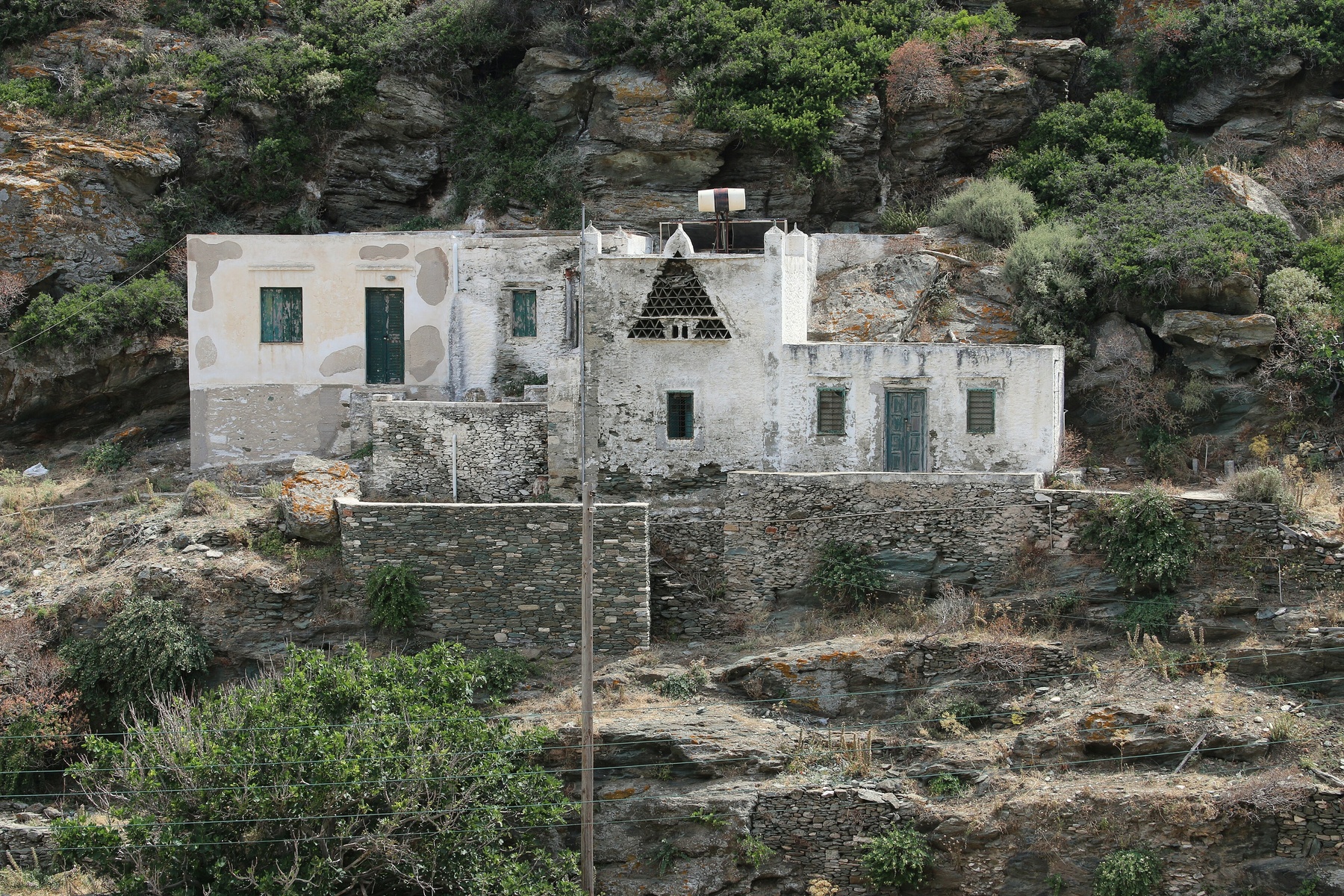
Sifnian architecture is notable for the way buildings, paths and agricultural infrastructure form a unified landscape. The central settlements have been protected since 1962 as places of outstanding natural beauty. Whitewashed houses generally have flat roofs designed to collect scarce rainwater into cisterns. Clay chimneys known as flaroi provide one of the island's most distinctive architectural details. Paved courtyards, narrow lanes, dovecotes and windmills add to the visual vocabulary. Beyond the villages, extensive dry-stone terraces retain soil and water on steep slopes while marking property boundaries. These terraces are not picturesque ornament but the accumulated result of centuries of labor. The architecture of Sifnos is consequently both environmental and social: scarcity of water, wind, terrain, agriculture, craft and communal building practices all shaped its form.
Pottery: Clay, Fire and Island Identity
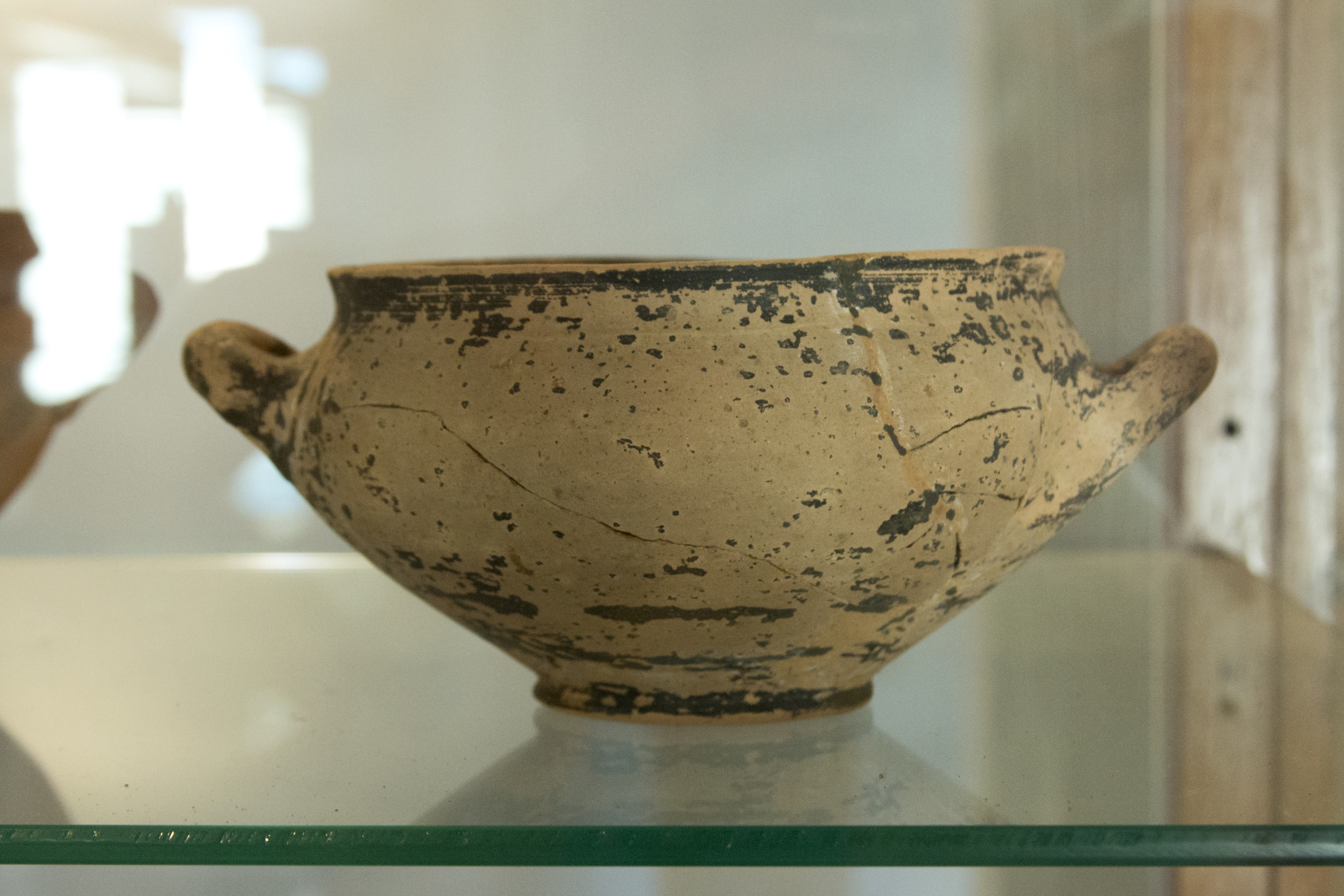
Pottery is among the longest-lived crafts of Sifnos, with roots extending back into prehistory and an unbroken importance in modern island culture. Sifnian potters developed a reputation across the Aegean and often migrated seasonally or permanently to other islands and ports while preserving distinctive forms and techniques. Local workshops traditionally exploited suitable clays and located kilns near the coast where fuel, raw materials and maritime transport could be managed. Functional vessels remained central: cooking pots, water jars, storage containers and specialized forms such as the mastelo and skepastaria linked ceramic production directly to cuisine. The flaros chimney itself is also a ceramic expression embedded in domestic architecture. Modern workshops continue to produce both traditional and contemporary ceramics, making pottery one of the rare cultural traditions on the island that connects archaeological evidence, everyday household life and present-day artistic production.
Gastronomy and Nikolaos Tselementes
Sifnos's culinary reputation is not a recent tourism invention. Foodways developed from local agriculture, pastoralism, pulses, capers, cheese, wine and the use of wood-fired communal and household ovens. Revythada—chickpeas slowly baked overnight in a covered clay vessel—and mastelo—lamb or goat cooked with wine and dill in the pot of the same name—are especially characteristic because they unite local ingredients with the island's ceramic tradition. Chickpea fritters, caper preparations, manoura cheese and almond sweets form part of the same culinary system. Sifnos is also the birthplace of Nikolaos Tselementes of Exambela, whose twentieth-century cookbooks and teaching profoundly influenced modern Greek domestic cuisine. His national importance can obscure the older island traditions that preceded him, but on Sifnos his legacy forms one layer of a much deeper relationship between craft, ritual meals and food.
Churches, Monasteries and Sacred Geography
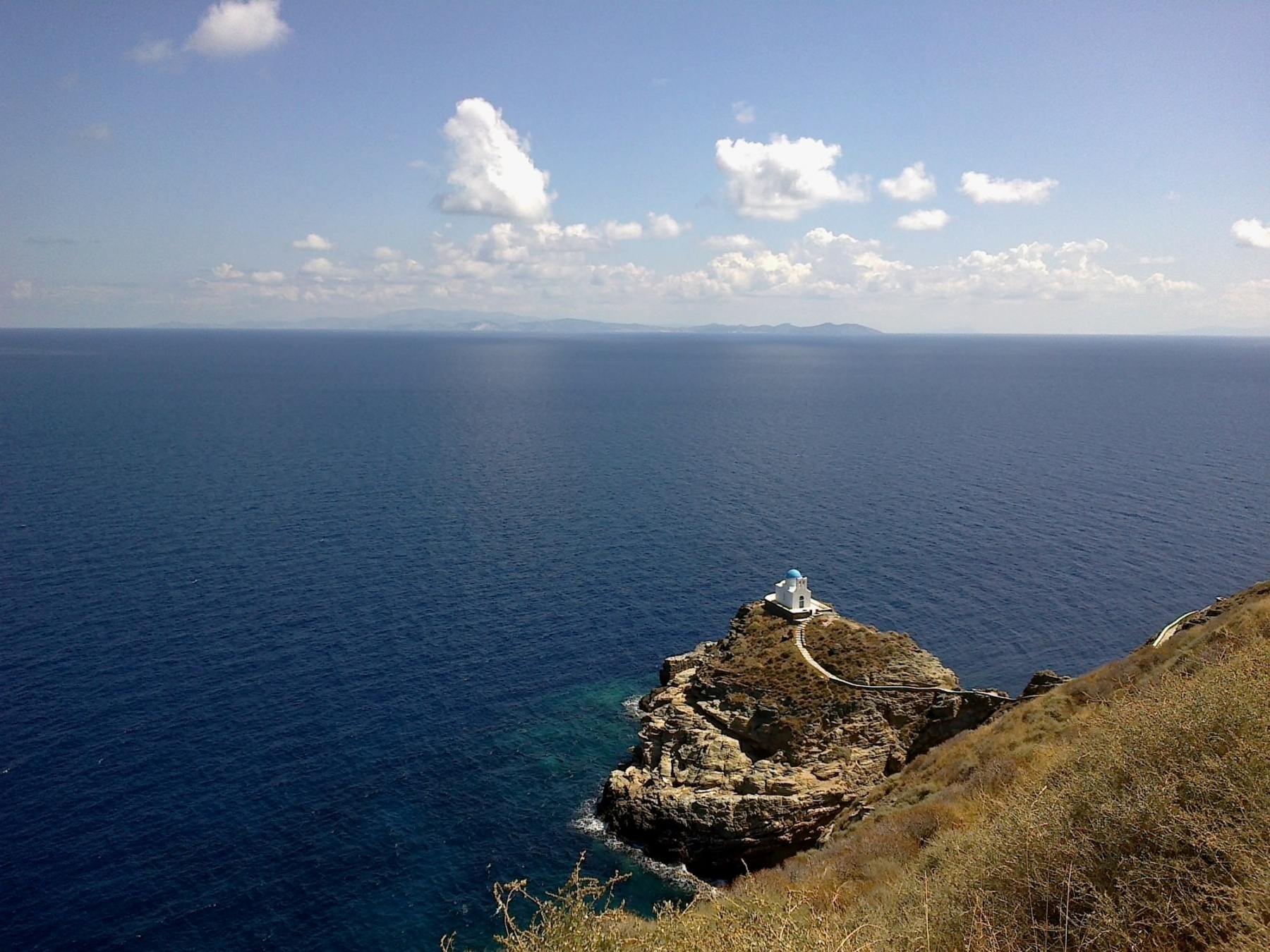
Religious architecture is extraordinarily dense on Sifnos. The Municipality records 237 churches and monasteries, a striking number for an island of its size. Many are family foundations or are maintained by local fraternities and church committees. The seventeenth-century monastery of Vryssiani, the high monastery of Profitis Elias, Panagia Fyrogia, Panagia tou Vounou and many smaller chapels create a sacred geography extending from village centers to remote ridges and coves. Several monasteries also had educational or charitable roles. Architectural form varies from compact domed churches embedded in settlements to isolated white sanctuaries commanding vast maritime views. The density of sacred buildings demonstrates the economic investment, family prestige and communal organization that historically centered on the Orthodox Church.
Chrysopigi and the Patronal Cult
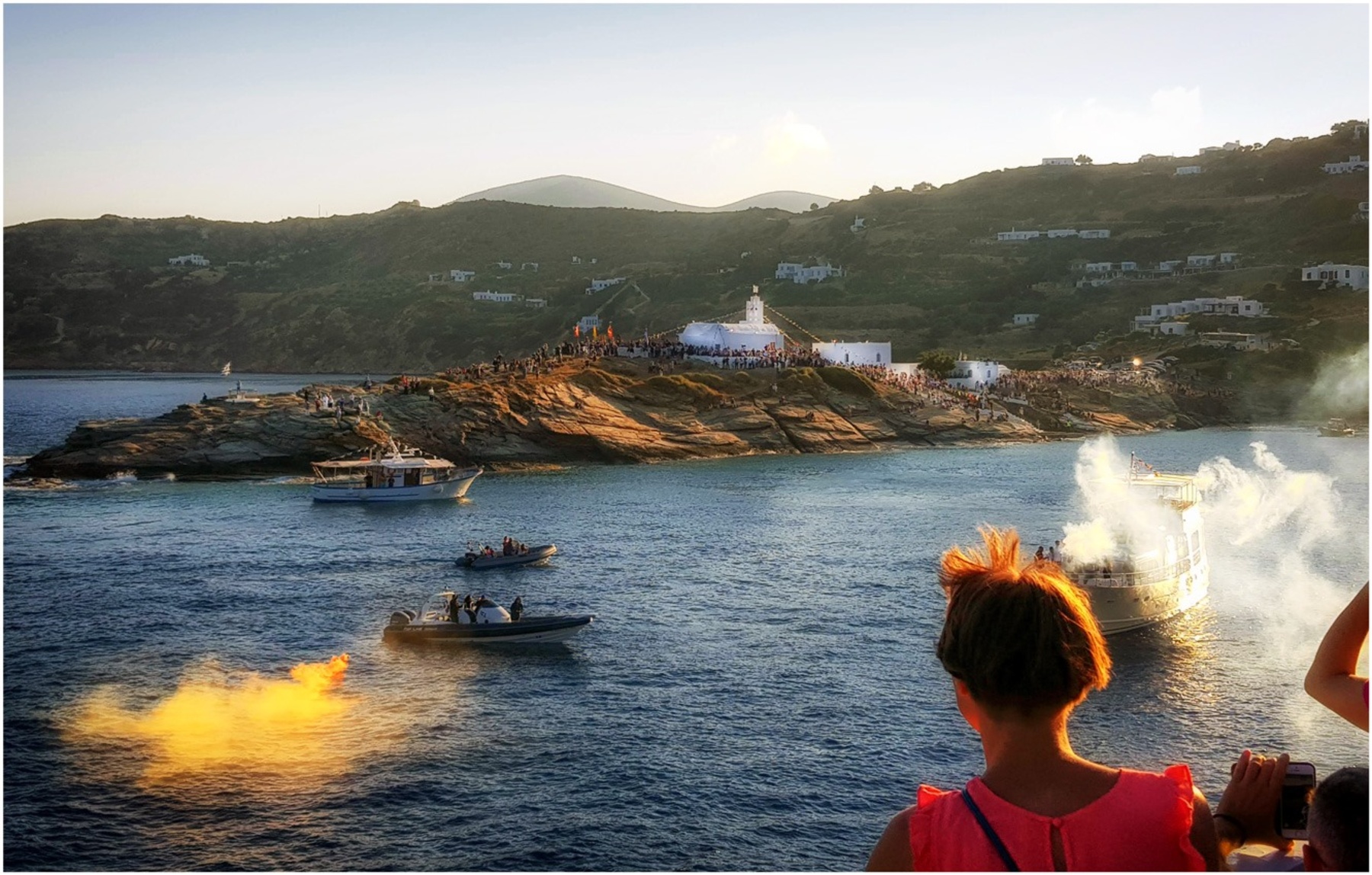
Panagia Chrysopigi, dramatically placed on a narrow rocky promontory on the southeast coast, is the island's principal pilgrimage sanctuary and one of its defining images. The patronal feast is celebrated on Ascension Day. Ritual practice extends far beyond a church service: the icon is ceremonially transferred, clergy and lay participants process through the island, maritime transport forms part of the celebration, and communal meals bind religious devotion to hospitality. The sanctuary's setting also encapsulates a recurrent Sifnian theme—the placement of sacred architecture in direct dialogue with exposed geology and the sea. Chrysopigi is consequently important not only as a monument but as the center of a living ritual network.
Panigyria and the Social Life of the Island
Sifnian panigyria preserve a highly structured form of communal celebration. Responsibility for a feast is assumed by a panigiras or a brotherhood, which maintains the church, provides food and wine, pays musicians and religious personnel, and keeps the saint's icon in a household for the following year. Evening worship is followed by communal dining at refectory-like tables, a custom locally compared to early Christian agape meals. Chickpea dishes, braised meat or fasting foods are prepared in large communal hearths, while violin and lute accompany singing and dancing into the night. The custom links household prestige, religious obligation, hospitality and collective memory. It is one of the clearest examples of intangible heritage reinforcing the island's architectural landscape: remote chapels remain maintained and socially meaningful because ritual responsibility continues to circulate through the community.
Museums and the Preservation of Sifnian Memory
Sifnos maintains several institutions that interpret different layers of its history. The Archaeological Museum at Kastro presents sculpture, ceramics and finds from the ancient city and other island sites. Agios Andreas includes an exhibition hall integrated into the organized archaeological site. The Museum of Ecclesiastical Art at Vryssiani preserves icons, liturgical vessels, vestments and documents. In Apollonia, the Popular and Folklore Museum of the Siphnians' Association presents traditional occupations, household objects, costumes, ceramics and portraits of prominent Sifnians. Together these institutions prevent the island's heritage from being reduced to whitewashed scenery: they connect standing architecture with the material record of mining, religion, domestic life, education, pottery and work.
Why Sifnos Matters
Sifnos is exceptional because successive historical systems remain legible in one compact island. Early metal extraction links it to the technological transformation of the prehistoric Aegean; Agios Andreas preserves a major Mycenaean and Geometric fortified settlement; Archaic mining wealth financed one of Delphi's most famous treasuries; the countryside's towers reveal organized control beyond urban walls; Kastro shows how medieval households themselves became fortification; Ottoman-era churches and schools record ecclesiastical and intellectual resilience; and pottery, cuisine, panigyria and terraces keep older relationships between material, labor and community alive. For Castles of Greece, the Kastro remains a central monument, but Sifnos as a whole is the richer historical subject.
Architecture
- Mycenaean fortified acropolis of Agios Andreas with Cyclopean inner wall, bastions, gates and later outer defenses
- Ancient acropolis walls at Kastro incorporated into the continuously inhabited medieval settlement
- Medieval Kastro organized in two defensive residential rings rather than a conventional free-standing fortress
- Close-packed castle-houses whose exterior walls collectively formed the defensive envelope
- Inner Castle (Mesa Kastro) containing elite residences, ecclesiastical buildings and administrative functions
- Limited gated entrances and narrow internal lanes characteristic of defensive Cycladic urbanism
- Two- and three-storey houses reflecting intense use of constrained fortified space
- Horizontal ownership in some Kastro houses, with separate families occupying different floors
- Marble lintels, heraldic elements and architectural spolia integrated into Kastro houses and churches
- Network of ancient stone towers distributed across the countryside, including the well-preserved White Tower
- Whitewashed Cycladic houses with flat cistern roofs, paved courtyards and clay flaroi chimneys
- Dry-stone agricultural terraces that retain soil and water while defining property boundaries
- Windmills and dovecotes integrated into the productive landscape
- Numerous post-Byzantine churches and monasteries, many adapted to dramatic ridge, coastal or cliff settings
Timeline
- Neolithic period Human activity is documented on Sifnos before the Bronze Age.
- Late 4th–3rd millennia BC Early Bronze Age settlements developed at several locations, while mining and metallurgy connected Sifnos to wider Aegean exchange.
- Late 13th–early 12th century BC The strongly fortified acropolis of Agios Andreas was established with Cyclopean walls, bastions and gates.
- mid-11th century BC The prehistoric settlement at Agios Andreas was abandoned.
- mid-8th century BC Agios Andreas was resettled; its fortifications were repaired and a sanctuary and new buildings were established.
- 6th century BC Sifnos reached exceptional prosperity associated with its mineral wealth and dedicated the richly sculpted Siphnian Treasury at Delphi.
- c. 525 BC Samian exiles attacked Sifnos after being refused a loan and extracted a large indemnity, an episode narrated by Herodotus.
- 5th century BC Sifnos participated in the Athenian-led alliance and paid substantial tribute recorded in Athenian lists.
- Classical–Hellenistic periods A dense network of stone towers developed across the countryside, serving surveillance, refuge, signaling and territorial functions.
- Roman period Material from cemeteries, including sarcophagi and glassware, documents continued prosperity and Mediterranean connections.
- late 10th–11th century Panagia Kitriani represents an important surviving Middle Byzantine ecclesiastical monument.
- 1204–1207 The Fourth Crusade and subsequent Latin expansion transformed the political order of the Cyclades.
- 1307 The Da Corogna family became established on Sifnos.
- 1365 A surviving Latin inscription in Kastro names Giannoulis da Coronia and provides a secure medieval chronological marker.
- early 15th century Kastro was demonstrably fortified and appears in the work of Cristoforo Buondelmonti.
- 1465 The Gozzadini family succeeded the Da Corogna as rulers of Sifnos.
- 1537 Ottoman conquest ended independent Latin lordship, although the Gozzadini later continued as tributary rulers.
- 1617 Latin rule on Sifnos ended definitively.
- 1646 The Archbishopric of Sifnos was established, extending ecclesiastical jurisdiction over numerous Aegean islands.
- c. 1650 An early Greek school operated at the monastery of Chrysostomos in Kato Petali.
- 1687–1835 The School of the Holy Sepulchre at Kastro functioned as an important educational institution known as the Paideftirion of the Archipelago.
- 18th century Kastro gradually expanded beyond its defensive rings as workshops and service buildings appeared outside the enclosure.
- 1836 The island's administrative capital moved from Kastro to Apollonia.
- 1867–1874 The metropolitan and village landscape continued to expand as post-independence Sifnos developed beyond older defensive patterns.
- 20th century Nikolaos Tselementes of Exambela became one of the most influential figures in modern Greek cookery.
- 1962 The central village settlements received formal landscape and architectural protection.
- 2010 The restored and organized archaeological site of Agios Andreas opened to visitors and received Europa Nostra recognition for conservation and presentation.
- 21st century Archaeological research, heritage conservation, ceramic production and communal religious traditions continue to shape the island's cultural identity.
Visiting today
Sifnos rewards an island-wide approach. Kastro should be paired with the Archaeological Museum and the ancient acropolis walls embedded in the village. The organized archaeological site of Agios Andreas is essential for the prehistoric and Archaic story and includes an exhibition facility. The countryside preserves numerous ancient towers, while Chrysopigi, Vryssiani, Profitis Elias and the island's smaller churches reveal the religious landscape. Apollonia, Artemonas and Exambela are important for vernacular architecture, museums, pottery and modern cultural history. Pottery workshops remain active in several settlements, especially around Platy Gialos and Vathi. Current opening hours for museums and archaeological sites should be confirmed with the Ephorate of Antiquities of the Cyclades.
Historical contexts
- Late Byzantium
- Venetian Maritime Empire
- Ottoman Period
- Rise of Modern Greece
- Harbor Defense and Sea-Lane Control
Expedition guides
Images
References
- Ephorate of Antiquities of the Cyclades — Siphnos: Island History
- Ephorate of Antiquities of the Cyclades — Acropolis of Agios Andreas, Siphnos
- Ephorate of Antiquities of the Cyclades — Kastro, Siphnos from the Byzantine Period Onwards
- Hellenic Ministry of Culture — Ancient Wall of the Acropolis at Kastro, Sifnos
- Municipality of Sifnos — History
- Municipality of Sifnos — Kastro
- Municipality of Sifnos — Architecture
- Municipality of Sifnos — Pottery
- Municipality of Sifnos — Gastronomy
- Municipality of Sifnos — Churches and Monasteries
- Municipality of Sifnos — Traditional Feasts
- Municipality of Sifnos — Museums
- Greek National Tourism Organisation — Sifnos
- Ephorate of Antiquities of the Cyclades — Opening Hours and Admission
Related places
Related Stops
Topics
- Cyclades
- Historic Island
- Fortified Settlement
- Kastro
- Mycenaean
- Ancient Greek
- Mining History
- Metallurgy
- Ancient Towers
- Latin Rule
- Venetian
- Ottoman
- Post Byzantine
- Pottery
- Gastronomy
- Vernacular Architecture
- Religious Heritage
- Maritime History