Overview
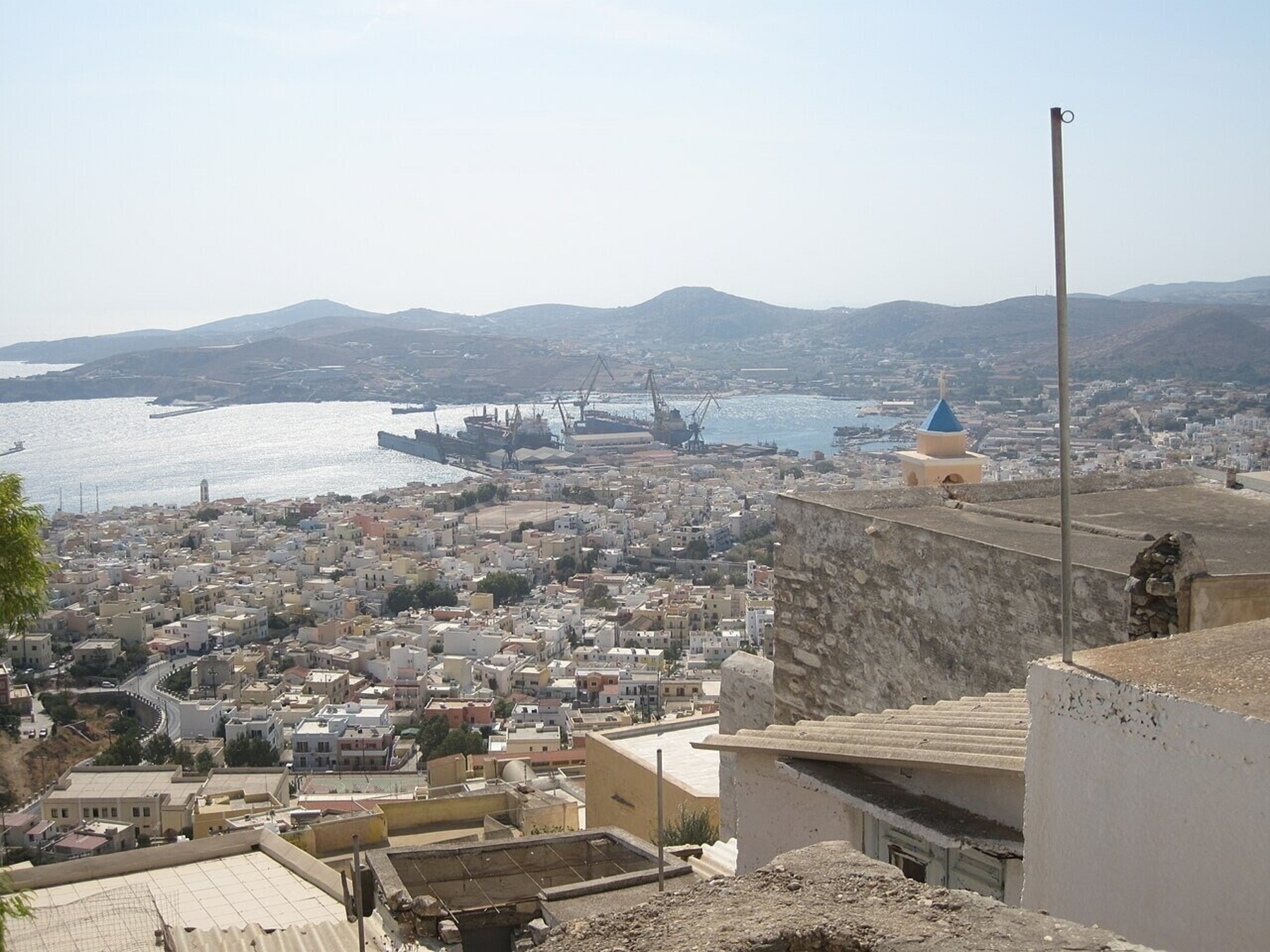
Syros differs from many Cycladic islands because its most important historical layers are not concentrated in a single castle or ancient acropolis. In the north, Chalandriani and Kastri preserve two of the defining Early Cycladic archaeological sites: the cemetery and settlement of Chalandriani and the strongly fortified Kastri acropolis of about 2300–2000 BC. During historical antiquity, the principal city occupied the site of modern Ermoupoli, while a second fortified city grew at Galissas. The natural philosopher Pherecydes, traditionally regarded as a teacher of Pythagoras, was associated with Syros. In the Byzantine and medieval periods population increasingly concentrated at Ano Syros, a hill settlement whose present urban character took shape mainly around the thirteenth century. Unlike many Cycladic castle-villages, Ano Syros was enclosed by strong purpose-built walls and entered through seven gates, of which two survive. Latin rule gave the community a durable Catholic identity; under Ottoman sovereignty it remained under papal and French protection and developed a remarkable network of Catholic institutions alongside a smaller Orthodox population. The Greek War of Independence transformed the island. Refugees from Chios, Psara, Smyrna, Kydonies, Kasos and elsewhere settled below Ano Syros and in 1826 named the rapidly growing port Ermoupoli, the City of Hermes. Within decades it became the leading port, commercial center, shipbuilding hub and one of the first industrial cities of the Greek kingdom. Its Town Hall, Apollo Theatre, Vaporia mansions, churches, warehouses and factory districts express a bourgeois urban culture unusual in the Cyclades. Syros therefore offers a continuous study in defensive settlement, religious coexistence, migration, maritime capitalism, industrialization and modern Greek cultural life.
Highlights
- Chalandriani and Kastri
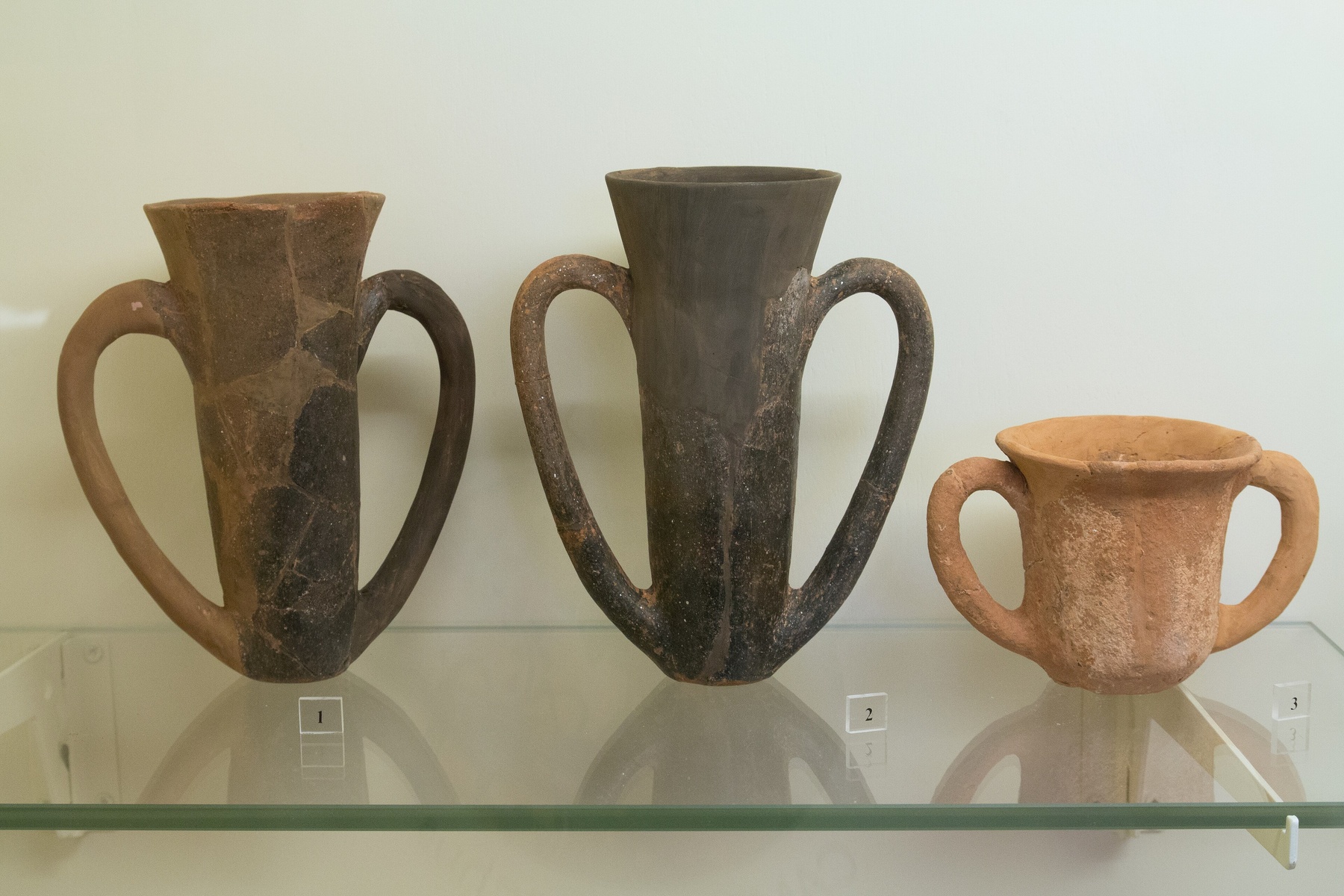
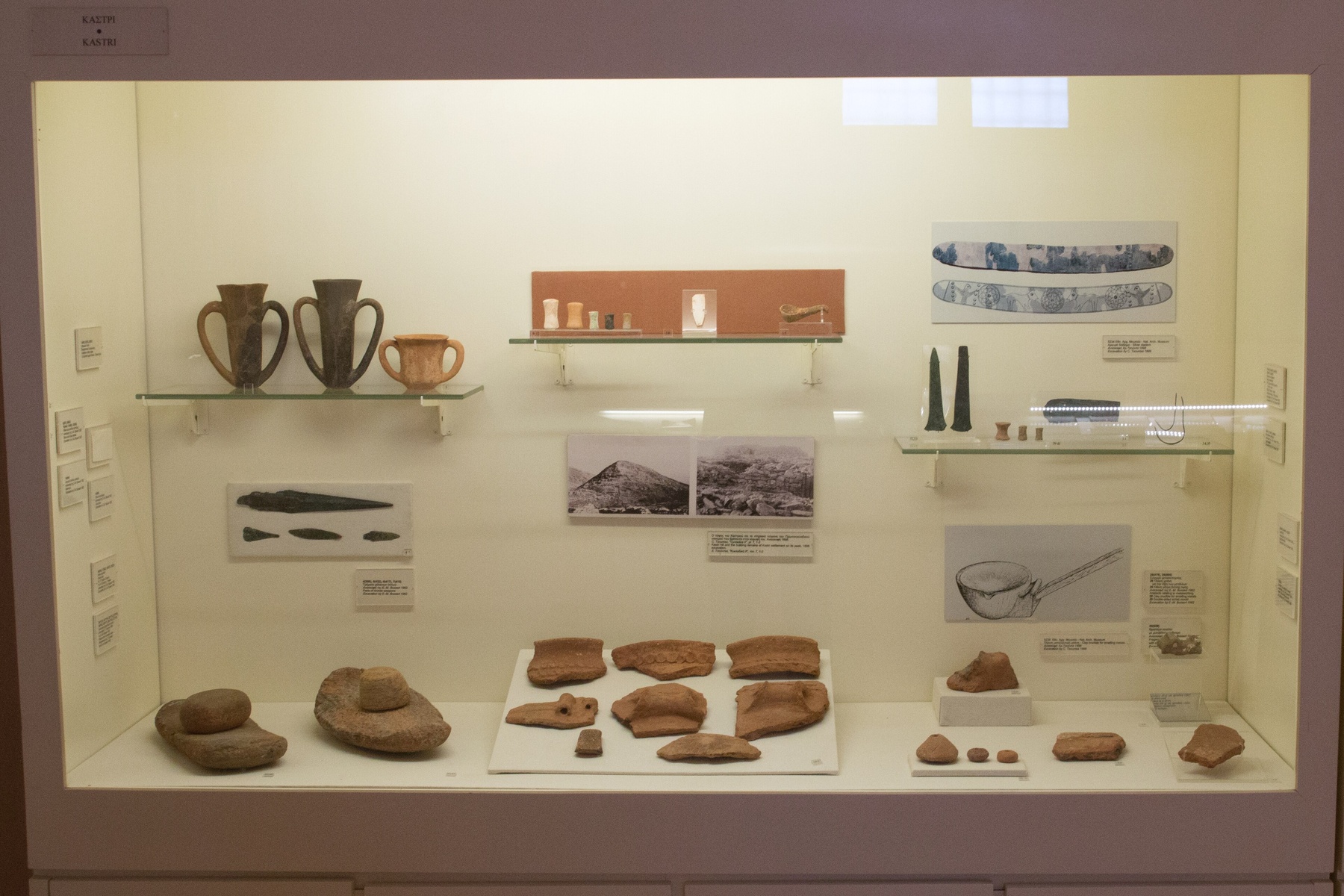
Two of the Aegean's most important Early Cycladic sites, combining a major cemetery with a fortified settlement that gave its name to the Kastri cultural group.
- Ano Syros
A genuine medieval walled town with strong purpose-built defenses, seven historical gates and a long-lived Catholic community.
- Ermoupoli
A refugee-founded city of 1826 that became the leading port, commercial hub and one of the first industrial centers of the Greek state.
- Miaouli Square and Town Hall
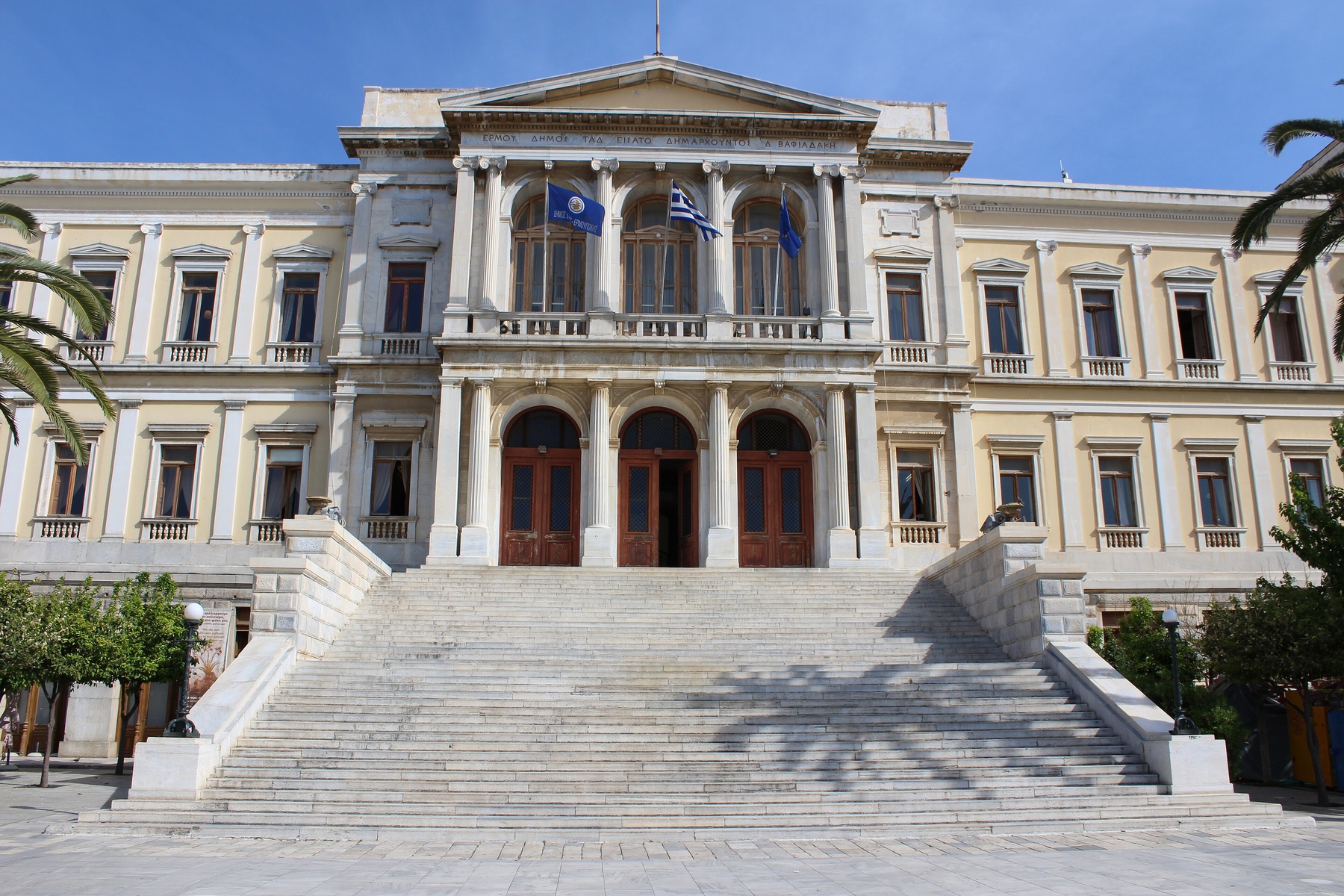
The monumental civic heart of neoclassical Ermoupoli, dominated by Ernst Ziller's Town Hall.
- Vaporia
Seafront district of merchant mansions embodying the wealth generated by nineteenth-century shipping and trade.
- Apollo Theatre
The 1862–1864 theatre designed by Pietro Sampo expresses Ermoupoli's cosmopolitan cultural ambitions.
- Industrial Heritage
Shipyards, tanneries, factories and warehouses make Syros one of Greece's most important landscapes of nineteenth-century industrialization.
- Saint George Cathedral
The Catholic cathedral crowns Ano Syros and symbolizes centuries of Latin Christian continuity in the Cyclades.
- Markos Vamvakaris
The Ano Syros-born musician became a foundational figure of rebetiko and remains central to the island's modern cultural identity.
- Grammata
Ancient and medieval prayers carved by sailors into coastal rocks preserve a rare archive of Aegean maritime devotion.
Strategic role
A strategically placed central Cycladic island whose history combines prehistoric fortified communities, ancient harbor settlements, a medieval walled capital, a resilient Catholic population, and the principal commercial-industrial port city of the early modern Greek state.
Overview
Syros is not a castle stop in the narrow sense, but one of the most historically layered islands of the Cyclades. Prehistoric Kastri provides an exceptionally early example of fortified settlement; ancient cities developed beneath modern Ermoupoli and at Galissas; medieval Ano Syros concentrated its population behind strong walls; and nineteenth-century Ermoupoli transformed the same harbor into a commercial and industrial metropolis. Catholic and Orthodox institutions, refugee history, shipbuilding, neoclassical architecture and rebetiko music make the island a compact record of major transformations in Aegean society.
Chalandriani and Kastri: A Landmark of Early Cycladic Civilization
The archaeological complex of Chalandriani and Kastri in Apano Meria is among the most important prehistoric landscapes in the Aegean. Chalandriani includes an Early Cycladic settlement and a major cemetery whose characteristic finds helped define the Keros–Syros cultural group of roughly 2700–2300 BC. Nearby Kastri belongs mainly to the succeeding Early Cycladic IIIA phase, around 2300–2000 BC. Its settlement occupied a steep, naturally defensible hill and was strengthened with substantial fortifications. Finds include pottery and metalwork showing connections not only within the Cyclades but toward Anatolia and the northeastern Aegean. The 'Kastri group' is consequently a major archaeological term, not merely a local phase. Long before the walls of Ano Syros, the island already participated in an Aegean world where security, metallurgy and long-distance exchange were closely connected.
The Ancient City Beneath Ermoupoli
The historical city of Syros occupied essentially the site later covered by Ermoupoli. Dense nineteenth-century construction hides most ancient remains, but the Ephorate records a strong fortification structure at Pefkakia, probably belonging to the ancient acropolis, and seats of a theatre or odeion preserved beneath a modern house. Nineteenth-century archaeologists also recorded sanctuaries of Poseidon and Amphitrite south of the harbor and Athena Phratria near the later Church of the Dormition. Architectural remains uncovered near Miaouli Square in 1855 were interpreted either as baths or a sanctuary of Isis. These discoveries make Ermoupoli a palimpsest: the celebrated modern city did not arise on empty ground, but over an ancient urban and harbor landscape.
Galissas: A Second Ancient Fortified City
Syros possessed another important ancient center at Galissas on the southwest coast. Excavation has revealed a settlement extending across the hills of Agia Pakou and Vounaki between the sheltered bays of Galissas and Armeos. Each hill carried a fortified acropolis, while occupation also spread beyond the defensive circuits. A circular structure interpreted as a tower once stood at the summit of Agia Pakou, beneath the later chapel. The city flourished from the Geometric through Classical periods and seems to have been known as Galissos. Its two natural harbors and paired acropoleis demonstrate how settlement, defense and maritime geography were integrated on the island centuries before medieval Ano Syros.
Pherecydes and the Intellectual Memory of Archaic Syros
The sixth-century BC thinker Pherecydes was associated in antiquity with Syros and became one of the island's most enduring historical figures. Later traditions regarded him as a teacher of Pythagoras and credited him with an innovative prose cosmology that stood between mythic genealogy and early Greek philosophical speculation. A cave on Syros bears his name, although the specific biographical traditions surrounding such places cannot be independently verified archaeologically. His importance to the island is nevertheless substantial: Pherecydes connects Syros to the intellectual transformations of Archaic Greece and gives the island a cultural history extending beyond commerce and fortification.
Roman Syros and the Harbor Economy
Syros became particularly important again in the later Hellenistic and Roman periods because of its harbor. The Ephorate notes that after the destruction of neighboring Delos in the first century BC, Syros benefited from shifting patterns of trade and developed as a transit center. Inscriptions, coins, reliefs and other finds testify to continued urban activity. This maritime function anticipated a recurring historical pattern: Syros was most successful when political or economic changes redirected regional traffic toward its secure central Cycladic harbor.
Byzantine Syros and the Formation of the Hill Settlement
Evidence for the Early Christian and Byzantine centuries is comparatively sparse. The Ephorate reports that by the fifth century the island's population was small enough to fall ecclesiastically under neighboring Delos rather than support its own metropolitan center. During the early Byzantine period settlement began to develop on the hill later known as Ano Syros. The movement away from exposed coastal positions belongs to a broader pattern of insecurity in the medieval Aegean. The church of Panagia Episkopiani at Piskopio is among the island's notable Middle Byzantine monuments. Because the documentary record is thin, the early evolution of Ano Syros should be described as gradual rather than attributed to a single foundation event.
Ano Syros and the Medieval Hill Town
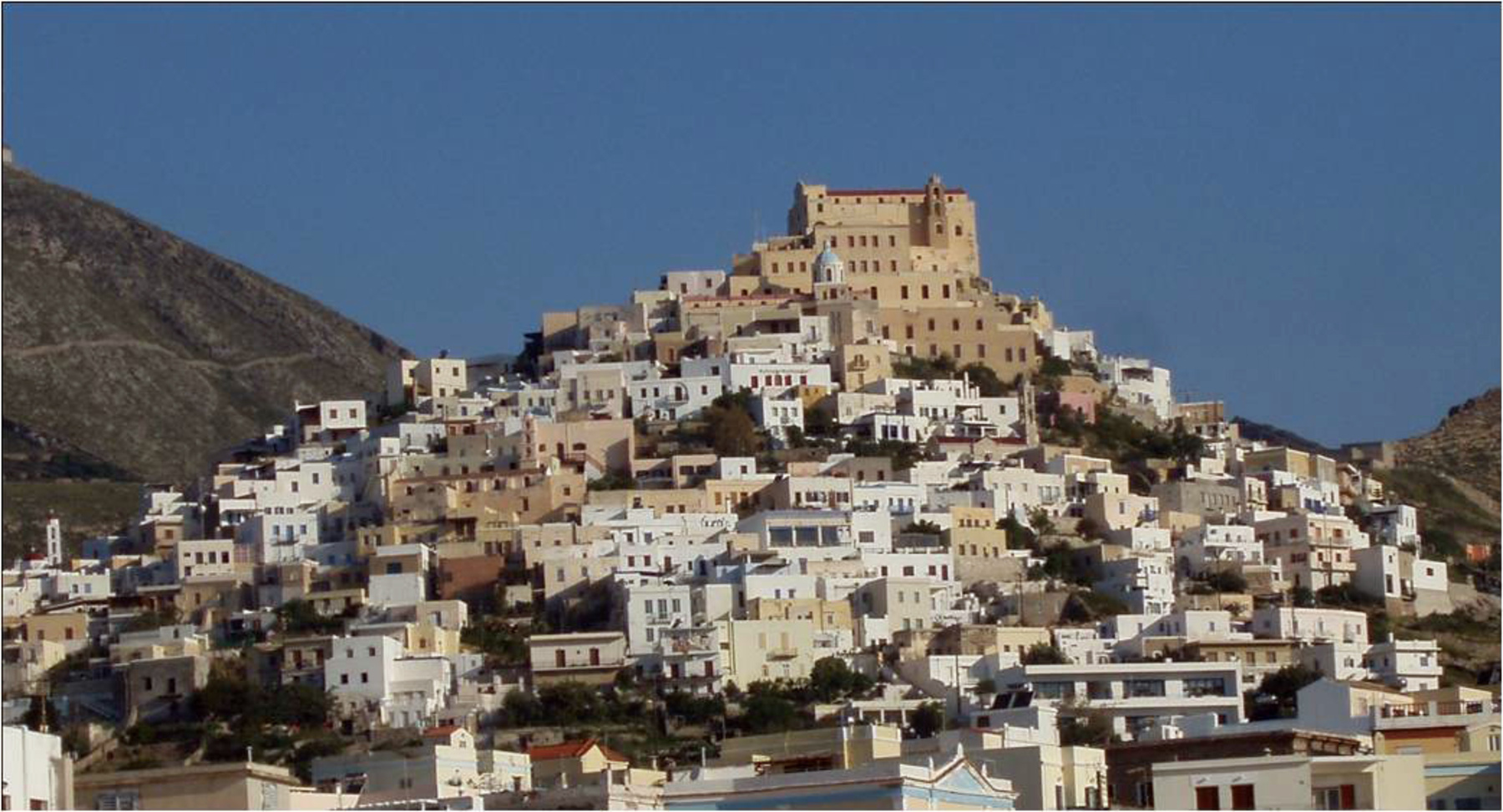
Ano Syros acquired its characteristic urban form mainly around the thirteenth century. Built on a steep hill away from the immediate shoreline, it was designed for defense against piracy and attack. The Ephorate emphasizes an important architectural distinction: unlike many Cycladic castle settlements, where the rear walls of perimeter houses served as the fortification, Ano Syros possessed strong purpose-built defensive walls. Seven gates once controlled access; only two survive. Inside, steep lanes, arches, stairs and tightly packed buildings form an organic plan adapted to the eastern slope. The settlement is therefore a genuine walled medieval town rather than simply a picturesque cluster of houses.
Latin Rule and the Catholic Identity of Ano Syros
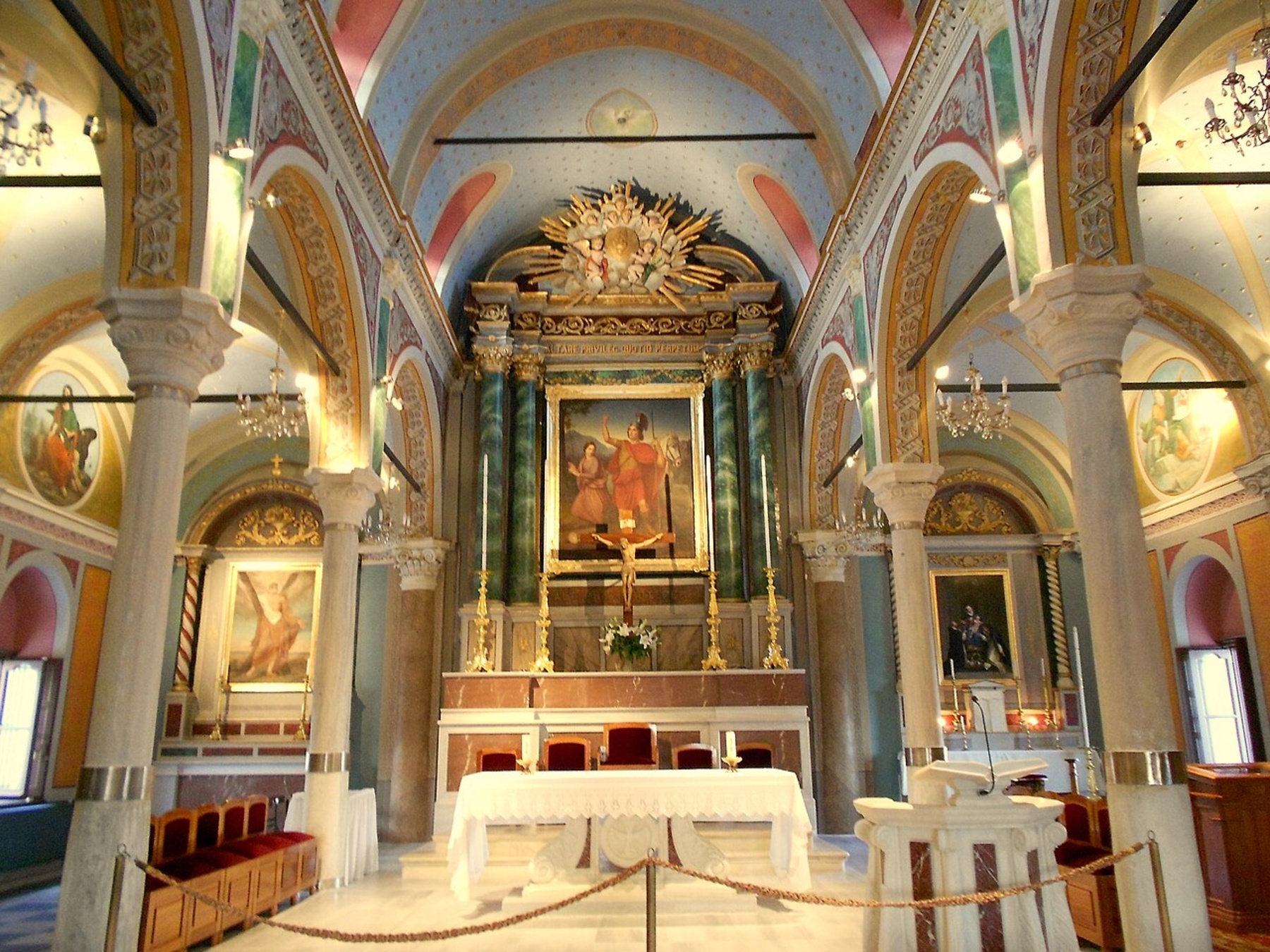
Following the Latin conquest of the Cyclades in the early thirteenth century, Syros entered a political and ecclesiastical environment dominated by western powers. The population of Ano Syros became overwhelmingly Catholic, and that identity survived later changes of sovereignty. Saint George Cathedral crowns the hill on a site used repeatedly for the Catholic metropolitan church; the existing building, the fifth church on the location, was constructed in 1832–1834. The Jesuits and Capuchins established monasteries within the settlement, while churches such as Agios Ioannis, Kioura tou Karlou and Agios Antonios preserve layers of seventeenth- and eighteenth-century Catholic devotion. Ano Syros thus became one of the most distinctive centers of Latin Christian continuity in the Greek Aegean.
Ottoman Rule, Protection and Religious Coexistence
Syros passed under Ottoman authority in 1566, yet its social history differed markedly from many neighboring islands. The Catholic population retained connections with the papacy and benefited from French diplomatic protection. The Ephorate notes that from the sixteenth through eighteenth centuries the island's population was overwhelmingly Catholic, with a much smaller Orthodox minority. Ottoman naval violence still touched the island—the Turkish fleet devastated Syros in 1617—but the long-term survival of Catholic institutions created an unusual confessional landscape. Orthodox churches also existed within Ano Syros, including Agios Nikolaos the Poor and Agia Triada. The later rise of Orthodox Ermoupoli therefore did not replace an earlier Catholic island; the two traditions continued side by side.
The Greek War of Independence and the Refugee Island
The decisive transformation of modern Syros came not from a siege but from migration. During the Greek War of Independence, refugees fleeing destruction and persecution in Chios, Psara, Smyrna, Kydonies, Kasos and other parts of the Greek world arrived at the protected harbor below Ano Syros. Because the Catholic population of the older hill town had maintained a degree of neutrality and international protection, Syros offered relative security in a violent Aegean. The refugees brought commercial networks, capital, technical knowledge and maritime experience. Their new settlement expanded with extraordinary speed. In 1826 it was formally named Ermoupoli—City of Hermes—after the god associated with commerce and eloquence. The Municipality marked 2026 as the bicentenary of this foundation.
Ermoupoli and the Rise of a Modern Port
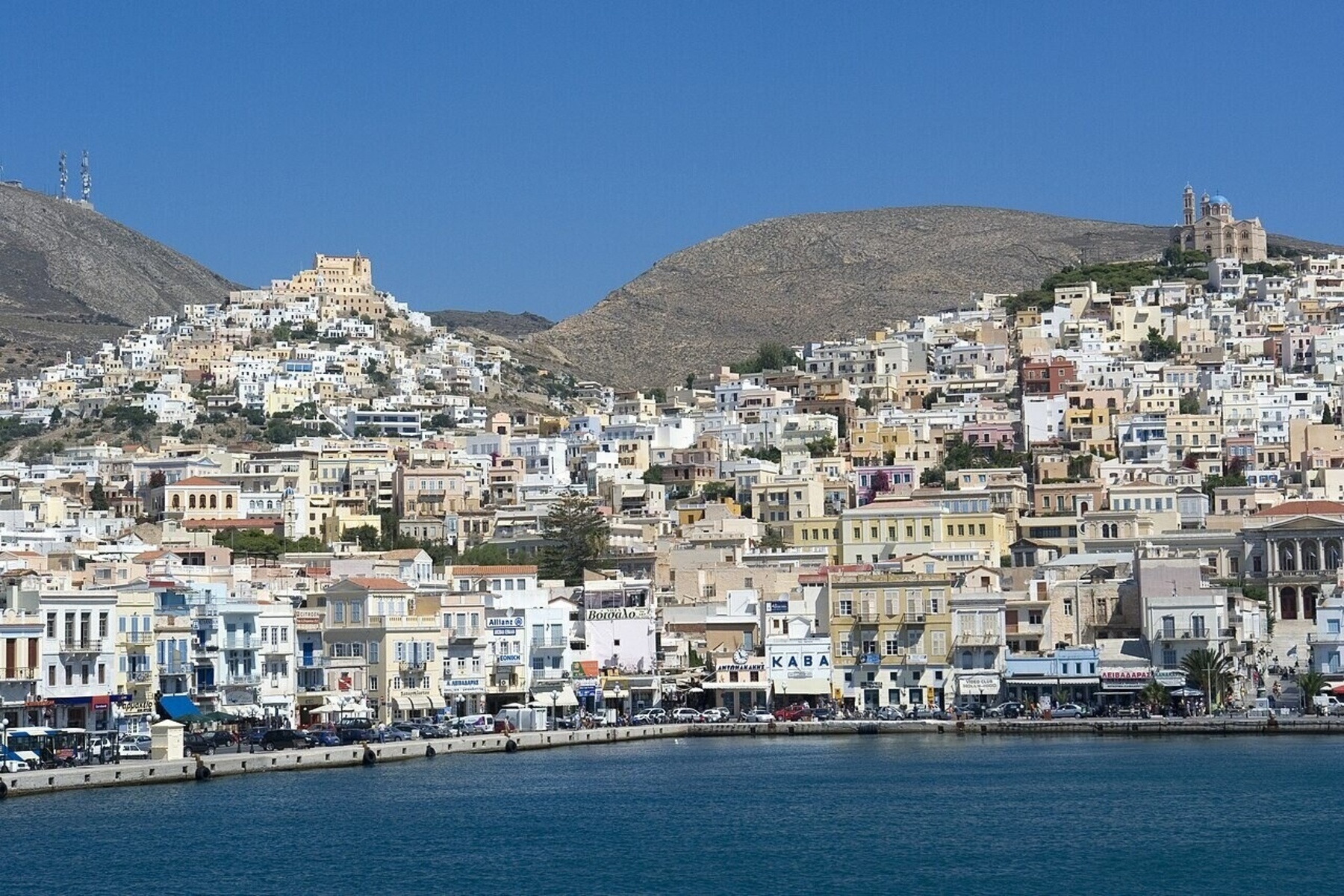
Ermoupoli became the most remarkable urban creation of the early Greek state. Within a few decades its harbor dominated Greek trade and linked the new kingdom to ports throughout the Mediterranean, Black Sea and western Europe. Merchant houses, shipping firms, banks, warehouses, workshops, printing presses and schools transformed a refugee settlement into a prosperous bourgeois city. Its importance initially surpassed Piraeus, and its cosmopolitan population helped create institutions rarely encountered elsewhere in the Cyclades. The urban fabric records this confidence: broad civic spaces and monumental public architecture face the harbor, while wealthy residential districts climb the surrounding slopes.
Shipbuilding, Industry and the Working Harbor
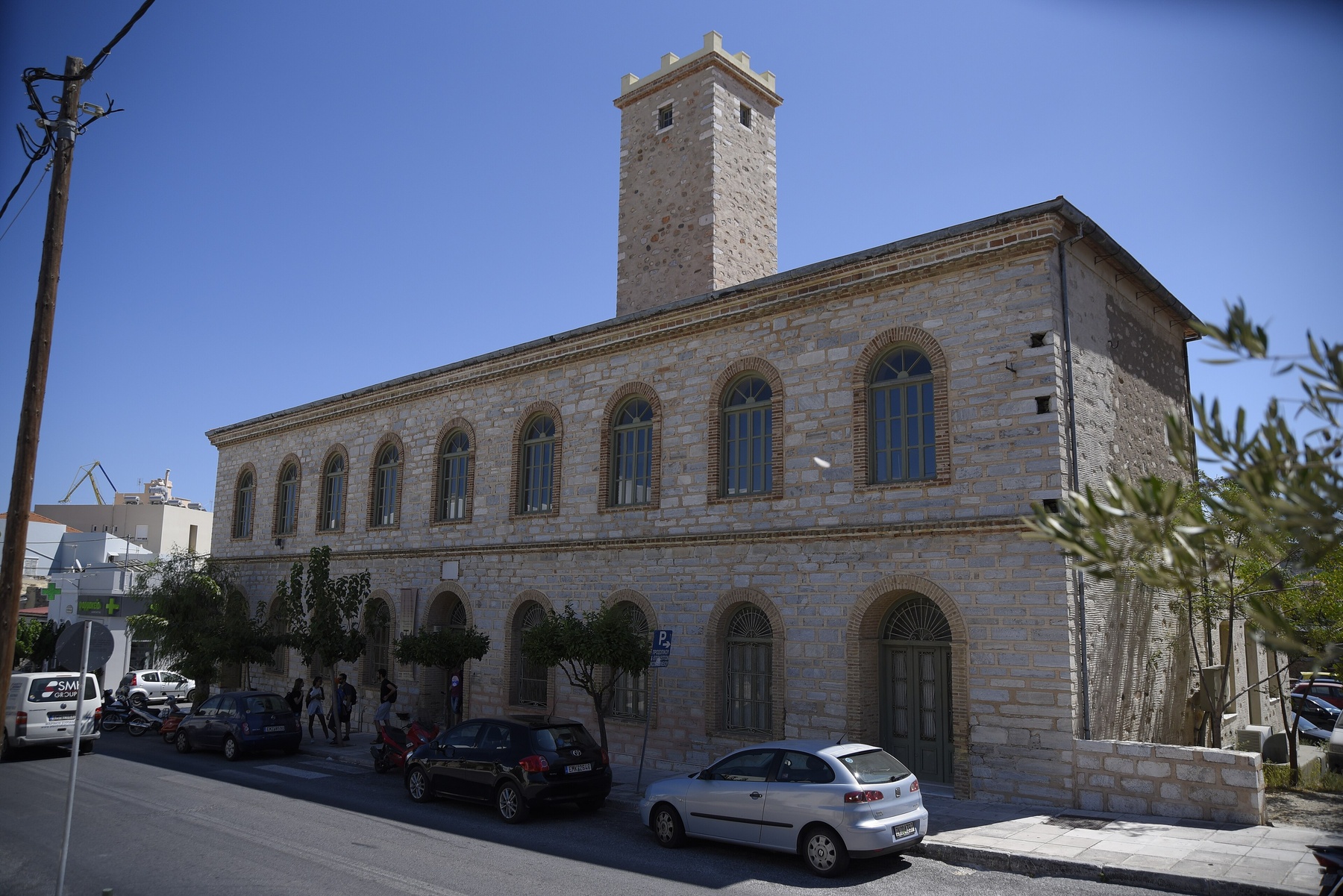
Ermoupoli was not merely a merchant port. Shipbuilding became one of its foundational industries, first through wooden sailing vessels and later through steam-era repair and construction. The Neorion shipyard grew into a major industrial complex and remains a living continuation of this maritime tradition. Tanneries, textile factories, machine works, flour mills and warehouses spread around the harbor and southern waterfront. The Industrial Museum of Ermoupoli preserves machinery, tools, manufactured products, archival material and industrial buildings from this period. These remains are essential to the island's identity because they show a form of Greek history often overshadowed by antiquity: Syros was one of the country's earliest industrial societies.
Neoclassical Ermoupoli and the Architecture of Civic Ambition
The architecture of Ermoupoli expresses the aspirations of a wealthy nineteenth-century mercantile city. Greek and European architects created a distinctive neoclassical language using marble, colored plaster, monumental stairs, balconies and elaborately decorated interiors. Miaouli Square became the civic center, dominated by the Town Hall designed by Ernst Ziller and constructed during the later nineteenth century. The Apollo Theatre, built in 1862–1864 to plans by Pietro Sampo, provided a setting for opera, theatre and elite social life. Churches, schools, clubs and commercial buildings reinforced the city's institutional character. Ermoupoli is therefore not simply a Cycladic settlement enlarged in the nineteenth century; it is a consciously planned bourgeois city whose architectural vocabulary looked toward Athens, Trieste, Italy and the wider Mediterranean.
Vaporia and the Merchant Elite
The Vaporia quarter occupies the northeastern seafront of Ermoupoli and preserves some of the city's most imposing merchant residences. Multi-storey mansions rise directly above the rocky coast, their façades, balconies and painted interiors reflecting the fortunes accumulated through shipping and trade. The district's name evokes the ships that defined the city's economy. Nearby Agios Nikolaos, one of Ermoupoli's monumental Orthodox churches, reinforces the social geography of the neighborhood. Vaporia demonstrates how commercial power translated into domestic architecture and urban prestige.
Religious and Urban Duality
Few Greek islands display religious and urban duality as clearly as Syros. Ano Syros preserves a Catholic, medieval and defensive environment centered on Saint George, while Ermoupoli developed primarily as an Orthodox, neoclassical and commercial city. Yet the contrast should not be simplified into two isolated communities. Economic, administrative and social ties connected the hill town and harbor, and both Catholic and Orthodox institutions contributed to modern Syros. The paired hills above the port remain one of the most legible urban expressions of confessional coexistence in Greece.
Markos Vamvakaris and the Rebetiko Tradition
Ano Syros is the birthplace of Markos Vamvakaris, one of the foundational figures of rebetiko music. Born into the island's Catholic community in 1905, Vamvakaris later became closely associated with the Piraeus school of rebetiko and the bouzouki. His songs repeatedly evoked Syros, transforming the island from a geographical birthplace into part of the emotional map of modern Greek urban folk music. Ano Syros maintains an exhibition dedicated to him, and the island now hosts an international rebetiko festival in his name. His legacy adds another layer to Syros's cultural history: medieval Catholic streets became the remembered landscape of one of twentieth-century Greece's most influential popular musicians.
Loukoumi, Halvadopita and the Refugee Commercial Culture
The food culture of Syros reflects the same movements of people and trade that created Ermoupoli. Syros became particularly associated with loukoumi, produced by refugee confectioners whose techniques and commercial networks connected the island to Asia Minor and the eastern Mediterranean. Halvadopita, a wafer sandwich filled with soft nougat, became another characteristic product. These foods are more than tourist specialties: they belong to the history of workshops, port commerce and refugee entrepreneurship that shaped the nineteenth-century city. Their survival helps preserve the sensory dimension of Ermoupoli's multicultural origins.
The Northern Landscape: Apano Meria and Grammata
Northern Syros is markedly different from the urbanized south. Apano Meria preserves a rugged landscape of archaeological sites, traditional paths and sparse settlement. At Grammata, ancient and medieval sailors carved prayers and dedications into coastal rocks, asking the gods or Christian saints for safe voyages and favorable seas. The inscriptions make this remote cove an exceptional archive of maritime anxiety and devotion. Together with Chalandriani and Kastri, the northern landscape demonstrates that Syros's historical geography extended far beyond the harbor city.
Museums and the Study of the Island
Syros has an unusually strong museum infrastructure for a Cycladic island. The Archaeological Museum, founded in 1834 and now housed within the Town Hall complex, is among the oldest archaeological museums in Greece. Its collections include Early Cycladic material from Chalandriani and Kastri as well as inscriptions, sculpture and finds from historical periods. The Industrial Museum interprets machinery, factories, shipbuilding and working-class urban history. Ano Syros preserves the Markos Vamvakaris exhibition and other displays of local life. Together they encourage an interpretation of Syros that connects archaeology, architecture, labor, migration and music rather than separating them into unrelated eras.
What to See
A rewarding visit should connect Ermoupoli's waterfront and Miaouli Square with the Town Hall, Apollo Theatre, Vaporia, Agios Nikolaos, the Archaeological Museum and the Industrial Museum, then climb to Ano Syros through its surviving defensive entrances. Saint George Cathedral, Catholic monastic buildings and the Markos Vamvakaris exhibition reveal the medieval and cultural layers of the hill. Beyond the capital, Chalandriani and fortified Kastri are fundamental for Early Cycladic history, while Galissas preserves another ancient fortified landscape. Grammata adds a distinctive maritime epigraphic site in the north.
Why Syros Matters
Syros is one of the best places in Greece to study how an island can repeatedly reinvent the relationship between defense, harbor and community. Kastri represents fortified settlement in the Early Bronze Age; ancient acropoleis guarded urban communities at Syros and Galissas; Ano Syros converted a hill into a strongly walled medieval refuge; and Ermoupoli replaced defensive withdrawal with confidence in commerce, industry and monumental civic architecture. The island also preserves a rare Catholic continuity, a refugee-founded modern city, major industrial heritage and the musical memory of Markos Vamvakaris. No single monument explains Syros: the island's significance lies in the dialogue among all these layers.
Architecture
- Early Cycladic fortified settlement of Kastri, occupying a naturally strong hill above the northeastern coast
- Ancient fortification remains at Pefkakia associated with the acropolis of the historical city beneath modern Ermoupoli
- Two fortified ancient acropoleis at Galissas, controlling the sheltered bays of Galissas and Armeos
- Medieval Ano Syros enclosed by strong purpose-built walls rather than relying solely on the rear walls of perimeter houses
- Seven medieval gates historically controlling entry to Ano Syros, of which two survive
- Organic stepped street plan of Ano Syros adapted to the steep eastern slope of the hill
- Catholic Cathedral of Saint George crowning Ano Syros; present basilica constructed 1832–1834 on a much older sacred site
- Jesuit and Capuchin monastic complexes embedded in the medieval Catholic settlement
- Ermoupoli's nineteenth-century neoclassical urban plan organized around harbor, civic squares and monumental public buildings
- Ermoupoli Town Hall by Ernst Ziller, monumentalizing the civic center at Miaouli Square
- Apollo Theatre, built 1862–1864 to designs by Pietro Sampo and expressing the city's cosmopolitan theatrical culture
- Vaporia district of high-status seafront mansions built for merchant and shipping families
- Orthodox churches including Agios Nikolaos and the Church of the Dormition integrated into Ermoupoli's civic landscape
- Industrial belt of tanneries, textile works, warehouses, machine shops and shipbuilding facilities around the harbor
- Neorion shipyard and associated maritime-industrial infrastructure, continuing a nineteenth-century shipbuilding tradition
Timeline
- Neolithic period The earliest known habitation of Syros belongs to the Neolithic, with several identified but incompletely excavated sites.
- c. 2700–2300 BC Chalandriani flourished during the Early Cycladic II period; its cemetery became fundamental to the archaeological definition of the Keros–Syros culture.
- c. 2300–2000 BC The fortified settlement of Kastri developed during Early Cycladic IIIA, giving its name to the Kastri cultural group.
- Geometric–Classical periods Urban communities developed at the site of modern Ermoupoli and at fortified Galissas.
- 6th century BC The philosopher Pherecydes of Syros became associated with early Greek cosmological thought and later tradition named him as a teacher of Pythagoras.
- 5th–4th centuries BC Syros participated in the Athenian alliances and remained integrated into the political world of the Cyclades.
- 1st century BC onward After the decline of Delos, Syros's harbor gained importance as a regional transit and trading center under Roman rule.
- Early Byzantine period Settlement began developing on the hill later known as Ano Syros; the island's Christian population remained relatively small.
- 13th century Ano Syros acquired much of its characteristic medieval form and defensive organization under Latin rule.
- 1566 Syros passed under Ottoman sovereignty while its Catholic population retained strong western ecclesiastical and diplomatic connections.
- 1617 An Ottoman fleet devastated the island during a period of conflict and insecurity.
- 1635 The church of Agios Ioannis in Ano Syros was granted to Capuchin monks, who established a monastery nearby.
- 1744 The Jesuit monastery of Ano Syros was established, strengthening the settlement's Catholic institutional network.
- 1821–1825 Refugees from Chios, Psara, Smyrna, Kydonies, Kasos and other eastern Mediterranean communities settled around the harbor during the Greek War of Independence.
- 1826 The new port settlement was named Ermoupoli, the City of Hermes; 2026 marks its bicentenary.
- 1832–1834 The present Catholic Cathedral of Saint George was constructed at the summit of Ano Syros.
- 1834 The Archaeological Museum of Syros was founded, making it one of the oldest museums in Greece.
- mid-19th century Ermoupoli became the leading commercial port and a principal shipbuilding and industrial center of the new Greek state.
- 1862–1864 The Apollo Theatre was built to designs by Pietro Sampo, reflecting Ermoupoli's cosmopolitan cultural ambitions.
- 1870s–1890s Ernst Ziller's monumental Town Hall reshaped Miaouli Square as the civic center of Ermoupoli.
- late 19th century The rise of Piraeus and changes in shipping routes reduced Ermoupoli's earlier commercial dominance, while industry and ship repair remained important.
- 1905 Markos Vamvakaris was born in Ano Syros; he later became one of the foundational musicians of rebetiko.
- 20th century Syros retained its role as an administrative, shipbuilding and cultural center even as its economy diversified.
- 2026 Ermoupoli celebrated 200 years since its naming and foundation with a municipal bicentenary cultural program.
Visiting today
A complete visit should connect the island's very different historical landscapes rather than treating Ermoupoli alone as Syros. In Ermoupoli, Miaouli Square, the Town Hall, Apollo Theatre, Vaporia, Agios Nikolaos, the waterfront, Archaeological Museum and Industrial Museum establish the nineteenth-century city and its ancient substratum. Ano Syros should be explored on foot through its surviving gates and narrow stepped lanes to Saint George Cathedral, the Catholic monastic complexes and the Markos Vamvakaris exhibition. For the prehistoric story, Chalandriani and Kastri in Apano Meria are fundamental but require more planning than the urban sites. Galissas preserves another ancient fortified landscape. Current archaeological access and museum hours should be checked with the Ephorate of Antiquities and the Municipality before visiting.
Expedition guides
Images
References
- Ephorate of Antiquities of the Cyclades — Kastri and Chalandriani, Syros
- Ephorate of Antiquities of the Cyclades — The Prehistoric and Classical Antiquities of Syros
- Ephorate of Antiquities of the Cyclades — Byzantine Syros
- Ephorate of Antiquities of the Cyclades — Archaeological Museum of Syros
- Municipality of Syros-Ermoupoli — 200 Years of Ermoupoli
- Municipality of Syros-Ermoupoli — Syros Culture 2026
- Syros.gr — Highlights of Syros
- Syros.gr — Experiences and Cultural Heritage
- Greek National Tourism Organisation — Syros cultural destination
Related places
Related Stops
Topics
- Cyclades
- Historic Island
- Early Cycladic
- Fortified Settlement
- Kastri
- Ano Syros
- Medieval Town
- Catholic Heritage
- Latin Rule
- Ottoman
- Ermoupoli
- Refugee History
- Neoclassical
- Industrial Heritage
- Shipbuilding
- Maritime History
- Rebetiko
- Markos Vamvakaris